Introduction
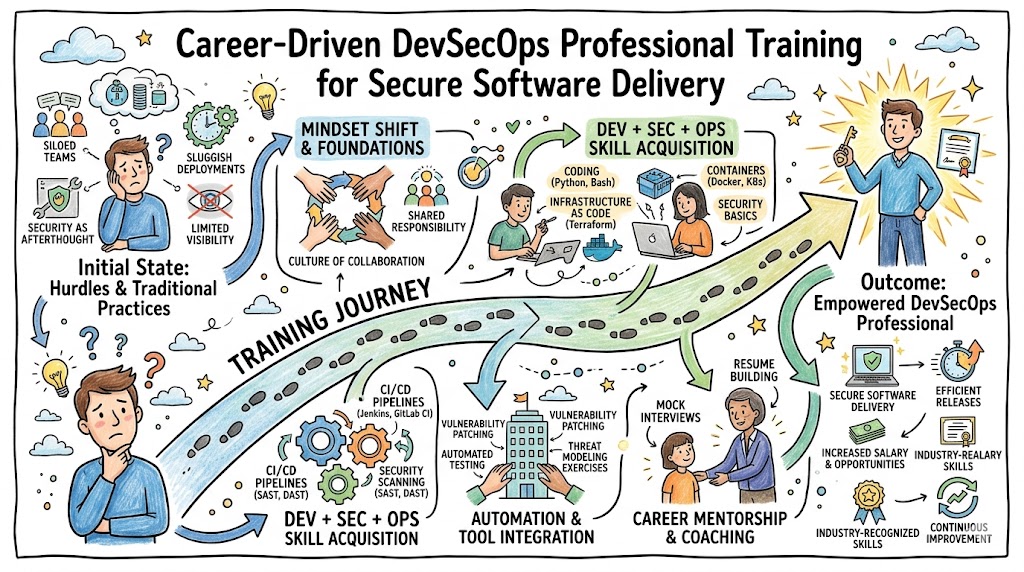
The Certified DevSecOps Professional certification acts as a practical framework for those responsible for securing software supply chains. As organizations move away from slow, manual security audits toward automated, continuous delivery, the ability to integrate security controls directly into the CI/CD pipeline has become a vital skill. This guide is written for software engineers, SREs, and platform architects who need to understand how to build secure systems without slowing down the development team. By breaking down the program and its outcomes, this guide helps you decide if this path is the right move for your career evolution.
What is the Certified DevSecOps Professional?
The Certified DevSecOps Professional is a validation of your ability to merge security best practices with modern DevOps workflows. It focuses on the reality of production environments rather than theoretical security concepts. You will learn how to treat security as code, manage vulnerability scanning, and ensure compliance in a way that aligns with agile development. This program exists to help engineers become comfortable with the tools and techniques required to build, deploy, and maintain secure applications at scale, ensuring protection is a standard part of the pipeline.
Who Should Pursue Certified DevSecOps Professional?
This certification is designed for any technical professional working in the software development lifecycle. If you are a DevOps engineer or an SRE, this program will help you add a critical security layer to your infrastructure work. For security analysts, it provides the technical context needed to work inside automated developer workflows. It is also highly relevant for cloud engineers and technical managers who want to understand how to manage risk in complex, distributed systems. The curriculum is built to be accessible yet challenging for professionals across global and local markets.
Why Certified DevSecOps Professional
As software vulnerabilities continue to be a top concern for enterprises, professionals who can automate security have a distinct advantage. This certification is valuable because it focuses on foundational, long-term skills—such as threat modeling, identity management, and pipeline orchestration—that remain useful regardless of which specific tools are in style. It offers a strong return on time invested by positioning you as a versatile engineer capable of preventing bottlenecks. In an era of continuous delivery, the ability to build secure-by-design systems is a career-defining capability that ensures your relevance.
Certified DevSecOps Professional Certification Overview
The Certified DevSecOps Professional program is available through the official training portal hosted on devopsschool. It is structured to be practical, focusing on hands-on application rather than simple multiple-choice testing. Candidates are expected to engage with real scenarios, labs, and project-based assessments that mirror day-to-day engineering challenges. Earning this certification means you have demonstrated the ability to maintain a strong security posture in a professional, high-pressure environment, which is the exact skill set employers are looking for today.
Certified DevSecOps Professional Certification Tracks & Levels
The program follows a logical progression, starting from foundational concepts and moving toward advanced architectural strategy. Foundation levels cover the essential shift-left mindset and basic security integration, while professional tiers address complex vulnerability management and policy as code. Specialized advanced tracks then allow you to focus on areas like infrastructure hardening, container security, or cloud-native defense. These levels are designed to grow with you as your career progresses from a contributor to an architect or technical lead.
Complete Certified DevSecOps Professional Certification Table
| Track | Level | Who it’s for | Prerequisites | Skills Covered | Recommended Order |
| Security Ops | Foundation | Aspiring Engineers | Linux & Cloud Basics | Security Basics | 1 |
| Pipeline Security | Professional | DevOps/SREs | CI/CD Knowledge | Pipeline Hardening | 2 |
| Advanced Defense | Advanced | Security Architects | Professional Level | Threat Modeling | 3 |
Detailed Guide for Each Certified DevSecOps Professional Certification
Certified DevSecOps Professional – Core Practitioner
What it is
This certification confirms your ability to integrate security tools into standard development pipelines and manage basic container vulnerabilities.
Who should take it
Ideal for developers and junior DevOps engineers with at least six months of hands-on experience in software delivery.
Skills you’ll gain
- Setting up automated security scanners.
- Understanding container image security.
- Managing environment secrets securely.
Real-world projects you should be able to do
- Integrate a vulnerability scanner into a GitHub Actions pipeline.
- Create a secure workflow for handling API keys.
- Perform a security assessment of a simple microservice.
Preparation plan
- 7–14 days: Review documentation and understand core security concepts.
- 30 days: Complete all hands-on labs and exercises.
- 60 days: Build an end-to-end project that secures a sample application.
Common mistakes
Candidates often try to memorize tool commands rather than learning the logic behind security automation.
Best next certification after this
- Same-track: Cloud-Native Security Specialist.
- Cross-track: SRE Foundations.
- Leadership: Engineering Team Management.
Choose Your Learning Path
DevOps Path
The DevOps path centers on automating infrastructure and removing the barriers between development and operations. You will learn to incorporate security checks into the provisioning process, ensuring that every deployment meets organizational standards. This path is essential for those who want to build efficient and reliable platforms.
DevSecOps Path
The DevSecOps path is all about maintaining a continuous, secure delivery lifecycle. You will focus on integrating security into every stage of the pipeline, creating a culture where defense is part of the development process. It is the best choice for engineers committed to automated compliance.
SRE Path
The SRE path bridges the gap between system reliability and security defense. You will learn how to monitor for threats and automate incident responses, ensuring your services stay both available and secure. This is ideal for those who love building resilient, self-healing systems.
AIOps Path
The AIOps path focuses on utilizing data and machine learning to detect patterns in system security. You will learn how to process log files to identify anomalies that signal a potential breach. This is a forward-thinking path for those interested in intelligent, data-driven defense.
MLOps Path
The MLOps path is designed for securing machine learning pipelines and protecting training data. You will master the unique challenges of model security, ensuring that your AI projects are robust against tampering. This is a vital track for the modern data-centric enterprise.
DataOps Path
The DataOps path focuses on the governance and protection of data as it moves through various systems. You will learn how to enforce access controls, encryption, and auditing to ensure data integrity at every step. This is crucial for managing high-value information systems.
FinOps Path
The FinOps path balances the cost of cloud services with the necessity of security. You will learn how to build architectures that are not only protected but also cost-efficient. This is perfect for engineers who need to consider business impact alongside technical security.
Role → Recommended Certified DevSecOps Professional Certifications
| Role | Recommended Certifications |
| DevOps Engineer | Core Practitioner, Pipeline Security |
| SRE | SRE Security Foundations, Advanced Defense |
| Platform Engineer | Infrastructure Security, Compliance |
| Cloud Engineer | Cloud-Native Security Professional |
| Security Engineer | Advanced DevSecOps Architect |
| Data Engineer | DataOps Security Specialist |
| FinOps Practitioner | FinOps & Security Governance |
| Engineering Manager | DevSecOps Leadership & Strategy |
Next Certifications to Take After Certified DevSecOps Professional
Same Track Progression
Deepen your expertise by taking advanced certifications focused on specific cloud technologies or complex Kubernetes security. This helps you specialize in the exact tech stack your company uses, making you an invaluable resource.
Cross-Track Expansion
Expand your value by learning about reliability (SRE) or data integrity (DataOps). This makes you a “T-shaped” professional who can understand how security impacts other areas of the business, leading to more architectural influence.
Leadership & Management Track
If you want to move into management, look for certifications that focus on team leadership and security strategy. These roles require understanding how to align technical security goals with overall business requirements and budgets.
Training & Certification Support Providers for Certified DevSecOps Professional
DevOpsSchool offers a structured learning path with practical content designed to get you ready for real-world engineering challenges.
Cotocus provides advanced workshops and hands-on guidance that helps you tackle complex security hurdles in a professional setting.
Scmgalaxy is great for learning how version control integrates with pipeline security and overall team workflows.
BestDevOps provides high-quality resources and prep material focused on modern, cloud-native engineering trends.
devsecopsschool is your dedicated platform for all security-centric DevOps training, offering a clear roadmap for certification.
sreschool specializes in training that covers both system reliability and the security measures needed to keep services running.
aiopsschool teaches you how to leverage intelligence to automate security monitoring and incident detection.
dataopsschool focuses on securing the flow of data through your infrastructure, protecting integrity from end to end.
finopsschool helps you understand the balance between secure cloud architecture and smart cost management.
Frequently Asked Questions (General)
- What is the typical difficulty level of these certifications?
The programs are designed to be challenging but rewarding, requiring a mix of conceptual study and practical application. - How much study time should I set aside?
Most professionals find that 30 to 60 days of consistent effort is sufficient to gain a solid grasp of the material. - What background do I need before starting?
A basic understanding of Linux, cloud environments, and CI/CD pipelines will give you a significant head start. - Is this certification recognized by global employers?
Yes, the skills validated by this program are in high demand across the tech industry worldwide. - Should I renew my certification over time?
It is a good practice to update your knowledge every two years to ensure your skills keep up with the latest industry shifts. - Are the exams held remotely?
Yes, most certification programs offered through these platforms are accessible online, providing flexible testing options. - Is this just for security professionals?
Not at all. It is built for DevOps engineers, developers, and SREs who want to integrate security into their daily tasks. - Will I get hands-on experience?
The labs are a core component, allowing you to practice in environments that mimic real-world production setups. - What if I need help during the training?
Most providers offer access to mentor support or community groups where you can ask questions and network. - Does it cover different cloud platforms?
The principles are designed to be cloud-agnostic, meaning they apply whether you are using AWS, Azure, or GCP. - Can this help me with a salary negotiation?
Certifications prove your dedication and technical depth, which are strong assets when discussing your career growth and compensation. - What if I don’t pass the exam on the first try?
Most platforms have a retake policy to ensure you have the opportunity to succeed after further preparation.
FAQs on Certified DevSecOps Professional
- What is the primary goal of the certification?
It aims to teach you how to automate security, reduce vulnerabilities, and ensure compliance within high-velocity engineering teams. - How does this change my work as a developer?
It allows you to identify security flaws before code even reaches production, making your releases safer and more stable. - Do I need to know a specific programming language?
While not strictly required, basic knowledge of script-based languages like Python or Bash is highly beneficial. - Is this better than a general cybersecurity degree?
This certification is more focused and practical, making it better suited for engineers who work in software delivery. - How are the exams structured?
They generally focus on practical tasks and scenarios rather than just theoretical, definition-based questions. - Can I use these skills for remote work?
Yes, the ability to automate security is one of the most sought-after skills for global, distributed engineering teams. - Will it help with compliance audits?
Yes, you will learn how to implement automated checks that simplify the process of meeting regulatory standards. - Is this suitable for someone in a non-technical role?
It is best for those with a technical foundation; if you are non-technical, start by learning basic operations and Linux.
Final Thoughts: Is Certified DevSecOps Professional Worth It?
At the end of the day, any certification is only as good as the effort you put into learning the underlying concepts. The Certified DevSecOps Professional program provides a structured, honest look at what it takes to protect modern software. It does not promise shortcuts, but it does offer a clear path to becoming a more capable and confident engineer. If your goal is to grow your technical skills and bring more value to your team, this certification is an investment that will pay off throughout your career. Think of it as a tool to sharpen your craft, not just a line to add to your resume.
