Introduction
Getting a machine learning model to work on a local laptop is a solved problem; the real headache begins when you try to deploy that model into production and keep it running smoothly. Modern engineering teams regularly run into major roadblocks when trying to bridge the gap between experimental data science and stable cloud operations. This guide is built to help software professionals understand how systematic operational practices can eliminate those deployment bottlenecks for good.
Whether you are currently managing cloud infrastructure or writing backend software, learning how to handle data-driven applications is one of the most reliable ways to future-proof your career. We will take a close look at the value, structure, and real-world impact of the MLOps Foundation Certification program so you can see exactly how it fits into your professional growth. By focusing on automated pipelines, reproducible environments, and solid system monitoring, you will gain a clear roadmap for your next career steps.
If you are an engineer looking to upgrade your skillset or a manager trying to improve team delivery, this breakdown shows how formal validation directly translates to smoother daily operations. The program, which is hosted entirely on aiopsschool, provides a structured approach to managing the entire lifecycle of production-ready intelligent applications. Aligning your professional development with these industry-vetted standards allows you to choose an educational path that matches your everyday engineering goals.
What is the MLOps Foundation Certification?
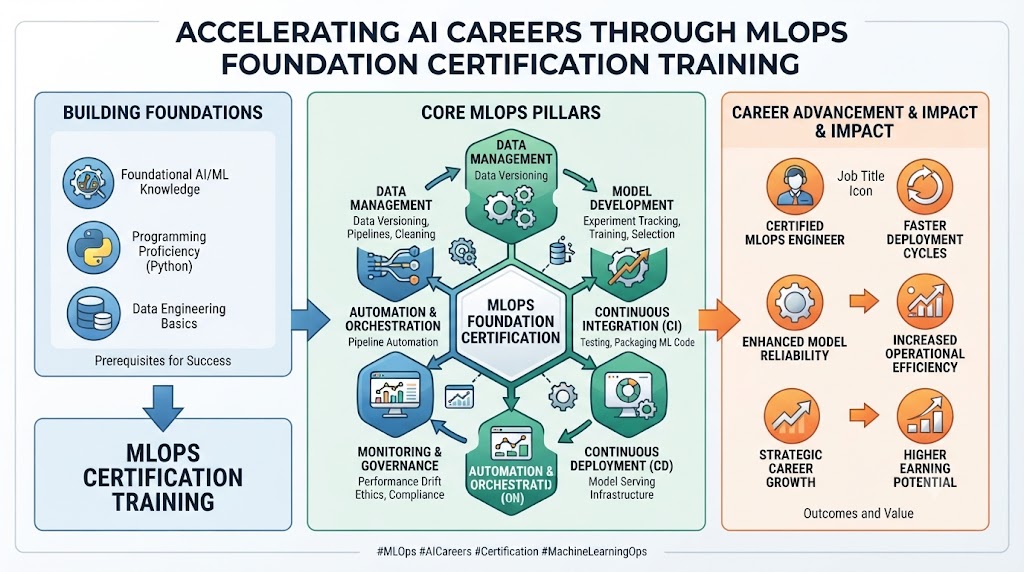
The MLOps Foundation Certification is a practical validation program focused on the core engineering skills needed to deploy and maintain machine learning workloads in production. Instead of burying you in abstract mathematical theory, the curriculum focuses squarely on the infrastructure paradigms required to move models out of isolated code notebooks and into resilient cloud environments. It addresses the unique reality that data-driven systems require specialized continuous integration and deployment pipelines due to the constant threat of data drift and performance decay.
This program zeroes in on the practical convergence of automated data movement, dataset version control, and containerized deployment strategies. It ensures that infrastructure teams, software developers, and data scientists all speak the same language and use a unified approach when collaborating on enterprise applications. By teaching you how to build consistent validation loops around your code, data, and infrastructure, this certification gives you the tools to design highly dependable delivery systems.
Who Should Pursue MLOps Foundation Certification?
This program is built for a wide range of technology professionals who play a part in designing, deploying, or managing modern software infrastructure. System administrators, site reliability specialists, and cloud architects who want to build stable environments for smart applications will find immediate, actionable value here. Backend developers who want to expand their capabilities into data-heavy applications will gain a deep understanding of how automated deployment pipelines actually function.
Data engineers responsible for setting up upstream pipelines and database professionals managing enterprise feature repositories will find this structured framework incredibly useful. Technical leads and engineering managers who need to structure efficient teams, accelerate deployment speeds, and implement clear governance will gain the insights needed to guide their organizations. The lessons are tailored to fit both the fast-paced demands of global tech companies and the structured needs of engineering teams across major technology hubs.
Why MLOps Foundation Certification
Modern enterprise architectures are rapidly evolving to include intelligent, automated decision-making components directly inside core software systems. Because these applications depend on dynamic data that shifts alongside real-world human behavior, old-school software deployment methods are no longer enough to keep systems stable. Earning a credential in this field proves that you know how to build self-healing, predictable delivery setups that handle both code changes and data updates simultaneously.
This foundational knowledge stays highly relevant across different technology shifts because it focuses on underlying architectural patterns rather than temporary software tools. As companies look to optimize their automation budgets, professionals who know how to monitor, validate, and troubleshoot live intelligent systems will remain in high demand. Putting time into mastering these standards ensures you remain a vital part of your engineering organization as companies move toward advanced, automated data systems.
MLOps Foundation Certification Overview
The training curriculum is delivered directly through the official educational platform and is hosted on the primary website portal. The assessment methodology is carefully designed to test your actual system comprehension, architectural decision-making, and troubleshooting skills through realistic scenarios. It serves as an objective, unbiased benchmark of an engineer’s true capability to spot pipeline inefficiencies and apply modern automation principles.
The governance and ongoing updates of this program ensure that the course materials change alongside modern shifts in cloud architecture and container orchestration networks. Candidates are guided through structural blueprints that mirror real enterprise environments, steering clear of isolated code snippets in favor of complete, systems-level thinking. This hands-on approach ensures that once you are certified, you can step into any production team and immediately contribute to live infrastructure projects.
MLOps Foundation Certification Tracks & Levels
The educational roadmap is broken down into clear, progressive steps to support you through different stages of your professional career. The foundation level focuses on setting up a shared vocabulary, core components, and the cross-functional communication skills needed to work effectively across teams. Moving up to the professional tier introduces deep technical implementations, hands-on automation scripting, and complex deployments across multiple cloud platforms.
The advanced levels shift focus toward large-scale systems design, multi-region cluster management, cost tracking, and strict corporate compliance frameworks. Specialized tracks also allow site reliability, security, and data professionals to focus on their specific day-to-day duties while maintaining a shared operational baseline. This clear progression ensures that as your workplace responsibilities grow, your technical credentials can scale right along with you.
Complete MLOps Foundation Certification Table
| Track | Level | Who it’s for | Prerequisites | Skills Covered | Recommended Order |
| Core Operations | Foundation | System Engineers, Cloud Analysts | Basic Linux, Python familiarity | CI/CD concepts, Pipeline basics, Artifact tracking | First |
| Platform Engineering | Professional | Site Reliability Engineers, DevOps | Foundation tier, Container basics | Kubernetes orchestration, Drift monitoring | Second |
| Data Infrastructure | Professional | Data Engineers, Pipeline Specialists | Basic SQL, Cloud storage knowledge | Feature stores, Data versioning, Data lineages | Third |
| Security & Governance | Advanced | DevSecOps, Security Architects | Professional tier, Access control | Model signing, Vulnerability scanning, Auditing | Fourth |
| Architecture & Strategy | Advanced | Tech Leads, Engineering Managers | Extensive infrastructure experience | Cost optimization, Multi-cloud system design | Fifth |
Detailed Guide for Each MLOps Foundation Certification
MLOps Foundation Certification – Foundation Level
What it is
This entry-level certification confirms an engineer’s solid grasp of the machine learning lifecycle, basic automation pipelines, and core deployment setups.
Who should take it
Operations professionals, junior backend developers, and cloud administrators who want to break into managing infrastructure for automated data systems.
Skills you’ll gain
- Building continuous integration workflows for automated software packages
- Tracking and versioning massive datasets within standard developer repositories
- Setting up core system alerts and health monitoring for active applications
Real-world projects you should be able to do
- Create an automated build script that containerizes an application whenever code is updated
- Configure a centralized monitoring dashboard to track system health and application uptime metrics
Preparation plan
- 7–14 days: Dive into core theoretical concepts, learn the standard vocabulary terms, and study how different system components interact.
- 30 days: Work through practical, hands-on lab exercises focused on building containers and configuring basic delivery pipelines.
- 60 days: Take full practice exams, study common pipeline failure scenarios, and review cross-functional operational documentation.
Common mistakes
- Treating data-driven application deployment exactly like traditional software delivery without accounting for data changes.
- Spending too much time memorizing specific code lines instead of understanding the bigger architectural design patterns.
Best next certification after this
- Same-track option: MLOps Professional Specialist
- Cross-track option: DataOps Engineering Foundations
- Leadership option: Technical Product Management Certification
Choose Your Learning Path
DevOps Path
Engineers following this path focus on blending machine learning deliverables directly into existing continuous delivery setups. The learning approach centers on expanding standard code repositories to handle large data packages without breaking system stability. You will learn to design flexible build systems that handle long execution times without stalling regular developer workflows. This pathway ensures traditional operations teams can manage data workloads with the exact same discipline they use for microservices.
DevSecOps Path
This track is all about embedding automated security checks directly into your asset delivery pipelines from day one. Candidates learn to implement automated container scans, verify digital signatures on production artifacts, and manage system secrets across distributed clusters. The material covers security compliance frameworks, access control settings, and clear audit logging for model histories and training datasets. This approach ensures that every automated component you deploy meets your company’s data protection standards.
SRE Path
Site reliability specialists focus heavily on maintaining high availability, tracking performance metrics, and managing incident responses for data infrastructure. The curriculum highlights how to collect custom application metrics, set up early alerts for data anomalies, and build self-healing cluster environments. Engineers study gradual deployment methods, automated rollbacks, and high-availability storage setups. This path ensures your infrastructure can scale up smoothly while maintaining strict system uptime agreements.
AIOps Path
This path specializes in applying automated operational patterns directly to IT service management and infrastructure data analysis. Professionals learn to build automated log parsers, system anomaly detection systems, and correlation engines to spot potential infrastructure failures early. The training focuses on using system metrics to optimize cloud resources, lower alert noise, and automate root-cause analysis workflows. This path is perfect for operations professionals looking to manage massive cloud setups using intelligent automation.
MLOps Path
This dedicated operational path focuses entirely on the end-to-end lifecycle management of machine learning models in production environments. Engineers dive deep into setting up continuous training workflows, model validation rules, and real-time inference serving architectures. The coursework covers artifact registration standards, low-latency model serving practices, and reliable rollback methods for analytical applications. This ensures that experimental work from your data science teams moves smoothly into dependable production services.
DataOps Path
Data infrastructure specialists on this path learn to build agile, automated systems for gathering, cleaning, and transforming data assets. The lessons target automated data quality testing, versioning massive databases, and managing enterprise feature store applications. Professionals master the setup of complex batch and streaming data flows while keeping clear data lineage records for regulatory audits. This pathway ensures that clean, reliable data is always available for downstream automated systems.
FinOps Path
This financial management track addresses cloud cost transparency, resource efficiency, and budget accountability within automation frameworks. Participants learn to track utilization metrics for expensive computing clusters, analyze storage costs, and set up automated shutdown schedules for idle resources. The modules focus on designing cost-allocation tags, building budget dashboards, and forecasting infrastructure spend based on changing workloads. This path ensures your scaling initiatives stay financially lean and efficient.
Role → Recommended MLOps Foundation Certification Certifications
| Role | Recommended Certifications |
| DevOps Engineer | MLOps Foundation Certification + DevOps Professional Track |
| SRE | MLOps Foundation Certification + Site Reliability Track |
| Platform Engineer | MLOps Foundation Certification + Advanced Systems Architecture |
| Cloud Engineer | MLOps Foundation Certification + Cloud Infrastructure Specialty |
| Security Engineer | MLOps Foundation Certification + DevSecOps Security Track |
| Data Engineer | MLOps Foundation Certification + DataOps Engineering Specialty |
| FinOps Practitioner | MLOps Foundation Certification + Financial Optimization Track |
| Engineering Manager | MLOps Foundation Certification + Strategic Leadership Track |
Next Certifications to Take After MLOps Foundation Certification
Same Track Progression
Moving up within this dedicated automation domain means stepping into advanced certifications that cover complex pipeline management and large-scale model serving setups. These higher-level credentials confirm your ability to manage multi-region automated clusters, build resilient failover paths, and set up zero-downtime swaps for real-time applications. This deep technical focus positions you as an expert capable of leading major automation projects inside large organizations.
Cross-Track Expansion
Broadening your professional reach means exploring closely related fields like cloud data engineering or advanced security automation systems. Gaining credentials in fields like DataOps or DevSecOps allows you to fix security flaws and data pipeline bottlenecks before they ever impact production. This well-rounded skillset makes you a highly adaptable engineer who can build reliable solutions that connect different technical teams.
Leadership & Management Track
If you are looking to move into strategic or administrative positions, you should focus on certifications that target enterprise architecture, technical governance, and cloud finances. These advanced paths prepare you to build long-term technology roadmaps, oversee large engineering budgets, and set company-wide compliance rules. This educational step helps you transition smoothly from handling daily technical tasks to directing entire engineering departments.
Training & Certification Support Providers for MLOps Foundation Certification
DevOpsSchool offers comprehensive, instructor-led training courses that focus heavily on infrastructure automation, delivery pipelines, and enterprise-scale configuration management.
Cotocus provides practical, hands-on training built around real-world lab environments, giving candidates deep exposure to container systems and cloud orchestration methods.
Scmgalaxy serves as an excellent community knowledge hub, offering technical guides, documentation, and study paths for operations professionals looking to upscale.
BestDevOps specializes in delivering intensive technical bootcamps that focus on modern continuous integration tools, cloud deployment strategies, and system automation.
devsecopsschool focuses on teaching teams how to shift security practices to the very beginning of the development lifecycle, covering secure repositories and compliance tracking.
sreschool provides targeted training courses that cover system reliability engineering, custom application tracking, incident management, and platform scaling patterns.
aiopsschool gives clear, architecture-focused guidance that connects infrastructure tracking, machine learning workflows, and automated system management.
dataopsschool focuses on teaching data professionals how to set up continuous quality checks, automated data orchestrations, and dependable distributed storage networks.
finopsschool delivers specialized coursework aimed at improving cloud cost visibility, tracking infrastructure spending, and optimizing resource allocations.
Frequently Asked Questions (General)
- What exactly is the main goal of the MLOps Foundation Certification?The program is built to teach you the foundational concepts, shared terminology, and deployment workflows needed to automate, deliver, and monitor machine learning models in production safely.
- Are there any hard technical prerequisites before I can sign up for the exam?No formal certifications are required beforehand, but having a working knowledge of Linux environments, basic Python scripting, and cloud basics will make your studying much easier.
- How long does it typically take a working professional to prepare for this exam?Most professionals find that spending a few hours a week on theory and practical lab exercises allows them to fully prepare within 30 to 60 days.
- Does this certification tie me to specific software vendors or focus on open-source tools?The course highlights core architectural concepts and open-source design patterns, meaning the skills you learn can be applied to any cloud provider or toolset.
- What should I expect from the actual exam format?The test uses a mix of multiple-choice questions, scenario analysis, and architectural problems to evaluate your practical engineering judgment.
- How does this certification benefit an engineer who already knows traditional DevOps?It expands your traditional continuous delivery skillset into data-heavy applications, making you incredibly valuable to companies looking to scale their automation teams.
- Do I need to be a skilled data scientist or know how to write complex algorithms to pass?Not at all. The exam does not test your ability to build machine learning models; it focuses entirely on infrastructure, pipeline automation, and system stability.
- How long does the certificate remain valid after I pass the test?The certification stays valid for three years, and you can keep it active by taking updated delta assessments or moving up to a higher specialization track.
- Is this foundational program worth it for technical project managers or engineering leaders?Yes, it gives managers the essential vocabulary, workflows, and organizational structures needed to run cross-functional data and operations teams successfully.
- How does the curriculum handle security concerns and compliance requirements?The program includes dedicated modules covering secure access control, artifact signing, clear audit trails, and data protection rules within automated setups.
- Are there any real-world lab environments available to practice with while studying?Yes, the hosting platform provides detailed technical blueprints and sandbox environments to help you practice real-world deployment scenarios firsthand.
- What makes this different from a standard cloud provider certification?This program deals directly with the challenges of managing shifting data, continuous retraining cycles, and performance tracking, which general cloud exams usually skip.
FAQs on MLOps Foundation Certification
- How does the MLOps Foundation Certification handle tracking data and model drift?The course teaches you how to build automated tracking systems that watch for statistical shifts in live production data, alerting your team before those changes impact application performance.
- Does the curriculum explain how to set up continuous training loops?Yes, it covers the exact design patterns needed to build automated pipelines that retrain models on the fly whenever data drift is flagged or new data arrives.
- What role do feature stores play in this specific certification blueprint?The exam evaluates your understanding of feature stores as a central data hub, ensuring your teams use clean, consistent data inputs for both training and live systems.
- How are container deployment tools like Kubernetes taught in this program?The lessons introduce container architecture patterns, showing you how to package complex analytical workloads into predictable containers that scale smoothly across cloud networks.
- Will I be tested on how to manage and version model artifact registries?Yes, you will learn how to use secure registries to save, version, and track model weights, code dependencies, and clear data lineages for corporate audits.
- How does this training help fix the communication gaps between developers and data teams?By setting up a clear operational standard and a shared vocabulary, it removes manual handover bottlenecks and helps teams build predictable deployment paths together.
- Are safe rollback strategies for failing models covered in the exam?Yes, the training focuses heavily on risk control, teaching you how to use canary deployments and blue-green updates to transition user traffic safely.
- What kind of infrastructure cost control practices does the training provide?The course shows you how to track compute-heavy clusters, helping you schedule intensive automated workflows during off-peak times to keep cloud budgets under control.
Final Thoughts: Is MLOps Foundation Certification Worth It?
Upgrading your skills always requires balancing your busy schedule against the career value you gain. The MLOps Foundation Certification offers a highly practical route for engineers who want to move beyond basic application hosting and start managing complex, data-driven systems. By focusing on lasting architectural principles instead of short-lived software tools, this program ensures your skills stay relevant as technology evolves.
For operations engineers, data professionals, and engineering managers, this credential provides a clear, reliable blueprint for building automated systems. It replaces risky trial-and-error workflows with proven, field-tested standards for deploying intelligent applications. If you want to lead infrastructure upgrades and solve tough deployment issues on your team, taking this certification is a smart, effective step forward.
