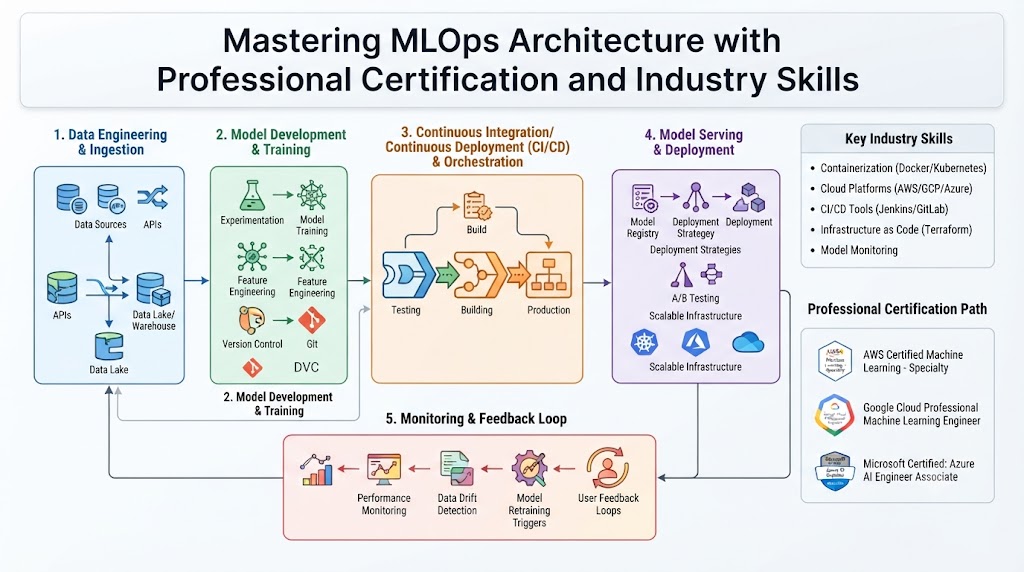
Introduction
As modern software architecture shifts toward intelligent systems, mastering the Certified MLOps Architect program offered by aiopsschool is crucial for technical growth. This comprehensive guide helps working software engineers, SREs, and platform architects navigate the complexities of production machine learning lifecycles. By bridging the gap between traditional software development and data science, this certification empowers professionals to design resilient, scalable infrastructure. Whether you are scaling machine learning models in enterprise environments or building automated CI/CD pipelines for data, this handbook provides the clarity needed to make strategic career decisions in cloud-native ecosystems.
What is the Certified MLOps Architect?
The Certified MLOps Architect represents a rigorous validation of professional capability in deploying, monitoring, and scaling machine learning workloads in production. It exists to replace superficial theoretical knowledge with hands-on, battle-tested execution strategies for real-world enterprise environments. This curriculum aligns directly with modern engineering workflows, ensuring that automation, reproducibility, and security remain core components of every data pipeline. Practitioners learn to handle complex model drift, infrastructure bottlenecks, and resource constraints using industry-standard tools and robust cloud architectures. Ultimately, it establishes a high standard of operational excellence for machine learning engineering across diverse industry sectors.
Who Should Pursue Certified MLOps Architect?
This certification is designed for software engineers, site reliability engineers, and cloud architects who want to expand their expertise into machine learning infrastructure. DevOps and platform professionals will find the curriculum invaluable for mastering model deployment pipelines and infrastructure-as-code automation. Data engineers and security professionals can also leverage this track to ensure data governance and secure model serving at scale. Engineering managers and technical leaders benefit by gaining the strategic oversight needed to guide AI initiatives and evaluate technical talent effectively. Both global practitioners and professionals in India’s booming tech sector will find immediate career relevance in these enterprise-grade skills.
Why Certified MLOps Architect
Enterprise demand for robust machine learning infrastructure continues to surge as organizations move proof-of-concept models into production environments. This certification ensures long-term career relevance by focusing on foundational architectural principles rather than fleeting, tool-specific trends. Professionals achieve a high return on their time and career investment by mastering skills that directly reduce technical debt and operational failures. Organizations actively seek certified architects who can bridge the communication gap between data scientists and infrastructure operations teams. Consequently, holding this credential signals to employers that you possess the practical expertise to deliver secure, scalable, and reliable AI systems.
Certified MLOps Architect Certification Overview
The program is delivered via the Certified MLOps Architect Course and hosted on aiopsschool. The certification structure incorporates practical assessments, architectural design reviews, and hands-on laboratory exercises to validate real-world readiness. Assessment approaches focus on practical problem-solving, ensuring candidates can design end-to-end pipelines under simulated production constraints. Ownership of the certification reflects a commitment to maintaining high engineering standards in machine learning operations and infrastructure management. The modular program design allows professionals to progress systematically from core concepts to advanced architectural patterns.
Certified MLOps Architect Certification Tracks & Levels
The learning journey begins at the foundation level, establishing core competencies in version control, data management, and basic pipeline automation. The professional track dives deeper into containerization, Kubernetes orchestration, automated testing, and continuous delivery for machine learning. Advanced levels focus on enterprise-grade multi-cluster management, advanced security paradigms, cost optimization, and complex monitoring systems. Specialization tracks allow practitioners to tailor their expertise toward specific operational domains like infrastructure automation or reliability engineering. This structured progression ensures that engineers build a strong, cohesive skill set that scales seamlessly with their career growth.
Complete Certified MLOps Architect Certification Table
| Track | Level | Who it’s for | Prerequisites | Skills Covered | Recommended Order |
| Foundation | Beginner | Junior Engineers, Data Analysts | Basic Linux and Git | Version Control, Pipeline Basics | 1 |
| Professional | Intermediate | DevOps Engineers, ML Engineers | Foundation Track | Kubernetes, CI/CD, Model Serving | 2 |
| Advanced | Expert | Principal Architects, Tech Leads | Professional Track | Multi-Cluster Ops, Governance, Cost | 3 |
Detailed Guide for Each Certified MLOps Architect Certification
Certified MLOps Architect – Foundation Level
What it is
This certification validates fundamental knowledge of machine learning lifecycles, basic version control, and introductory pipeline automation.
Who should take it
Suitable for junior software engineers, aspiring data professionals, and developers looking to understand basic machine learning deployment workflows.
Skills you’ll gain
- Basic Git and data version control practices
- Introduction to containerization concepts using Docker
- Simple pipeline scripting and automation
- Basic monitoring and logging principles
Real-world projects you should be able to do
- Package a simple inference script into a Docker container
- Set up a basic data version control repository for small datasets
- Deploy a static machine learning model to a local development server
Preparation plan
- 7–14 days: Review foundational Linux, basic scripting, and introductory container concepts through targeted reading and short tutorials.
- 30 days: Build out small practice pipelines, experiment with local container registries, and complete introductory lab exercises.
- 60 days: Thoroughly review all core documentation, practice mock scenarios, and solidify understanding of basic MLOps terminology.
Common mistakes
- Relying purely on theoretical study without hands-on command-line practice.
- Ignoring the importance of data versioning fundamentals early in the learning process.
Best next certification after this
- Same-track option: Certified MLOps Architect Professional Level
- Cross-track option: Foundation DevOps Certification
- Leadership option: Technical Project Management Essentials
Certified MLOps Architect – Professional Level
What it is
This certification validates practical expertise in building, scaling, and maintaining production-grade machine learning pipelines and serving architectures.
Who should take it
Designed for experienced DevOps engineers, cloud professionals, and ML engineers with hands-on infrastructure background.
Skills you’ll gain
- Advanced Kubernetes orchestration for ML workloads
- Implementing robust CI/CD pipelines for model training and deployment
- Setting up automated model monitoring and drift detection
- Managing feature stores and artifact repositories
Real-world projects you should be able to do
- Deploy a scalable model serving endpoint on a Kubernetes cluster
- Implement an automated retraining pipeline triggered by performance drift
- Configure secure artifact storage and feature store integrations
Preparation plan
- 7–14 days: Deep dive into Kubernetes architecture, container networking, and advanced CI/CD tool configurations.
- 30 days: Build end-to-end automated pipelines in a cloud sandbox environment, integrating monitoring tools.
- 60 days: Simulate production outage scenarios, optimize resource allocation, and review complex deployment patterns.
Common mistakes
- Overlooking security configurations in container registries and service meshes.
- Failing to establish proper automated testing protocols for model updates.
Best next certification after this
- Same-track option: Certified MLOps Architect Advanced Level
- Cross-track option: Certified DevSecOps Professional
- Leadership option: Engineering Management in AI Operations
Certified MLOps Architect – Advanced Level
What it is
This certification validates expert-level mastery in designing resilient, multi-region, cost-optimized machine learning architectures for large enterprises.
Who should take it
Targeted at principal engineers, senior cloud architects, and technical leads responsible for enterprise AI strategy and infrastructure.
Skills you’ll gain
- Designing multi-cluster, high-availability ML architectures
- Implementing advanced enterprise governance and compliance frameworks
- Optimizing infrastructure costs for heavy GPU and TPU workloads
- Leading cross-functional teams in MLOps standardization
Real-world projects you should be able to do
- Architect a multi-region disaster recovery plan for critical AI services
- Establish enterprise-wide compliance and auditing guardrails for model usage
- Execute a comprehensive cost-reduction strategy for large-scale training clusters
Preparation plan
- 7–14 days: Study enterprise reference architectures, compliance frameworks, and advanced cost-management techniques.
- 30 days: Design comprehensive multi-region deployment blueprints and review complex security case studies.
- 60 days: Engage in architectural peer reviews, refine disaster recovery plans, and complete advanced simulation exams.
Common mistakes
- Neglecting financial governance and cost visibility across large training jobs.
- Designing overly complex architectures that reduce system maintainability.
Best next certification after this
- Same-track option: Enterprise AI Systems Masterclass
- Cross-track option: Certified FinOps Cloud Architect
- Leadership option: Director of Platform Engineering
Choose Your Learning Path
DevOps Path
The DevOps path focuses on establishing rock-solid automation, infrastructure-as-code, and continuous delivery pipelines across all engineering environments. Practitioners learn to integrate machine learning artifacts into standard release workflows with minimal friction and maximum reliability. This journey emphasizes containerization, configuration management, and robust deployment orchestration using industry-standard tooling. Engineers following this route become adept at bridging the gap between development teams and production infrastructure operations. Ultimately, this path ensures that machine learning systems are deployed with the same engineering rigor as traditional software applications.
DevSecOps Path
The DevSecOps path embeds security, compliance, and vulnerability management into every stage of the machine learning pipeline lifecycle. Learners focus on securing model artifacts, protecting sensitive training data, and implementing strict access controls across cloud environments. This track ensures that automated deployments do not introduce compliance risks or expose sensitive enterprise assets to external threats. Professionals master vulnerability scanning, secure secret management, and automated auditing for AI workloads. Adopting this approach guarantees that rapid innovation never compromises enterprise security posture or regulatory compliance requirements.
SRE Path
The SRE path emphasizes system reliability, fault tolerance, observability, and incident management for high-availability machine learning systems. Engineers learn to define service level objectives, monitor model inference latency, and handle sudden traffic spikes gracefully. This track equips professionals to build automated self-healing infrastructure that minimizes downtime and operational overhead. Practitioners master advanced logging, tracing, and metric collection techniques specific to distributed AI workloads. Following this path transforms unpredictable machine learning models into reliable, production-grade enterprise services.
AIOps / MLOps Path
The AIOps / MLOps path dives deep into the operational lifecycle of machine learning models from data ingestion to retirement. Learners master model training automation, feature store management, and continuous evaluation frameworks. This specialized track bridges data science innovation with robust software engineering and infrastructure management practices. Professionals gain expertise in tracking model lineage, managing experiment registries, and automating retraining workflows. This path is essential for engineers dedicated to maximizing the business value and operational efficiency of artificial intelligence initiatives.
DataOps Path
The DataOps path focuses on streamlining data pipelines, ensuring data quality, and accelerating the flow of reliable information to machine learning models. Practitioners learn to automate data integration, implement rigorous data testing, and maintain robust metadata catalogs. This track addresses the common bottleneck of dirty or inaccessible data in enterprise AI projects. Engineers master scalable data storage solutions, streaming architectures, and efficient data governance frameworks. Following this route ensures that downstream machine learning models are fed clean, consistent, and timely data feeds.
FinOps Path
The FinOps path addresses the critical need for financial accountability and cost optimization in resource-intensive machine learning environments. Professionals learn to allocate cloud spending accurately, right-size GPU and TPU clusters, and eliminate unnecessary infrastructure waste. This track empowers engineers and managers to balance high-performance computing requirements with strict budgetary constraints. Practitioners master cloud billing analytics, automated scaling policies, and cost-aware architectural design patterns. Adopting this approach ensures that enterprise AI initiatives remain financially sustainable and deliver a positive return on investment.
Role -> Recommended Certified MLOps Architect Certifications
| Role | Recommended Certifications |
| DevOps Engineer | Certified MLOps Architect Professional Level |
| SRE | Certified MLOps Architect Professional Level |
| Platform Engineer | Certified MLOps Architect Advanced Level |
| Cloud Engineer | Certified MLOps Architect Professional Level |
| Security Engineer | Certified DevSecOps Professional, Certified MLOps Architect |
| Data Engineer | Certified MLOps Architect Foundation Level |
| FinOps Practitioner | Certified FinOps Cloud Architect, Certified MLOps Architect |
| Engineering Manager | Certified MLOps Architect Advanced Level |
Next Certifications to Take After Certified MLOps Architect
Same Track Progression
Advancing along the same track involves pursuing expert-level masterclasses and specialized credentials in enterprise AI infrastructure. This deep specialization allows engineers to tackle increasingly complex multi-cluster environments and large-scale distributed training challenges. Professionals solidify their reputation as definitive technical authorities within their organizations on machine learning operations. Continuing down this path opens doors to principal engineering and enterprise architect roles.
Cross-Track Expansion
Cross-track expansion involves broadening your technical horizon by acquiring certifications in adjacent domains like security or financial operations. Combining MLOps expertise with cloud security or financial governance creates a uniquely versatile and highly valuable engineering profile. This holistic understanding enables professionals to design solutions that are not only performant and reliable but also secure and cost-effective. Organizations actively seek versatile architects who can navigate multiple operational disciplines seamlessly.
Leadership & Management Track
Transitioning to the leadership track involves moving from hands-on implementation to strategic technical governance and team management. Certifications in technical leadership and engineering management help architects guide organizational AI strategy effectively. Leaders learn to mentor junior engineers, evaluate complex technology stacks, and align technical initiatives with business goals. This career evolution empowers professionals to drive organizational transformation and scale engineering excellence across entire enterprises.
Training & Certification Support Providers for Certified MLOps Architect
DevOpsSchool provides comprehensive training programs and structured learning paths designed to prepare professionals for complex architectural certifications. Their experienced mentors offer practical insights and hands-on laboratory sessions that bridge theory and real-world execution.
Cotocus delivers specialized enterprise training focused on modern cloud-native architectures, infrastructure automation, and container orchestration workflows. Their programs emphasize interactive learning and real-world scenario problem-solving for engineering teams.
Scmgalaxy offers extensive resources, community support, and structured courses tailored to version control, continuous integration, and modern delivery pipelines. Their curriculum helps engineers build solid technical foundations for advanced operational certifications.
BestDevOps focuses on delivering high-impact training sessions covering essential DevOps tools, cloud platforms, and modern deployment strategies. Their expert-led courses ensure participants gain practical, job-ready skills for enterprise environments.
devsecopsschool specializes in security-first engineering education, integrating vulnerability management and compliance into standard development lifecycles. Their training equips professionals to secure modern cloud-native and machine learning infrastructures effectively.
sreschool offers targeted instruction on site reliability engineering principles, observability, incident response, and fault-tolerant system design. Their programs help engineers build resilient infrastructure capable of handling high-availability demands.
aiopsschool provides cutting-edge education on machine learning operations, intelligent automation, and production-grade AI deployment pipelines. Their expert-driven courses prepare engineers to design and maintain scalable artificial intelligence systems.
dataopsschool delivers specialized training on data pipeline automation, data quality management, and scalable data engineering practices. Their curriculum ensures data is reliably prepared and delivered for advanced machine learning workloads.
finopsschool focuses on financial accountability, cloud cost optimization, and resource management for modern engineering infrastructures. Their programs empower professionals to maximize efficiency and control spending in heavy computing environments.
Frequently Asked Questions
- How difficult is the Certified MLOps Architect exam for experienced engineers?
The exam requires a solid grasp of both software engineering principles and machine learning pipelines, making it moderately challenging. Experienced engineers with practical cloud and container background will find the concepts intuitive with adequate preparation.
- What are the official prerequisites required before enrolling in the program?
Candidates should have a foundational understanding of Linux administration, Git version control, and basic containerization concepts. Prior exposure to cloud platforms and basic Python scripting will significantly ease the learning curve.
- How much time should I dedicate daily to prepare effectively?
Allocating one to two hours daily over a four to six-week period is generally sufficient for thorough preparation. Consistency and hands-on laboratory practice are far more effective than cramming right before the assessment.
- What is the typical return on investment after earning this certification?
Certified professionals often experience accelerated career growth, enhanced job security, and increased earning potential in competitive markets. Organizations actively reward engineers who can successfully bridge data science and reliable infrastructure operations.
- Can I take the certification exams remotely from any location?
Yes, the certification assessments are available online, allowing candidates worldwide to complete exams securely from their preferred location. Flexible scheduling accommodates working professionals across different time zones.
- How often should certified professionals renew or update their credentials?
Technology stacks and enterprise practices evolve rapidly, so annual reviews or continuing education credits are recommended. Staying updated ensures your skills remain aligned with current industry standards and tool updates.
- Is hands-on coding experience mandatory to pass the assessment?
While deep programming expertise is not the primary focus, practical familiarity with scripting and configuration files is essential. You must be comfortable reading and interpreting infrastructure and pipeline code.
- How does this certification compare to general cloud certifications?
General cloud certifications focus broadly on infrastructure, whereas this track specializes specifically in machine learning workflows and model lifecycles. It provides targeted expertise that generic cloud credentials do not cover in sufficient depth.
- What kind of practical projects are included in the learning labs?
Labs typically involve building automated CI/CD pipelines, deploying model serving endpoints, and configuring monitoring tools. These practical scenarios replicate real-world challenges faced by production engineering teams.
- Are there specific career support services provided upon completion?
Certified graduates gain access to professional networking communities, career guidance resources, and specialized job boards. These resources help connect skilled architects with organizations seeking production-ready talent.
- How do I choose between foundation and professional levels initially?
If you have less than two years of infrastructure experience, starting with the foundation level is strongly recommended. Experienced DevOps or ML engineers can typically jump directly into the professional track.
- What programming languages and tools are covered in the curriculum?
The curriculum primarily utilizes Python for pipeline scripting alongside industry-standard tools like Docker, Kubernetes, and various CI/CD frameworks. Tool selection focuses on enterprise adoption and widespread industry relevance.
FAQs on Certified MLOps Architect
- Why is architecture focus critical in machine learning operations today?
Focusing on architecture ensures that machine learning systems scale efficiently without accumulating crippling technical debt over time.
- How does this certification address model drift and monitoring?
It teaches systematic approaches to implement automated monitoring dashboards and triggers for retraining degraded models.
- What role does Kubernetes play in the advanced curriculum tracks?
Kubernetes serves as the foundational orchestration layer for managing scalable, containerized model training and inference workloads.
- How are feature stores integrated into enterprise MLOps pipelines?
Feature stores ensure consistent feature generation and retrieval across both training and production inference environments.
- What strategies are taught for optimizing cloud GPU costs?
Candidates learn automated scaling, spot instance utilization, and resource right-sizing techniques tailored for heavy AI workloads.
- How does the program handle data governance and compliance?
It covers strict auditing practices, artifact lineage tracking, and secure access controls to meet enterprise compliance standards.
- Can data scientists benefit from taking this architecture track?
Yes, data scientists gain valuable infrastructure awareness that helps them write production-ready code and collaborate better with engineers.
- What distinguishes this certification from standard data science credentials?
This track focuses exclusively on infrastructure, deployment, scaling, and operational reliability rather than algorithmic mathematics.
Final Thoughts: Is Certified MLOps Architect Worth It?
Investing time in the Certified MLOps Architect program is a pragmatic step for professionals serious about mastering enterprise AI infrastructure. The curriculum cuts through industry hype, focusing entirely on practical, production-grade skills that solve real operational challenges. If your goal is to build resilient systems that bridge the gap between data science and reliable deployment, this credential delivers immense value. Approach your learning journey with dedication, prioritize hands-on practice, and apply these architectural principles directly to your daily work for maximum career impact.
