Introduction
In the current era of hyper-scale cloud infrastructure, the volume of data generated by our systems has outpaced the human ability to monitor them manually. This is where the Certified AIOps Professional comes into play, serving as a vital bridge for engineers aiming to transition from reactive troubleshooting to proactive, data-driven systems management. As a professional, navigating this space requires more than just tool knowledge; it requires a deep understanding of how machine learning can interpret logs, metrics, and traces to solve complex operational riddles. By engaging with the structured programs at aiopsschool, engineers gain the expertise needed to build self-healing environments. This guide serves as your roadmap for leveraging this certification to stay ahead in the competitive landscape of platform engineering and site reliability.
What is the Certified AIOps Professional?
At its core, the Certified AIOps Professional represents a shift in mindset toward algorithmic operations. It is not just about installing a tool; it is about designing ecosystems that learn from historical telemetry to predict failures before they impact the end user. This certification validates your capability to implement intelligent workflows that automate the mundane aspects of system maintenance, such as event noise reduction and automated root-cause analysis. It represents a commitment to modernizing the engineering stack by integrating data science techniques directly into the heart of IT operations, ensuring that infrastructure remains stable, performant, and resilient.
Who Should Pursue Certified AIOps Professional?
This program is crafted for the modern technical workforce—from DevOps engineers who want to automate their feedback loops to Site Reliability Engineers managing massive distributed clusters. Security professionals and data engineers also stand to gain significantly, as the ability to analyze massive operational datasets is universal. Whether you are an early-career engineer looking to build a robust foundation or a seasoned manager aiming to lead a data-centric team, this certification provides the necessary framework. Its global relevance makes it a standout credential for professionals in India and beyond who are tasked with maintaining high-availability environments in competitive enterprise sectors.
Why Certified AIOps Professional
The demand for professionals who can marry software engineering with operational intelligence is growing rapidly. Organizations are moving away from manual “dashboard staring” toward intelligent systems that can alert, analyze, and sometimes remediate issues independently. Holding the Certified AIOps Professional credential proves that you possess the skills to facilitate this digital transformation. It is a future-proof investment, as the core methodologies of predictive maintenance and automated observability will remain relevant regardless of how the specific tooling landscape changes over time.
Certified AIOps Professional Certification Overview
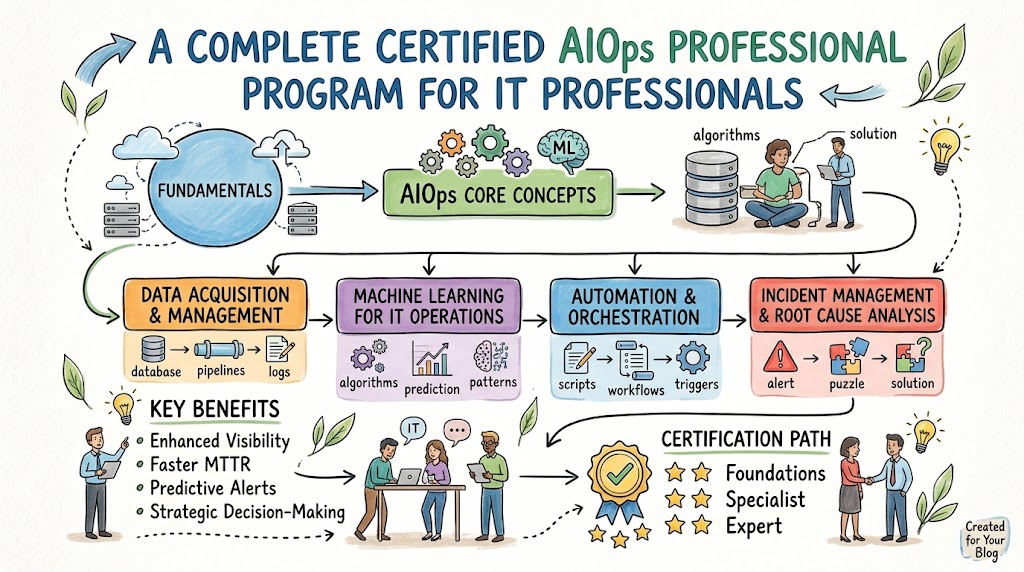
The program provided by [aiopsschool] is structured to ensure that theory is immediately paired with practice. It moves away from rigid, theoretical testing to focus on real-world scenarios that an engineer might face during a production incident. The curriculum is divided into clear levels of mastery, each designed to build upon the last. By focusing on ownership of the full AIOps lifecycle—from initial data ingestion to the final automated resolution—the certification provides a comprehensive view of how to manage intelligent infrastructure effectively.
Certified AIOps Professional Certification Tracks & Levels
The certification path is tiered to respect different stages of professional development. The foundational tier establishes the necessary vocabulary and understanding of the AIOps pipeline. The professional tier digs into the practical implementation of machine learning models for operations. Finally, the advanced tier challenges you to design and scale intelligent observability strategies across multi-cloud environments. This progression ensures that whether you are just starting or already deep in the trenches of SRE, there is a level that challenges you and expands your utility.
Complete Certified AIOps Professional Certification Table
| Track | Level | Who it’s for | Prerequisites | Skills Covered | Recommended Order |
| Operational Intel | Foundation | Entry Engineers | IT Basics | Log Analysis, Monitoring | 1 |
| Intelligent SRE | Professional | DevOps/SRE | Foundation | Predictive Ops, Anomaly Detection | 2 |
| AIOps Architecture | Advanced | Architects | Professional | ML Models, Scaling Strategies | 3 |
Detailed Guide for Each Certified AIOps Professional Certification
Certified AIOps Professional – Foundation
What it is
This entry-level certification confirms your grasp of the fundamental concepts that define intelligent IT operations.
Who should take it
Cloud administrators and junior engineers who need to understand how AIOps integrates with existing monitoring tools.
Skills you’ll gain
- Understanding the lifecycle of operational data.
- Identifying the difference between traditional monitoring and AIOps.
- Basic setup of telemetry collection.
Real-world projects you should be able to do
- Clean and aggregate disparate log files into a central observability tool.
- Define basic thresholds for automated alerts.
Preparation plan
- 7 days: Absorb core theory and industry standards.
- 14 days: Work with basic log aggregation tools.
- 30 days: Finalize study and sit for the foundational assessment.
Common mistakes
Trying to overcomplicate the solution before mastering the basic telemetry flow.
Best next certification after this
- Same-track: Certified AIOps Professional – Professional Level
- Cross-track: Certified DevOps Professional
- Leadership: IT Infrastructure Strategy
Choose Your Learning Path
DevOps Path
This path allows you to integrate intelligence into your CI/CD pipelines. You will learn how to automate the detection of regressions in deployments by comparing current performance against historical norms, effectively reducing the risk of bad releases.
DevSecOps Path
Focusing on the security angle, this path teaches you how to train models to spot unusual traffic patterns or unauthorized access attempts. It is about shifting security left by letting algorithms flag anomalies that a human might miss in a sea of logs.
SRE Path
This path is all about reliability. You will learn how to apply predictive analytics to manage SLIs and SLOs more proactively. By anticipating performance degradation, you can take action before an outage occurs, keeping your services stable and your users happy.
AIOps Path
This core track is for those who want to specialize in the “AI” part of the equation. It focuses on the selection and training of models specifically for infrastructure datasets, ensuring that the insights generated are accurate and actionable.
MLOps Path
This path addresses the unique challenge of maintaining ML models in production. You will learn how to handle model drift and re-training, ensuring your operational intelligence remains as relevant on day 100 as it was on day one.
DataOps Path
A successful AIOps strategy lives or dies by the quality of its data. This path teaches you how to build pipelines that ensure data is clean, timely, and properly structured, providing the perfect foundation for any AIOps model.
Role → Recommended Certified AIOps Professional Certifications
| Role | Recommended Certifications |
| DevOps Engineer | Professional Level |
| SRE | Professional/Advanced |
| Platform Engineer | Professional Level |
| Cloud Engineer | Foundation Level |
| Security Engineer | DevSecOps Track |
| Data Engineer | DataOps Track |
| FinOps Practitioner | Foundation Level |
| Engineering Manager | Strategy/Advanced |
Next Certifications to Take After Certified AIOps Professional
Same Track Progression
Once you reach the advanced level, you should focus on niche specializations like predictive capacity planning or custom heuristic development. This is where you transition from using tools to becoming an architect of intelligent systems.
Cross-Track Expansion
Diversifying into fields like FinOps or DataOps will make you a well-rounded expert. Understanding how AIOps impacts cloud spend or data quality puts you in a prime position to advise on overall infrastructure strategy.
Leadership & Management Track
For those interested in the management side, look for certifications that focus on digital transformation and technical leadership. Guiding a team toward a data-driven culture is a rare and highly valued skill.
Training & Certification Support Providers for Certified AIOps Professional
DevOpsSchool offers structured learning environments that help professionals grasp complex AIOps concepts through real-world examples.
Cotocus provides intensive, hands-on workshops that focus on the practical implementation of intelligence in production systems.
Scmgalaxy focuses on the technical nuances of operational automation, helping engineers bridge the gap between theory and execution.
BestDevOps features comprehensive training programs that align with the latest industry standards for modern observability.
devsecopsschool offers specialized paths for those looking to combine security with intelligent operational practices.
sreschool provides targeted training for those specializing in reliability and predictive system management.
aiopsschool acts as the primary authority for curriculum and certification standards in the intelligent operations space.
dataopsschool centers on the data engineering requirements that underpin every successful AIOps implementation.
finopsschool specializes in the intersection of operational metrics and cloud cost management for the modern engineer.
Frequently Asked Questions (General)
- How difficult are these exams?They are designed to be challenging and require hands-on experience, not just reading theory.
- How long does it take to prepare?Depending on your background, we suggest 30 to 60 days of focused study and practice.
- What is the best way to start?Evaluate your current daily tasks and choose the path that most directly improves your ability to solve those problems.
- Is this certification recognized worldwide?Yes, it is built to be a standard that is respected in global tech markets and Indian enterprise environments.
- Does this training cover specific tools?We focus on methodology so you can apply the principles across any AIOps platform or observability stack.
- Are there any lab requirements?Yes, our programs emphasize labs because we believe practical experience is the only way to master intelligent systems.
- How does this affect my career growth?It validates your expertise, often serving as a key factor in landing senior roles or transitioning into architecture-focused positions.
- Is it worth it for a junior engineer?Absolutely, it provides a head start by teaching you the systems and workflows that top-tier engineers are using today.
- Can I take the exam online?Yes, the certification is designed for global accessibility, allowing you to complete your assessments from your own environment.
- How do I maintain the certification?We encourage regular updates and re-certification every few years to keep pace with the evolving AI landscape.
- Are the training materials updated often?Yes, the curriculum is regularly revised to reflect the latest advancements in machine learning and operational practices.
- Who should I reach out to for support?The hosting platform provides dedicated support channels for all enrolled students throughout their learning journey.
FAQs on Certified AIOps Professional
- What makes this certification unique?It focuses entirely on production-grade operational intelligence rather than theoretical AI concepts.
- Can I use this for SRE work?Yes, it is highly recommended for SREs focused on noise reduction and predictive incident response.
- Does it teach model training?It covers the basics of model selection and training, specifically tailored for infrastructure performance data.
- Is this just for managers?No, it is designed primarily for hands-on engineers who build and maintain the systems.
- How does it help with MTTR?By correlating events and identifying root causes automatically, you can drastically reduce the time spent investigating incidents.
- Do I need to know Python?Basic scripting knowledge is highly recommended, as it will help you better understand and implement the automation tasks.
- Are there practice tests?Yes, the learning path includes multiple scenarios to help you test your understanding before the final assessment.
- Is this suitable for platform engineers?It is essential for platform engineers who want to build more resilient, intelligent, and self-managing infrastructure.
Final Thoughts: Is Certified AIOps Professional Worth It?
Investing in the Certified AIOps Professional program is essentially investing in your own career longevity. The industry is clearly moving toward intelligent, automated operations, and those who can navigate this space effectively will be the ones leading technical teams tomorrow. It is not about hype or buzzwords; it is about mastering the practical skills needed to keep modern systems running in an increasingly complex world. Take the time to study, get your hands dirty with the labs, and focus on solving real operational problems. That is the most honest way to build a career that truly lasts.
