Introduction
The IT landscape is undergoing a massive shift. As cloud architectures grow more intricate and businesses tie revenue directly to uptime, DevOps has transitioned from a set of cultural practices into one of the highest-paying engineering disciplines globally. Today, the ability to build seamless automation pipelines, secure software supply chains, and govern cloud spending dictates an organization’s competitive edge.
The global demand for DevOps and its specialized offshoots continues to break records. As cloud adoption scales across multi-cloud environments, organizations are moving away from manual infrastructure management toward absolute automation. This architectural complexity means companies are facing a steep shortage of professionals who can bridge the gap between development efficiency and system reliability.
However, the modern market has evolved beyond simple tool-based execution. Today, compensation tracks business risk rather than just a checklist of certifications. Having deep architectural understanding and problem-solving capability is what truly commands premium compensation.
Whether you are a newcomer trying to break into the industry or a seasoned professional planning your next career leap, this comprehensive guide—compiled from the extensive global market data available at Best DevOps Salary Report—will help you map out your salary trajectory and maximize your earning potential.
Why DevOps Salaries Are High
The premium compensation commanded by modern DevOps professionals is driven by clear structural shifts in the tech sector:
- Pervasive Cloud Adoption: Companies are moving past basic migration into advanced cloud-native architectures that require continuous engineering oversight.
- The Mandate for Automation: Standard provisioning is a thing of the past. Organizations depend on Infrastructure as Code (IaC) to eliminate manual errors and speed up release cycles.
- Kubernetes and Containerization: Operating container networks at scale is inherently complex, making engineers who can govern container orchestration highly valuable.
- Widespread CI/CD Integration: Modern software development relies on continuous, automated pipelines to ensure code changes are tested and safely deployed.
- The Rise of DevSecOps: Security can no longer be an afterthought. Integrating automated security scanning directly into pipelines prevents costly compliance failures and data breaches.
- Multi-Cloud Engineering: Operating across AWS, Azure, and Google Cloud reduces vendor lock-in but significantly increases structural complexity.
- Talent Scarcity: While many can run basic automation scripts, there remains a severe deficit of senior professionals capable of treating infrastructure as a scalable software product.
Who Should Read This Guide
This career and salary breakdown is structured explicitly for:
- Freshers wanting to step into the DevOps landscape with a highly marketable skill set.
- Developers looking to pivot into operations, infrastructure design, and system availability.
- Linux Administrators striving to upgrade traditional system management skills into cloud automation.
- Cloud Engineers looking to transition from basic cloud provisioning into highly structured platform pipelines.
- Automation Engineers seeking to specialize in enterprise orchestration and configuration.
- SRE Engineers focusing on system reliability, SLO management, and incident response architectures.
- Platform Engineers aiming to design internal developer platforms (IDPs) that minimize developer friction.
- DevSecOps Professionals dedicated to weaving automated security controls throughout the modern SDLC.
DevOps Salary Overview
According to global data documented by the Best DevOps Salary Report, DevOps compensation is splitting into three distinct paying models:
- Hyperscale Tech & Product Orgs: High-scale ecosystems where total compensation is heavily tied to equity.
- Enterprise & Regulated Sectors: Enterprise organizations where compensation emphasizes structured base pay and performance bonuses.
- Services & Outsourcing Firms: Vendor-driven organizations tied tightly to client rate cards.
The market is also moving from generic “CI/CD execution” toward specialized disciplines. A baseline DevOps profile serves as a strong core, but specializing in fields like Site Reliability Engineering (SRE), DevSecOps, and Platform Engineering yields significant salary premiums.
DevOps Salary by Experience Level
The table below outlines how compensation scales from entry-level positions up to organizational leadership, tracking the exact scope of responsibility expected at each level:
| Experience Level | Typical Roles | Skills Expected | Salary Growth Potential | Career Scope |
| Fresher | Trainee, Associate Cloud Engineer | Linux basics, Git, basic networking, scripting | Entry-level baseline | Task execution under direct supervision |
| Junior DevOps Engineer | DevOps Engineer I, Associate SRE | Basic CI/CD pipelines, container basics, cloud landing zones | Moderate | Managing smaller pipeline tasks and learning on-call |
| Mid-Level DevOps Engineer | DevOps Engineer II, SRE | Core IaC (Terraform), Jenkins, advanced Docker, cloud architecture | Strong market average | Independently shipping infrastructure and pipeline changes |
| Senior DevOps Engineer | Senior SRE, Senior Platform Engineer | Advanced Kubernetes, DevSecOps, multi-cloud patterns, observability | High premium scaling | Designing resilient systems, leading major incident responses |
| Lead Engineer | DevOps Lead, SRE Lead | Cross-team architecture, platform product strategy, cost optimization | Excellent | Driving technical standards and mentoring engineering teams |
| Architect / Platform Engineer | Principal Engineer, Cloud Architect | Internal Developer Platforms (IDPs), org-wide governance, FinOps | Top-tier maximum ceiling | Defining global technical direction and infrastructure roadmaps |
Highest Paying DevOps Roles
Different specializations command varied premiums depending on how closely their responsibilities tie to system reliability, security risk, and product delivery efficiency.
| Role | Main Skills | Difficulty Level | Salary Potential | Career Demand |
| DevOps Engineer | CI/CD, Infra Automation, Deployment Reliability | Medium | Baseline Market Rate | Continuous / High |
| Cloud DevOps Engineer | Cloud Landing Zones, IAM Patterns, Infra Delivery | Medium | Baseline to +10% | Steady |
| Kubernetes Engineer | Container Orchestration, Service Meshes, Scaling | High | Baseline to +10% | High Specialization |
| Site Reliability Engineer (SRE) | SLOs, Incident Response, Toil Reduction, Resiliency | High | +0% to +15% Premium | Critical for Scale |
| Platform Engineer | Internal Platforms (IDPs), Developer Paved Roads | High | +5% to +20% Premium | Rapidly Growing |
| DevSecOps Engineer | Policy-as-Code, Secure SDLC, Secrets Management | High | +10% to +30% Premium | High Priority |
| Cloud Architect | Distributed Systems, Global Cloud Strategies | Very High | Top Tier Premium | Executive / Strategic |
| Infrastructure Automation Engineer | Compute/Storage/Network Automation, Scripting | Medium | -15% to +5% vs Baseline | Stable |
DevOps Salary by Skills
Your skill matrix dictates your leverage during compensation discussions. The market has shifted: basic container management and script writing are now foundational expectations rather than premium skills.
High-Impact & Premium Skills
- Kubernetes Orchestration: Moving past mere container operations into multi-cluster management and advanced traffic routing.
- DevSecOps & Policy-as-Code: Shifting security to the left by embedding static analysis (SAST/DAST) and dynamic scanning into deployment engines.
- Platform Product Thinking: Designing Internal Developer Platforms (IDPs) so development teams can self-provision resources via clean, standardized workflows.
- Observability Architecture: Setting up advanced distributed tracing, structured logging, metrics aggregation, and actionable SLO alert mechanics.
- FinOps & Cost Engineering: Analyzing cloud spend, managing capacity economics, and ensuring architecture choices align with corporate margins.
Baseline & Foundational Skills
- Linux & Shell Scripting: The foundational layer for system management, process control, and debugging.
- Infrastructure as Code (IaC): Using tools like Terraform to systematically declare resources.
- CI/CD Systems: Designing automated build, test, and release flows using orchestrators like Jenkins.
- Public Cloud Environments: Operating across primary cloud footprints including AWS, Azure, and Google Cloud.
DevOps Salary by Certification
According to data on the Best DevOps Salary Report, specific industry certifications validate technical focus areas and support career progression across varying operational levels.
| Certification | Best For | Career Level | Skills Covered | Salary Impact |
| AWS Certified DevOps Engineer – Professional | AWS Infra & CI/CD Automation | Mid to Senior | Multi-account setups, automated deployment, disaster recovery | Strong validation for enterprise roles |
| Certified Kubernetes Administrator (CKA) | Container Orchestration Specialists | Mid to Senior | Cluster architecture, installation, storage, networking, troubleshooting | High value for containerized infrastructures |
| Microsoft Certified: DevOps Engineer Expert | Azure Cloud Operations | Mid to Senior | Agile processes, instrumentation, security, continuous delivery | Essential for Microsoft enterprise ecosystems |
| Google Cloud Professional DevOps Engineer | GCP Infrastructure & SRE | Mid to Senior | Managing workspace reliability, service monitoring, pipeline optimization | Highly valued in modern data/cloud-native teams |
DevOps Salary by Country or Region
Compensation scales differently based on local economic factors, living costs, and tech ecosystem maturity. Annual base salary medians for flagship DevOps roles across major target markets follow a distinct global pattern:
- United States (USD): Represents the highest base salary baseline. A standard DevOps Engineer carries a local base median of $115,072, while advanced Site Reliability Engineers ($124,278), Platform Engineers ($128,881), and DevSecOps Engineers ($135,785) earn significant premiums.
- India (INR): A massive hub for both engineering services and global capability centers (GCCs). The baseline DevOps Engineer holds a local base median of 2,085,429 INR. Specialized talent commands higher figures, with SREs at 2,252,263 INR, Platform Engineers at 2,335,681 INR, and DevSecOps Engineers leading at 2,460,806 INR.
- Europe (EUR/CHF/SEK): European compensation features high variance based on geography. Switzerland commands top continental figures (e.g., DevOps Engineer median of 111,204 CHF). Tech hubs like the Netherlands show strong medians (75,757 EUR), followed closely by France (68,120 EUR) and Spain (58,326 EUR). Meanwhile, Poland shows robust local numbers with a DevOps baseline median of 211,077 PLN.
- Remote & Corporate Dynamics: Top-tier global firms continue to pay close to top-of-market rates for highly specialized skills regardless of location, whereas mid-market companies maintain stricter regional salary bands. Product-focused companies and cloud-native startups typically trade higher immediate cash or equity for cross-functional performance, while traditional service firms stick closer to fixed client billing rates.
DevOps Salary by Company Type
Where you work impacts both your financial package and your long-term career growth:
Startups (Early-Stage)
- Compensation: Cash-constrained but equity-heavy.
- Learning Curve: Fast-paced. You act as a generalist handling cloud architecture, CI/CD pipelines, security, and immediate troubleshooting.
- Growth Potential: Exceptional title progression if the startup scales rapidly.
Product-Centric Companies
- Compensation: Highly competitive base salaries combined with structured equity packages and performance bonuses.
- Learning Curve: Focused on deep, sustainable scaling, infrastructure stability, and internal developer enablement.
- Growth Potential: Structured and clear progression pathways using defined engineering ladders.
Service-Based Companies & MNCs
- Compensation: Highly stable, predictable salary structures tied to client billing agreements.
- Learning Curve: Broad exposure across diverse enterprise client projects, though access to core internal engineering choices can sometimes be restricted.
- Growth Potential: Steady, predictable promotions based on tenure and project delivery milestones.
Cloud-Native Enterprises
- Compensation: Top-of-market compensation designed to attract premium technical specialists.
- Learning Curve: Steep. Implements advanced patterns like GitOps, comprehensive policy-as-code, and automated self-healing systems.
- Growth Potential: Provides a platform for elite technical leadership and industry prominence.
Factors That Affect DevOps Salary
Your earning potential is shaped by a combination of key professional attributes:
- Practical Experience: Navigating complex system failures and handling architectural growth over multiple release cycles.
- Multi-Cloud Architecture: Designing infrastructure seamlessly across disparate cloud ecosystems like AWS and Azure.
- Kubernetes Management: Moving beyond basic container operations to design resilient, production-ready clusters.
- Advanced Automation: Writing clean, modular Infrastructure as Code (IaC) that standardizes deployments.
- Targeted Certifications: Earning relevant, practical credentials that align with your specialized career goals.
- Production Portfolio: Proving your abilities through documented real-world projects and open-source contributions.
- Communication & Collaboration: Acting as the operational bridge between development, security, and business leadership.
- Security Integration: Ensuring automated compliance checks are built directly into every phase of the delivery pipeline.
- Leadership & Mentorship: Guiding teams through complex migrations and modernizing outdated operational workflows.
Best Skills for High DevOps Salary
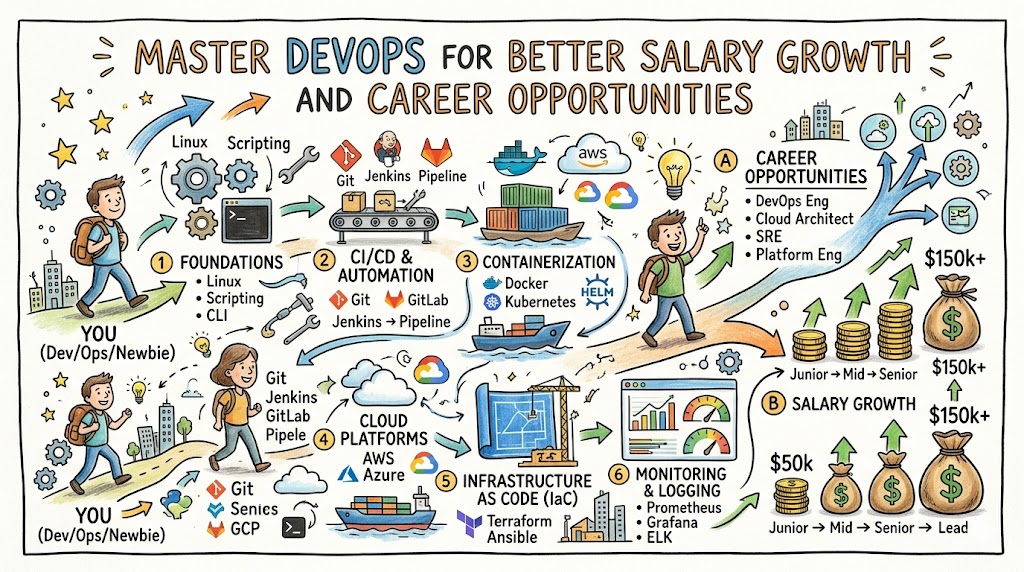
To systematically maximize your earning potential, focus on building your skills across these developmental tiers:
[BEGINNER]     Linux Foundations ──> Git Version Control ──> Networking Basics ──> Shell Scripting
                                                                                        │
                                                                                        ▼
[INTERMEDIATE] Docker Containers ──> CI/CD Pipelines ──> Terraform IaC ──> Jenkins / Automation
                                                                                        │
                                                                                        ▼
[ADVANCED]     Kubernetes Scale ──> Observability & SLOs ──> DevSecOps ──> Platform Engineering
1. Beginner Skills
- Linux Mastery: Core administration, file permissions, log monitoring, and process management.
- Git Controls: Version tracking, branching models, and clean pull request workflows.
- Networking Essentials: Understanding DNS routing, Subnets, VPC setups, and load-balancing principles.
- Shell Scripting: Writing bash scripts to automate repetitive system tasks.
2. Intermediate Skills
- Docker Containerization: Packaging multi-tier applications into efficient, secure container files.
- CI/CD Implementations: Building reliable automated test and build steps using orchestrators like Jenkins.
- Infrastructure as Code: Developing modular Terraform scripts to provision resources deterministically.
3. Advanced Skills
- Kubernetes at Scale: Managing high-availability clusters, service discovery, and network policies.
- Observability & Telemetry: Creating centralized dashboards using metrics, traces, and logs linked to clear SLO thresholds.
- DevSecOps Frameworks: Enforcing policy-as-code and automated secrets vulnerability scanning within active pipelines.
- Platform Engineering Design: Creating clean Internal Developer Platforms (IDPs) to enable developer self-service.
Real-World Career Scenarios
Scenario A: The Fresher Breaking In
- Path: Starts by mastering Linux administration, basic scripting, and foundational cloud support roles.
- Salary Outlook: Enters at a baseline entry rate. Earning potential rises quickly upon demonstrating the ability to build and run automated CI/CD jobs independently.
Scenario B: The Software Developer Transitioning
- Path: Capitalizes on existing coding knowledge to treat infrastructure as software code. Focuses on declarative IaC and pipeline automation tools.
- Salary Outlook: Commands immediate mid-level compensation due to a strong coding foundation, quickly moving into premium spaces like Platform Engineering.
Scenario C: The System Administrator Moving to Cloud DevOps
- Path: Replaces manual system patching and script deployments with modern cloud landing zones, automated configuration engines, and Terraform.
- Salary Outlook: Transitions traditional infrastructure knowledge into competitive DevOps compensation by demonstrating modern automation and cloud design skills.
Scenario D: The Specialist Scaling into SRE/Platform Engineering
- Path: Focuses on system availability, handling enterprise-wide reliability strategies, minimizing operational toil, and designing internal development ecosystems.
- Salary Outlook: Reaches top-tier compensation brackets by tying technical execution directly to business uptime and engineering efficiency.
Common Mistakes That Reduce Salary Growth
Avoid these common professional pitfalls to ensure your compensation keeps growing:
- Learning Tools in Isolation: Memorizing tool syntax without deploying them to solve real-world infrastructure problems.
- Ignoring System Foundations: Attempting to manage advanced cloud orchestrators while skipping core Linux and networking basics.
- Relying Solely on Certifications: Collecting certifications without building a hands-on portfolio to back them up.
- Overlooking Container Platforms: Avoiding Kubernetes and container networking concepts in a modern cloud market.
- Neglecting System Security: Treating security as an isolated operations phase rather than an integral part of the development lifecycle.
- Isolating Communication: Staying siloed instead of actively collaborating across development and business teams.
- Lacking a Public Portfolio: Failing to document clean IaC architectures or pipeline configurations in a public GitHub repository.
Hands-On Projects to Increase Salary Opportunities
Building verifiable projects helps demonstrate your expertise to hiring teams and commands higher compensation. Focus on these practical applications:
- Multi-Stage CI/CD Pipeline: Build an automated pipeline that pulls code, runs unit tests, performs linting, and packages the app into a secure container.
- Production Kubernetes Cluster: Deploy a cluster featuring automated horizontal scaling, ingress routing, and isolated network namespaces.
- Infrastructure via Modular IaC: Provision a multi-tier network environment using modular Terraform scripts stored securely in version control.
- GitOps Deployment Engine: Set up continuous deployment where changes to your production infrastructure are driven entirely by Git repository commits.
- Centralized Observability Stack: Implement system tracking that aggregates application logs and performance metrics into clean dashboards with automated alerts.
- Secure DevSecOps Pipeline: Build a delivery flow that automatically halts deployments if dependency scans detect critical vulnerabilities or exposed secrets.
Career Roadmap Summary
- Phase 1 (The Baseline): Focus on Linux administration, Git version control, basic shell scripting, and core cloud configurations.
- Phase 2 (The Core): Master declarative Infrastructure as Code (Terraform), container creation (Docker), and automated pipeline tools (Jenkins).
- Phase 3 (The Premium Specialist): Scale into Kubernetes management, establish telemetry monitoring, implement DevSecOps compliance, and design automated Developer Platforms.
FAQs
Is DevOps a high-paying career?
Yes. By bridging development and operations to directly protect uptime and revenue, DevOps engineers command some of the highest salaries in the global tech market.
Which DevOps skill gives the highest salary?
Advanced specializations in Kubernetes orchestrations, DevSecOps framework integration, and Platform Engineering design consistently command the highest compensation premiums.
Is Kubernetes good for salary growth?
Absolutely. Running container orchestration at scale involves significant architectural complexity. Engineers who can govern production clusters command premium salaries.
Which cloud platform pays more?
Major providers like AWS, Azure, and Google Cloud all offer strong earning potential. Value comes from understanding multi-cloud patterns and structural architecture rather than favoring a specific vendor.
Does certification increase salary?
Certifications validate your focus areas and help open doors during interviews. However, long-term salary growth is driven by practical project execution and real-world experience.
Is DevOps better than software development?
Neither is inherently better, but DevOps offers distinct advantages for engineers who enjoy system design, automation, and reliability engineering over writing pure feature code.
How long does it take to become a DevOps engineer?
Building a strong grasp of foundational skills like Linux, cloud networking, and basic CI/CD tools typically takes 6 to 12 months of dedicated, hands-on practice.
Final Recommendation
To maximize your growth in the DevOps field, focus on continuous, hands-on learning. Prioritize solving real-world infrastructure problems over simply accumulating certifications. True career growth comes from mastering core cloud architectures, container orchestration, and continuous automation.
As the industry moves toward Platform Engineering and DevSecOps, building a strong technical foundation will ensure your skills remain highly marketable and well-compensated for years to come. Focus on engineering reliable systems, share your work through public portfolios, and treat infrastructure as a core product. For a deeper look at global compensation metrics and trends, explore the detailed breakdowns over at the Best DevOps Salary Report.
