Introduction
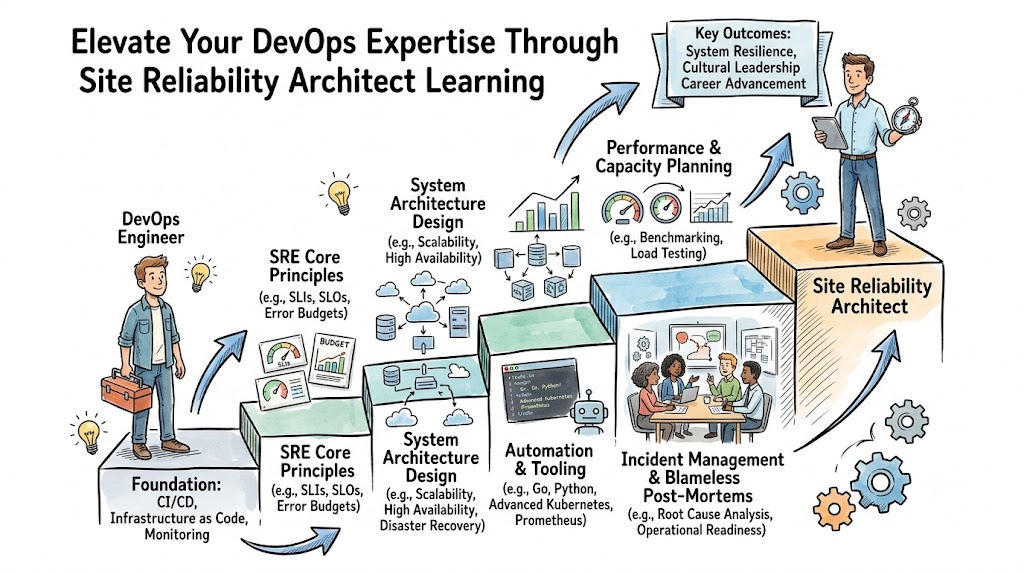
The demanding nature of modern production environments requires specialized leadership capable of designing highly available, fault-tolerant systems. This comprehensive guide is written for software engineers, platform specialists, and engineering managers who want to understand the strategic impact of advanced technical training. Choosing the right credential shapes your career trajectory across global markets, including the fast-growing technology sectors in India. By examining the structural layout of this program, infrastructure professionals can make informed, data-driven decisions regarding their professional development, skill acquisition, and long-term career progression.
What is the Certified Site Reliability Architect?
The Certified Site Reliability Architect designation represents the pinnacle of production-focused infrastructure engineering and systemic resilience design. Unlike entry-level certifications that focus purely on isolated software utilities or basic administrative tasks, this program emphasizes systemic reliability, scalability, and holistic architectural patterns. It exists to bridge the gap between theoretical software development and large-scale enterprise operations. Professionals pursuing this track learn to design frameworks that handle massive traffic loads, mitigate systemic failures, and automate complex infrastructure operations. The curriculum aligns directly with modern cloud-native deployment patterns and distributed system management.
Who Should Pursue Certified Site Reliability Architect?
This architectural track is specifically engineered for experienced systems administrators, cloud engineers, DevOps practitioners, and site reliability specialists seeking to move into high-level design roles. It provides intermediate and senior professionals with the advanced frameworks needed to oversee large, complex clusters and distributed software environments. Engineering managers and technical directors also benefit by gaining the insights required to build resilient organizational structures and establish error budget policies. The certification carries substantial weight both in major technology hubs across India and within global enterprise markets where infrastructure downtime translates directly to financial loss.
Why Certified Site Reliability Architect
Enterprise infrastructure shifts rapidly, but the foundational principles of distributed systems engineering, capacity planning, and fault isolation remain constant. This certification provides long-term value because it focuses on architectural principles rather than the specific syntax of ephemeral software tools. By mastering structural reliability patterns, professionals ensure their skills remain highly relevant even as organizations transition between public cloud vendors or hybrid hosting frameworks. The substantial return on investment manifests as enhanced operational credibility, an increased capability to lead multi-million dollar migration projects, and sustained protection against technical obsolescence.
Certified Site Reliability Architect Certification Overview
The structured educational program is delivered directly via the official Certified Site Reliability Architect curriculum and hosted online by sreschool. The certification process uses rigorous, performance-based assessments and case-study reviews rather than basic multiple-choice memory tests. This evaluation approach ensures that certified individuals possess actual engineering competency and can manage real-world infrastructure failures effectively. The ownership and administration of the program maintain strict alignment with current international engineering standards, making it a highly respected credential among enterprise employers.
Certified Site Reliability Architect Certification Tracks & Levels
The curriculum is split into three progressive tiers to accommodate different career stages: foundation, professional, and expert architect levels. The introductory tier ensures a firm grasp of metrics, logging, and basic automation patterns across standard deployments. The intermediate professional level introduces deep-dive reliability engineering, advanced deployment strategies, and complex distributed tracing frameworks. Finally, the expert architect level focuses entirely on macro-level system architecture, financial optimization, cross-organizational reliability governance, and comprehensive disaster recovery design across multi-cloud topologies.
Complete Certified Site Reliability Architect Certification Table
| Track | Level | Who it’s for | Prerequisites | Skills Covered | Recommended Order |
| Core SRE | Foundation | Systems Administrators, Developers | Basic Linux & Networking | SLOs, SLIs, Basic Monitoring | First |
| Advanced SRE | Professional | Senior DevOps, SRE Specialists | Foundation Certification | Chaos Engineering, Tracing | Second |
| Enterprise Architecture | Expert | Principal Engineers, Tech Leads | Professional Certification | Multi-Region Resilience, FinOps | Third |
Detailed Guide for Each Certified Site Reliability Architect Certification
Certified Site Reliability Architect – Foundation Level
What it is
This introductory credential validates an engineer’s understanding of core reliability metrics, incident response workflows, and fundamental automation principles. It ensures the candidate can operate effectively within an established site reliability culture.
Who should take it
Junior cloud engineers, system administrators, and software developers who want to transition into dedicated operations engineering and master foundational infrastructure terminology.
Skills you’ll gain
- Defining and calculating Service Level Objectives (SLOs) and Service Level Indicators (SLIs).
- Implementing automated alert configurations to prevent notification fatigue.
- Troubleshooting common Linux performance bottlenecks and network latency problems.
Real-world projects you should be able to do
- Configure a complete monitoring stack using Prometheus and Grafana for a multi-service web application.
- Write a post-mortem document analyzing a simulated database connection failure.
Preparation plan
- 7–14 days: Review the core definitions of error budgets, service metrics, and basic infrastructure configuration frameworks.
- 30 days: Build out isolated monitoring laboratories, run sample application workflows, and practice basic log parsing scripts.
- 60 days: Conduct deep-dive reviews of case studies focused on incident response and practice optimizing metric collections.
Common mistakes
- Focusing entirely on software syntax while ignoring the cultural principles of blame-free post-mortems and error budgets.
- Neglecting the fundamentals of standard network protocols and basic operating system internal mechanics.
Best next certification after this
- Same-track option: Certified Site Reliability Architect – Professional Level
- Cross-track option: Certified DevSecOps Engineer
- Leadership option: Technical Team Lead Foundation
Certified Site Reliability Architect – Professional Level
What it is
This intermediate certification verifies a professional’s capacity to design automated healing systems, manage large cluster deployments, and execute advanced telemetry strategies. It emphasizes production-grade implementation over simple component configuration.
Who should take it
Active SREs and cloud infrastructure engineers who have spent significant time running production workloads and wish to validate their automation expertise.
Skills you’ll gain
- Implementing controlled chaos engineering experiments within isolated staging environments.
- Designing distributed tracing systems to isolate microservice latency bottlenecks.
- Managing stateful applications across highly available cluster platforms.
Real-world projects you should be able to do
- Deploy an automated canary release pipeline that rolls back based on real-time HTTP error rates.
- Set up an end-to-end distributed tracing framework across five independent backend microservices.
Preparation plan
- 7–14 days: Analyze advanced telemetry architecture designs and study specific chaos engineering frameworks.
- 30 days: Build production-mimicking pipelines featuring auto-rollback routines and real-time validation checks.
- 60 days: Run system stress tests, evaluate complex log aggregation clusters, and review failure scenario logs.
Common mistakes
- Building brittle automation scripts that lack appropriate error handling or fallback states.
- Over-complicating telemetry pipelines to the point where the monitoring tools consume more resources than the application.
Best next certification after this
- Same-track option: Certified Site Reliability Architect – Expert Level
- Cross-track option: Certified MLOps Platform Specialist
- Leadership option: Systems Engineering Manager
Certified Site Reliability Architect – Expert Level
What it is
This premium credential certifies an engineer’s capability to architect international multi-region cloud infrastructures, establish corporate governance frameworks, and manage multi-million dollar operational budgets efficiently.
Who should take it
Principal engineers, enterprise infrastructure architects, and technology directors responsible for the global availability and financial efficiency of digital products.
Skills you’ll gain
- Designing multi-region, active-active storage architectures with robust data consistency models.
- Integrating advanced operational cost management practices across multi-cloud setups.
- Governing large engineering organizations via standardized technical baselines.
Real-world projects you should be able to do
- Design a comprehensive multi-cloud disaster recovery strategy providing a near-zero recovery point objective.
- Audit an enterprise application cluster to reduce operational infrastructure spend by thirty percent without reducing service performance.
Preparation plan
- 7–14 days: Review distributed systems consensus theories and evaluate high-level enterprise infrastructure topologies.
- 30 days: Model complex multi-region replication failures and design corresponding structural remediations.
- 60 days: Review complex organizational data governance frameworks and practice drafting large-scale technical migration strategies.
Common mistakes
- Focusing heavily on small code optimizations instead of looking at macro-level systemic dependencies and organizational bottlenecks.
- Failing to align infrastructure availability designs with actual corporate financial constraints and business models.
Best next certification after this
- Same-track option: Deep Enterprise Fellow Research
- Cross-track option: Certified Enterprise FinOps Architect
- Leadership option: Chief Technology Officer Certification Track
Choose Your Learning Path
DevOps Path
This pathway focuses on breaking down organizational walls between software development and systems operations by prioritizing repeatable delivery pipelines. Practitioners learn to build automated code integration frameworks, configuration management patterns, and reliable container orchestration systems. The objective is to establish an uninterrupted flow of code changes from local environments straight into production systems safely. Engineers mastering this route become experts at reducing cycle times and minimizing deployment-related software anomalies.
DevSecOps Path
Security must be woven directly into the core design of infrastructure networks rather than treated as a final inspection step. This path instructs engineers to inject static code scanning, vulnerable dependency checks, and compliance audits right into automated deployment pipelines. Professionals learn how to secure secrets management engines, isolate cloud networks, and block security threats before they ever hit production. This ensures that rapid software delivery does not introduce compliance flaws or unmitigated security vulnerabilities.
SRE Path
This technical track focuses deeply on maintaining system uptime, service resiliency, and highly scalable distributed systems architecture. Engineers specialize in building robust telemetry configurations, establishing precise error budgets, and conducting comprehensive incident investigations. The path trains individuals to treat operations entirely as a software engineering challenge, using code to replace manual intervention. Those pursuing this route are responsible for upholding the strict reliability metrics required by international digital platforms.
AIOps Path
Modern production systems generate huge volumes of log data, metric collections, and alerting signals that exceed human analysis capabilities. This specialized discipline focuses on applying machine learning algorithms to automate operational log parsing and anomaly detection routines. Engineers learn how to deploy predictive analytics engines that spot infrastructure issues before they cause service degradation. This enables operations teams to move away from reactive alerting and toward proactive, automated system remediation.
MLOps Path
Deploying artificial intelligence models into scalable production systems requires unique pipeline patterns distinct from standard web applications. This pathway concentrates on automating model training cycles, artifact version tracking, and large-scale inference cluster monitoring. Engineers bridge the gap between data science workflows and highly resilient cloud computing clusters to maintain model reliability. This ensures that machine learning algorithms serve accurate predictions efficiently under heavy concurrent user workloads.
DataOps Path
Data pipelines require high availability, robust quality checks, and repeatable delivery frameworks to feed modern business intelligence applications. This track focuses on automating large-scale data transformations, monitoring storage performance, and maintaining continuous delivery of analytic datasets. Practitioners learn how to orchestrate distributed processing clusters and track data schema migrations safely across various environments. This path removes manual bottlenecks from data integration pipelines, guaranteeing highly accurate data access.
FinOps Path
Cloud architecture optimization requires balancing high technical reliability with strict corporate financial accountability. This track educates engineering specialists to monitor multi-cloud resource spending, detect cloud waste, and forecast future infrastructure costs. Professionals learn to build real-time financial tracking dashboards and design highly efficient auto-scaling rules that lower costs. This path ensures that infrastructure growth scales sustainably alongside the business without driving up cloud bills.
Role → Recommended Certified Site Reliability Architect Certifications
| Role | Recommended Certifications |
| DevOps Engineer | Foundation Level, Professional Level |
| SRE | Professional Level, Expert Level |
| Platform Engineer | Foundation Level, Professional Level |
| Cloud Engineer | Foundation Level, Professional Level |
| Security Engineer | Foundation Level, Cross-Track Security |
| Data Engineer | Foundation Level, Cross-Track Data Ops |
| FinOps Practitioner | Foundation Level, Cross-Track FinOps |
| Engineering Manager | Foundation Level, Expert Level |
Next Certifications to Take After Certified Site Reliability Architect
Same Track Progression
After attaining the foundational and professional credentials, the logical progression is to pursue the expert architect level. This advancement forces the engineer to step away from daily scripting tasks and take on the responsibility of styling global corporate technology footprints. It hardens a specialist’s command over distributed systems engineering, enabling them to lead cross-functional architecture groups.
Cross-Track Expansion
Resilience does not exist in a silo, meaning an architect must master adjacent operational domains to succeed. Transitioning into dedicated security certification courses or specializing in automated machine learning platform tracks provides an engineer with a broader perspective. This multidisciplinary knowledge ensures that structural designs remain highly secure and can support advanced automated analytical tools.
Leadership & Management Track
For senior professionals looking to move into corporate governance, transitioning to an executive technology management program is an excellent step. This track develops organizational design capabilities, capital allocation skills, and long-term strategic technology planning competencies. It helps transform an expert technical engineer into a senior leader capable of driving enterprise-wide digital transformations.
Training & Certification Support Providers for Certified Site Reliability Architect
DevOpsSchool provides deep technical instruction paths featuring live engineering laboratories and hands-on guidance from industry veterans. The school specializes in translating complex multi-cloud deployments and automated pipeline management into digestible modules for working professionals.
Cotocus delivers focused enterprise training solutions designed to upskill large engineering teams in modern cloud infrastructure and system security methodologies. Their programs emphasize custom-tailored technical challenges that match actual corporate infrastructure setups.
Scmgalaxy offers a comprehensive library of open-source configuration guides, industry tutorials, and community forums focusing on software delivery systems. It serves as an active hub for engineers looking to troubleshoot real-world orchestration issues.
BestDevOps concentrates on delivering high-impact certification preparation bootcamps that focus on real-world tool implementation and infrastructure tracking. Their delivery system ensures engineers grasp theoretical operational concepts through practical production building.
devsecopsschool focuses entirely on the critical intersection of system security, automated software delivery, and cloud infrastructure compliance. Their specialized courses guide engineers through the process of embedding strict security checks into fast-moving deployment pipelines.
sreschool stands as a premier educational platform dedicated exclusively to distributed systems resilience, monitoring telemetry setups, and site reliability architectures. The site features extensive lab materials explicitly built around production scaling and emergency failure management.
aiopsschool leads educational programs targeting the deployment of machine learning algorithms within large-scale system monitoring networks. Their training materials help operations teams leverage predictive analytics to automate root-cause error analysis.
dataopsschool provides focused curriculum maps that address the automation, quality validation, and management of enterprise data delivery networks. Their training helps data engineers build highly resilient storage architectures and processing pipelines.
finopsschool delivers specialized education focused on cloud financial management, resource utilization auditing, and architectural cost optimization strategies. Their courses teach tech professionals how to maximize infrastructure performance while minimizing cloud operational expenditures.
Frequently Asked Questions (General)
- What is the primary difference between a DevOps certification and an SRE certification?DevOps programs focus broadly on software delivery speed and pipeline automation, while SRE paths emphasize production system uptime, service resilience, and software-driven operations management.
- How long does it typically take to prepare for the professional level examination?Most working professionals spending roughly ten to twelve hours per week require thirty to sixty days of consistent preparation to pass the professional level assessment.
- Are there any mandatory prerequisites required before attempting the expert architect exam?Yes, candidates must successfully pass the professional level certification exam and provide documented experience managing real-world cloud infrastructure deployments.
- Do these architectural certifications focus heavily on specific public cloud providers?No, the curriculum emphasizes cloud-agnostic architectural design patterns, distributed system principles, and systemic configurations that apply across all public and private cloud environments.
- How does this certification program help an engineer working in the Indian tech sector?It provides globally recognized credential validation that helps professionals stand out in highly competitive hiring landscapes like Bangalore, Hyderabad, and Pune.
- Can software developers with minimal operations experience take the foundation course?Yes, the foundation track is explicitly designed to introduce core operational workflows, metrics, and incident response terminology to software developers.
- What types of assessment methods are used in the expert level examination?The expert examination utilizes comprehensive case-study reviews and performance-based design scenarios rather than standard multiple-choice questions.
- How frequently do these certification tracks undergo curriculum updates?The certification materials are reviewed annually by a committee of principal engineers to ensure alignment with evolving industry practices.
- Does the program cover financial cloud optimization alongside system resilience?Yes, enterprise cost management and resource optimization are core components taught within the advanced architect level modules.
- What is an error budget and is it covered in the introductory tier?An error budget defines the acceptable amount of service downtime, and it is thoroughly explored starting in the foundation level course.
- Are these certifications valuable for traditional system administrators using on-premises hardware?Yes, the core principles of reliability engineering, storage configuration, and log aggregation apply directly to both on-premises data centers and cloud networks.
- Does this training program include automated incident response and self-healing systems?Advanced automated remediation, alert routing, and self-healing script designs are major focus points of the professional level track.
FAQs on Certified Site Reliability Architect
- How does the Certified Site Reliability Architect program handle modern container orchestration systems?The certification curriculum integrates container orchestration patterns directly into its core telemetry and scalability tracks. Engineers learn how to manage cluster networking, design persistent volume storage topologies, and debug distributed containers under heavy workloads. The program focuses on architectural resilience, teaching candidates how orchestration engines handle scaling operations and stateful application recovery during hardware infrastructure dropouts.
- What specific chaos engineering methodologies are tested within the advanced tracks?Candidates are tested on their capacity to design and execute controlled failure injections within staging and production environments. This includes simulating network latency spikes, terminating cluster nodes unexpectedly, and disrupting storage access routines safely. The exam validates whether an engineer can build automated monitoring systems that detect these faults and initiate self-healing protocols without user intervention.
- Does this certification program address multi-region disaster recovery and data replication?Yes, data consistency models and multi-region deployment topologies form a large section of the expert architect tier. The certification ensures that senior engineers can calculate recovery objectives, design active-active application pipelines, and manage database replication lags across geographically separate data centers while maintaining high user performance.
- How are real-world post-mortem methodologies integrated into the learning track assessments?The exam tracks evaluate an engineer’s ability to analyze system outages using blame-free post-mortem techniques. Candidates must demonstrate that they can isolate root technical failures, identify systemic process issues, and write actionable remediation tasks that prevent similar production incidents from occurring again within the organization.
- What telemetry and monitoring tools are covered during the practical lab sessions?The program emphasizes open-source standards and architectural design frameworks for log collection, metric gathering, and distributed tracing. Students learn how to build scalable telemetry structures that process thousands of data points per second without degrading the performance of the core application services.
- How does the curriculum prepare technical leaders to manage corporate error budgets?The course teaches architects how to negotiate service level objectives with business stakeholders and product managers. It provides frameworks for using the error budget to balance rapid feature releases with system stability requirements, ensuring product management and infrastructure teams share operational responsibility.
- Is script automation and infrastructure as code part of the certification requirements?Yes, automating manual tasks using code is a fundamental requirement across all levels of the architect program. Candidates must prove they can translate manual deployment steps and configuration tasks into reusable, version-controlled code templates that deploy infrastructure predictably.
- What value does this specific credential bring to engineering managers and technical directors?For management professionals, the program provides clear frameworks to structure operations teams and evaluate organizational technical debt. It gives leaders the strategic insight needed to champion modern reliability transformations, optimize infrastructure budgets, and establish high-performing operational cultures across their engineering departments.
Final Thoughts: Is Certified Site Reliability Architect Worth It?
Investing time and energy into professional credentials should always be guided by clear career goals. The Certified Site Reliability Architect path is not a shortcut or a simple badge meant to decorate a resume with marketing buzzwords. It is a structured, technically demanding framework built for professionals who want to master production systems engineering.
If your day-to-day goal is to design resilient infrastructure, reduce operational waste, and lead engineering teams through complex cloud migrations, this certification provides real clarity. It forces you to move past basic tool syntax and focus entirely on enduring architectural patterns. The long-term return on this investment shows up clearly in your daily engineering decisions, giving you the confidence to lead critical projects in any modern enterprise environment.
