Introduction
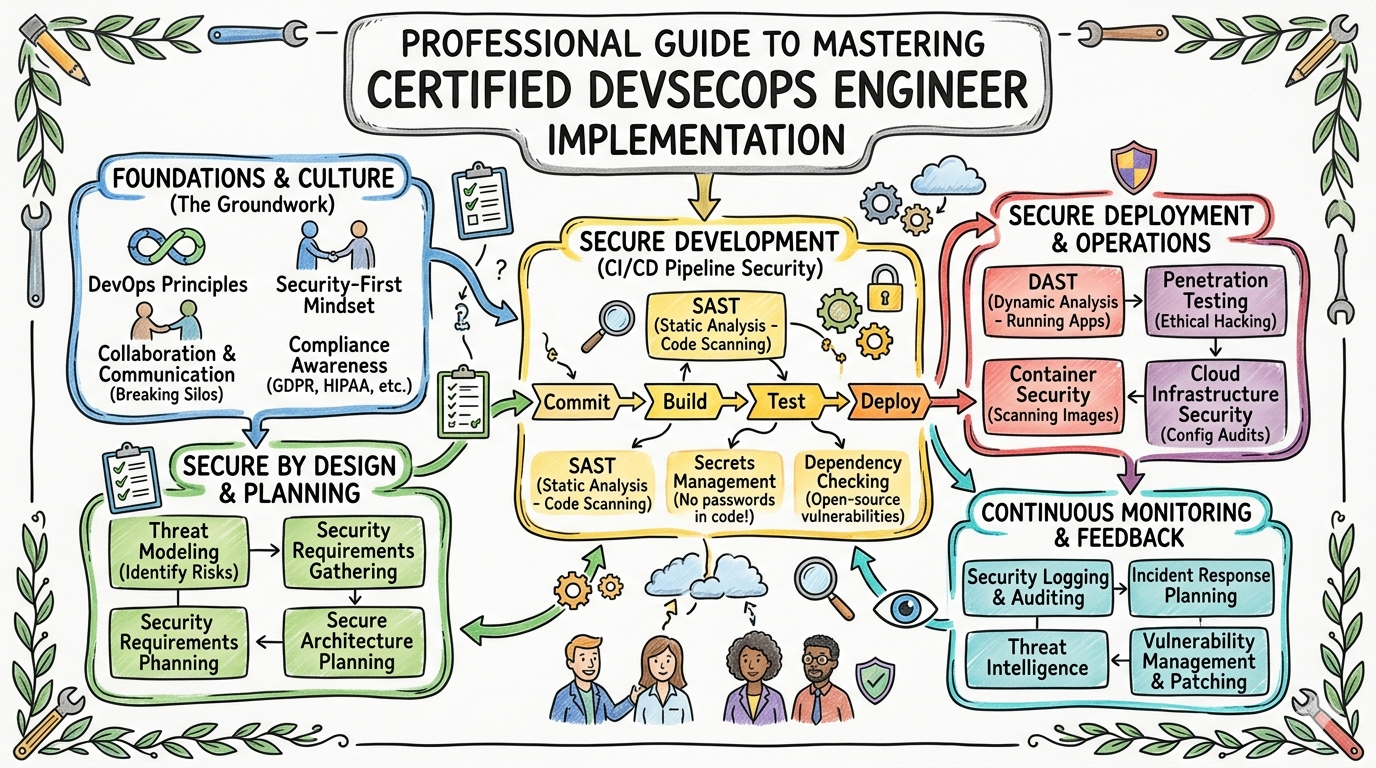
The integration of security into the software delivery lifecycle has shifted from a luxury to a fundamental requirement for modern engineering teams. The Certified DevSecOps Engineer program serves as a comprehensive framework for professionals aiming to bridge the gap between development, operations, and security practices. This guide is designed for software engineers, system administrators, and security specialists who want to standardize their knowledge and improve their deployment velocity while maintaining high security posture. By exploring the various tracks and requirements, this document helps you make an informed decision about your path forward on devopsschool and associated platforms like aiopsschool. Whether you are looking to refine your current skill set or transition into a specialized security-focused role, understanding this certification structure is the first step toward aligning your expertise with industry-standard expectations.
What is the Certified DevSecOps Engineer?
The Certified DevSecOps Engineer certification represents a commitment to implementing security-as-code within complex, cloud-native environments. It exists to provide a standardized benchmark for professionals who can effectively manage vulnerabilities, automate security testing, and maintain compliance throughout the CI/CD pipeline. Unlike purely theoretical certifications, this program emphasizes production-focused outcomes that mirror real-world enterprise challenges. It covers the essential intersection of security protocols with DevOps methodologies, ensuring that professionals understand how to protect infrastructure without sacrificing the speed and agility that modern development teams require.
Who Should Pursue Certified DevSecOps Engineer?
This certification is designed for a broad spectrum of IT professionals who touch the software delivery pipeline. DevOps engineers, Site Reliability Engineers, and platform engineers will find immense value in learning how to embed security controls directly into their automated workflows. Furthermore, security analysts and cloud architects who want to transition into more technical, implementation-heavy roles will benefit from the hands-on nature of the curriculum. Engineering managers who oversee secure development practices should also pursue this to better guide their teams. In the context of global and domestic markets, this certification provides the practical edge needed to lead security initiatives in fast-paced software organizations.
Why Certified DevSecOps Engineer
The demand for professionals who can balance rapid delivery with stringent security measures continues to grow across all enterprise sectors. This certification offers longevity because it focuses on core principles and methodologies rather than specific, fleeting tools that may become obsolete. By mastering these concepts, you ensure your relevance in a market that prioritizes automation, compliance, and risk mitigation. The return on investment is found in the ability to deliver more resilient systems, reduce post-deployment incidents, and provide leadership in security-conscious engineering cultures. It serves as a testament to your capability to handle the complexities of modern, distributed architectures.
Certified DevSecOps Engineer Certification Overview
The program is delivered via the official training provided at the Certified DevSecOps Engineer portal and is managed by devopsschool. It is structured to provide a logical progression from core security concepts to advanced implementation strategies. The assessment approach focuses on practical application, requiring candidates to demonstrate their ability to solve actual security problems within a simulated environment. Ownership of the certification signifies that the holder has reached a verifiable standard of competence, making it a reliable indicator of professional capability for employers worldwide.
Certified DevSecOps Engineer Certification Tracks & Levels
The certification hierarchy is divided into foundation, professional, and advanced levels to cater to varying levels of experience. The foundation level establishes the baseline knowledge of security tools and methodologies, while the professional level dives into pipeline integration and policy enforcement. The advanced level targets high-level architects and lead engineers who design and oversee complex security frameworks across entire organizations. Specialization tracks allow you to align your certification with your specific career goals, whether you are focused on pure security, SRE, or broad infrastructure management.
Complete Certified DevSecOps Engineer Certification Table
| Track | Level | Who it’s for | Prerequisites | Skills Covered | Recommended Order |
| Core | Foundation | Beginners | Basic Linux | Security Basics | First |
| Security | Professional | Engineers | Core knowledge | Pipeline Security | Second |
| Advanced | Architect | Leads | Professional Cert | Strategic Security | Third |
Detailed Guide for Each Certified DevSecOps Engineer Certification
Certified DevSecOps Engineer – Foundation Level
What it is
This level validates your fundamental understanding of why security must be integrated early in the development lifecycle. It covers the basic tools and security concepts required for entry-level tasks.
Who should take it
Aspiring engineers and junior developers looking to add a security-conscious perspective to their existing technical skill set.
Skills you’ll gain
- Understanding shift-left security principles
- Identifying common web vulnerabilities
- Basic secret management techniques
- Static analysis tool familiarity
Real-world projects you should be able to do
- Integrate a basic vulnerability scanner into a CI pipeline
- Configure secure environment variables for a simple application
- Execute a basic security audit of a container image
Preparation plan
- 7 days: Review basic security principles and terminology.
- 30 days: Practice hands-on labs focusing on basic pipeline integration.
- 60 days: Conduct a mock project and review assessment criteria.
Common mistakes
Focusing too much on theoretical definitions rather than practical application in a pipeline.
Best next certification after this
Professional Level Certification.
Choose Your Learning Path
DevOps Path
The DevOps path focuses on the automation aspects of the role, ensuring that security measures do not create bottlenecks in the development process. Professionals on this path learn how to maintain high deployment frequency while automating security gates. This ensures that the speed of delivery is matched by the strength of the underlying security infrastructure.
DevSecOps Path
The DevSecOps path is a deep dive into the integration of security at every stage of the software lifecycle. It emphasizes the cultural shift required to make security a shared responsibility among all team members. This path is essential for those who intend to lead security transformation initiatives within their organizations.
SRE Path
The SRE path focuses on the intersection of site reliability and security, ensuring that services remain secure while maintaining high availability. It involves learning how to respond to security incidents without compromising system stability. This path is crucial for professionals managing large-scale, production-critical environments.
AIOps Path
The AIOps path integrates artificial intelligence into the security monitoring process to detect anomalies faster. It explores how machine learning can be used to predict potential security threats before they impact the system. This path is for those looking to stay at the forefront of automated threat detection.
MLOps Path
The MLOps path is dedicated to securing the machine learning lifecycle, from data ingestion to model deployment. It covers the unique security challenges of ML pipelines and ensures that data privacy and model integrity are maintained throughout.
DataOps Path
The DataOps path focuses on securing data pipelines and ensuring compliance in data-intensive environments. It covers data encryption, access control, and privacy regulations that are critical for modern data-driven organizations.
FinOps Path
The FinOps path explores the financial implications of security and ensures that security spend is optimized for value. It involves managing the cost of security tooling and cloud resources while maintaining a robust security posture.
Role → Recommended Certified DevSecOps Engineer Certifications
| Role | Recommended Certifications |
| DevOps Engineer | Professional DevSecOps |
| SRE | SRE Security Specialist |
| Platform Engineer | Advanced Infrastructure Security |
| Cloud Engineer | Cloud Security Foundations |
| Security Engineer | Expert DevSecOps Architect |
| Data Engineer | Data Security Professional |
| FinOps Practitioner | Secure FinOps Operations |
| Engineering Manager | DevSecOps Strategic Leadership |
Next Certifications to Take After Certified DevSecOps Engineer
Same Track Progression
Once you have mastered the current track, consider moving to the architect level. This allows for deep specialization and helps you design complex, secure systems rather than just managing them.
Cross-Track Expansion
Expand your expertise by adding certifications in SRE or FinOps. Understanding how security interacts with reliability and cost-efficiency makes you a more versatile and valuable engineer.
Leadership & Management Track
Transitioning to leadership requires understanding how to align security goals with business objectives. Pursuing management-focused certifications will help you bridge the gap between technical execution and high-level strategy.
Training & Certification Support Providers for Certified DevSecOps Engineer
DevOpsSchool provides comprehensive training programs that emphasize practical skills and real-world application, ensuring that engineers are prepared for actual production environments.
Cotocus specializes in advanced technical training with a focus on deep-dive workshops that challenge students to solve complex architectural problems efficiently.
Scmgalaxy offers a wide range of courses that cater to the evolving needs of the modern IT industry, with a strong focus on automation and integration.
BestDevOps provides structured learning paths that help students build their careers systematically, starting from foundation levels up to advanced professional certifications.
devsecopsschool is dedicated to the intersection of security and development, offering specialized content that addresses the specific challenges of securing modern software pipelines.
sreschool focuses on reliability and performance, ensuring that engineers learn how to keep systems secure while maintaining the high availability required by users.
aiopsschool teaches students how to leverage artificial intelligence and machine learning in their operational and security workflows for faster, more intelligent decision-making.
dataopsschool provides expert-led training on managing data lifecycles securely, focusing on the unique challenges of data governance and compliance in production systems.
finopsschool focuses on the intersection of cloud finance and operations, teaching engineers how to balance security requirements with optimized infrastructure costs and resource management.
Frequently Asked Questions
- What is the difficulty level of this certification?The difficulty is calibrated to match real-world professional standards, requiring both conceptual knowledge and hands-on implementation skills to pass.
- How much time is required to prepare?Preparation time varies based on your existing experience, but most professionals dedicate between 30 to 60 days of consistent, practical practice to succeed.
- Are there any prerequisites for these certifications?While foundation levels have minimal prerequisites, professional and advanced levels require a strong grasp of Linux and basic CI/CD concepts.
- Is this certification recognized globally?Yes, the certification is respected by organizations worldwide as it focuses on universal engineering principles and standard industry practices.
- Does this certification help in salary growth?Industry data suggests that specialized certifications often lead to better career opportunities and competitive salary packages for skilled engineers.
- Can I take the exam online?The assessment platforms support online examination, allowing professionals to demonstrate their skills from anywhere in the world.
- How often should I renew my certification?Certifications are designed to reflect current industry standards, and periodic updates are recommended to stay aligned with new security practices.
- Is this training suitable for managers?Yes, managers find this training useful for understanding the technical requirements and processes their teams need to follow to maintain high security.
- What is the primary focus of the hands-on labs?The labs focus on real-world scenarios such as pipeline security, container hardening, and automated vulnerability management.
- Can I choose multiple tracks?Yes, you are encouraged to stack certifications to gain a broader perspective on how different disciplines like SRE and DevSecOps intersect.
- Are the assessment projects open-ended?They are designed to be practical and result-oriented, focusing on achieving specific outcomes that mirror daily production responsibilities.
- Who grades the practical assessments?Assessments are evaluated based on a strict set of criteria that ensure the candidate can independently perform key security tasks.
FAQs on Certified DevSecOps Engineer
- What specific security tools are covered?The curriculum focuses on industry-standard open-source tools that are widely used in enterprise environments for security scanning and automation.
- Does this help with compliance auditing?Yes, the skills learned include implementing policy-as-code, which is essential for maintaining compliance with major industry standards.
- Is coding required for these certifications?While you do not need to be a software developer, you must be comfortable reading and writing basic scripts for automation tasks.
- What if I have limited experience with containers?The foundation level covers the necessary container concepts to ensure you are well-prepared for more advanced security topics later.
- Can I apply these skills to any cloud provider?The principles taught are cloud-agnostic, meaning you can apply your security expertise regardless of the specific infrastructure provider being used.
- How does this differ from general security certs?This certification is focused specifically on the integration of security into the DevOps workflow, not just broad network or application security.
- Will I learn about threat modeling?Yes, threat modeling is a core component of the professional and advanced tracks, helping you design more secure architectures from the start.
- Are there real-world case studies?The training includes examples of common security failures and how to prevent them through proper design and automation.
Final Thoughts: Is Certified DevSecOps Engineer Worth It?
Investing in this certification is a strategic decision for any engineer aiming to advance their career in a security-conscious industry. It provides the structured knowledge and practical credibility needed to move beyond basic tasks and start influencing the architecture of secure systems. The value lies in the experience gained, which is directly applicable to the challenges you face in your daily work. If you are serious about becoming a proficient security-focused professional, this certification is a reliable guide for your journey. Focus on mastering the practical outcomes rather than just passing the exam, and you will find yourself better equipped for any security-related challenge that comes your way.
