Introduction
In the fast-evolving tech landscape, the boundaries between software development, infrastructure management, data science, and security have largely dissolved. Organizations no longer look for professionals who only write code or only manage servers. Instead, they demand highly skilled experts who can bridge these domains using automation, cloud-native architectures, and robust monitoring. Navigating this vast landscape can be overwhelming. Whether you are aiming for a career in core DevOps, cloud engineering, Site Reliability Engineering (SRE), DevSecOps, or modern MLOps, choosing a structured path is critical.
A well-chosen certification acts as a structured career roadmap, filtering out the noise and forcing you to master the exact toolchains and methodologies used by top-tier engineering teams. However, with dozens of platforms, cloud providers, and open-source tools offering validation, professionals often face immense confusion regarding where to invest their time and money. Selecting the Best DevOps Certification depends heavily on your current skill level, your engineering role, and your long-term career goals. This comprehensive guide breaks down the absolute best certifications across the entire modern tech ecosystem to help you make an informed, strategic decision.
What is a DevOps Certification?
A DevOps certification is a formal validation of a professional’s theoretical knowledge and practical competence in automating, managing, and optimizing the software development lifecycle (SDLC). Far beyond a simple piece of paper, a reputable certification demonstrates your ability to integrate development and operations teams, implement continuous pipelines, and manage cloud-infrastructure safely. It validates that you understand how to reduce delivery times, minimize deployment failures, and maintain system stability under heavy production loads.
Modern certifications are carefully structured around comprehensive learning paths that demand real-world execution. Instead of relying solely on multiple-choice questions, the industry’s most respected certs utilize performance-based, hands-on environments. When you prepare for these certifications, you are forced to build actual continuous integration and continuous deployment (CI/CD) pipelines, configure live container orchestration clusters, write declarative infrastructure as code, and debug real-time system failures. This rigorous process ensures that certified individuals possess functional, production-ready skills rather than just theoretical familiarity.
Why DevOps Certifications Matter
In a highly competitive job market, certifications serve as a powerful differentiator that can accelerate your career progression, validate your technical expertise, and unlock premium salary brackets. They prove to hiring managers that your skills have been audited against rigorous industry standards.
The Step-by-Step Validation Process
- Curated Knowledge Acquisition: You follow a structured curriculum designed by industry experts, eliminating gaps in your self-taught knowledge.
- Hands-On Lab Practice: You build, configure, and break systems within isolated sandbox environments to gain real operational confidence.
- Performance-Based Evaluation: You prove your technical competency by solving live architectural or troubleshooting challenges under exam conditions.
- Industry and Peer Recognition: You earn a verified digital credential that bypasses generic resume screeners and applicant tracking systems (ATS).
- Continuous Skill Upgradation: You maintain your cert through recertification cycles, ensuring you remain up to date with the latest cloud and automation shifts.
Who Should Take DevOps Certifications?
DevOps and automation certifications are not restricted to a single job title; they are designed for a broad spectrum of tech professionals aiming to modernize their skill sets.
- Students & Freshers: Aspiring IT professionals looking to break into the industry with verified, structured proof of their cloud and automation capabilities.
- Software Engineers & QA Professionals: Developers and testers who want to understand where their code lives, automate their test deployments, and eliminate the “works on my machine” dilemma.
- System Administrators & Cloud Engineers: Traditional infrastructure professionals transitioning away from manual server configurations toward code-driven, cloud-native environments.
- SRE & DevSecOps Specialists: Advanced engineers looking to validate their specific expertise in high-availability systems, automated telemetry, or shifting security left into the build pipeline.
- Data & Machine Learning Engineers: MLOps and data professionals who need to build automated, reproducible pipelines for training, testing, and deploying data models at scale.
- IT Managers & Platform Leaders: Technical leaders who need a deep structural understanding of modern engineering workflows to manage cross-functional teams effectively.
Core Skills Covered
Regardless of the specific path you choose, high-quality certifications focus on a core set of modern engineering principles that form the backbone of scalable software delivery.
- Continuous Integration & Continuous Delivery (CI/CD): Designing automated pipelines that compile, test, packages, and deploy code seamlessly upon every commit.
- Infrastructure as Code (IaC): Replacing manual console clicks with declarative configuration files to provision, version, and manage infrastructure predictably.
- Containerization & Orchestration: Packaging applications with all dependencies into lightweight containers and managing them across distributed compute clusters.
- Cloud Architecture & Security: Deploying highly available, fault-tolerant applications across public clouds while embedding security checks directly into the automated lifecycle.
- Observability & Monitoring: Implementing comprehensive log aggregation, metric collection, and distributed tracing to detect and resolve production anomalies before users notice.
Table 1 – Best DevOps Certifications
The table below outlines the top 20 certifications available in the industry today, linking directly to authoritative training and certification paths to jumpstart your career.
| Certification Name | Best For | Skill Level | Career Direction |
| DevOps Certified Professional (DCP) | Core DevOps Foundations & Core Multi-Tool Mastery | Beginner to Intermediate | DevOps Engineer / Systems Automation |
| DevSecOps Certified Professional (DSOCP) | Shifting Security Left & Automated Compliance | Intermediate to Advanced | DevSecOps Engineer / Security Architect |
| Site Reliability Engineering (SRE) Certified Professional | System Availability, SLOs, and Incident Management | Intermediate to Advanced | Site Reliability Engineer / Systems Engineer |
| Master in DevOps Engineering (MDE) | Advanced Full-Stack Automation & Orchestration | Intermediate to Advanced | Senior DevOps / Principal Platform Engineer |
| Master in Azure DevOps | Complete Enterprise Microsoft Cloud Tooling | Intermediate | Azure Cloud Solutions Architect / DevOps |
| AWS Certified DevOps Professional | Advanced AWS Infrastructure Automation & Guardrails | Advanced | AWS Cloud Engineer / DevOps Architect |
| Master in Python Programming | Automation Scripting, Tool Building, and Data Prep | Beginner to Intermediate | Automation Engineer / Software Developer |
| Hashicorp Certified Terraform Associate | Multi-Cloud Declarative Infrastructure as Code | Beginner to Intermediate | Cloud Engineer / Infrastructure Engineer |
| Certified Kubernetes Administrator (CKA) | Core Cluster Architecture, Networking, and Fixing Issues | Intermediate to Advanced | Kubernetes Specialist / Platform Engineer |
| Docker Certified Associate (DCA) | Container Runtimes, Image Optimization, & Security | Beginner to Intermediate | Container Engineer / Systems Administrator |
| Envoy ISTIO Certification Training | Service Mesh Traffic Management & Microservice Security | Intermediate to Advanced | Service Mesh Specialist / Cloud Architect |
| MLOps Certification Training Course | Automated ML Pipelines & Model Lifecycle Management | Intermediate to Advanced | MLOps Engineer / Machine Learning Architect |
| Google Cloud Professional Cloud DevOps Engineer | Google Cloud Site Reliability Engineering & Anthos | Advanced | GCP Cloud Engineer / SRE |
| Master in Machine Learning | Algorithm Development & Data Pattern Recognition | Intermediate | Machine Learning Scientist / Data Engineer |
| Master in Artificial Intelligence | Neural Network Architectures & Intelligent Systems | Advanced | AI Research Engineer / Cognitive Architect |
| Master in AppDynamics | Enterprise Application Performance Monitoring (APM) | Intermediate | Monitoring Specialist / Observability Engineer |
| Master in Data Science | Statistical Analysis, Data Modeling, & Big Data | Intermediate | Data Scientist / Big Data Analyst |
| Master in Deep Learning | Complex Multi-Layer Neural Networks & Computer Vision | Advanced | Deep Learning Researcher / AI Specialist |
| Prometheus with Grafana | Open-Source Time-Series Metrics & Visual Dashboards | Beginner to Intermediate | Observability Engineer / Operations Analyst |
| GitOps Certified Professional (GOCP) | Declarative Git-Driven Continuous Cloud Deployment | Intermediate | GitOps Practitioner / Platform Engineer |
Certification Deep Dive
To give you a clear, uniform picture of what prepping for a high-quality certification looks like, let’s explore the core DNA shared by these industry-recognized programs through a unified, deep-dive breakdown.
Real-World Use Case
Imagine an enterprise e-commerce platform facing massive traffic spikes during holiday shopping events. The engineering team must transition from a slow, manual infrastructure setup to an automated ecosystem. They use Terraform to spin up multi-region cloud resources, Docker and Kubernetes to package and scale microservices dynamically, a comprehensive CI/CD pipeline to roll out new code without downtime, DevSecOps scanners to check for security vulnerabilities automatically during the build, and Prometheus and Grafana to monitor system health in real time. This unified approach prevents crashes, secures payment processing, and ensures a seamless user experience under extreme stress.
Skills You Will Learn
- Declarative Infrastructure Management: Writing clear code to define, version, and spin up complex network and compute environments consistently.
- Container Lifecycle Orchestration: Building highly optimized container images, setting up secure container networks, and managing production workloads using Kubernetes.
- Automated Security & Compliance: Integrating automated security scanning tools directly into your build pipelines to flag software vulnerabilities and configuration mistakes instantly.
- Reliability & Performance Engineering: Defining explicit system reliability targets using metrics like Service Level Objectives (SLOs) and configuring automated alerts to handle system failures gracefully.
- Git-Driven Continuous Operations: Structuring Git as the absolute single source of truth for your application code and your infrastructure configuration (GitOps).
Career Scope
The demand for certified professionals spans across every modern technology vertical. Organizations are actively looking for engineers who can break down engineering silos, optimize cloud spending, and ensure system uptime. Earning these certifications sets you up for critical engineering roles, including Cloud DevOps Engineer, Platform Engineer, SRE, Site Reliability Specialist, DevSecOps Consultant, and MLOps Architect. These positions consistently rank among the highest-paid roles in the global tech ecosystem.
Difficulty Level
Varies from Beginner (foundational concepts, scripting fundamentals, basic cloud usage) to Advanced (performance-based lab exams requiring you to live-debug active clusters, design distributed service meshes, or configure advanced machine learning delivery systems under tight time constraints).
Best Career Fit / Who Should Take It
This learning path is ideal for proactive software developers eager to master production environments, infrastructure administrators transitioning away from manual configuration scripts, security professionals wanting to automate defense mechanisms, and data specialists looking to productionize complex analytical models at scale.
Hands-On Projects
- Automated Multi-Stage CI/CD Pipeline: Build a robust pipeline that triggers on code commits, runs unit tests, performs code linting, creates an optimized Docker image, and safely deploys to a Kubernetes staging environment.
- Multi-Cloud Infrastructure as Code Blueprint: Write reusable Terraform modules to provision secure virtual networks, load balancers, and auto-scaling compute groups across multiple cloud availability zones.
- Production Cluster Hardening & Monitoring Mesh: Deploy a multi-node Kubernetes cluster, implement network security policies, inject an Istio service mesh for traffic control, and build live Grafana dashboards connected to a Prometheus data source to track application latency.
DevOps Certification Roadmap
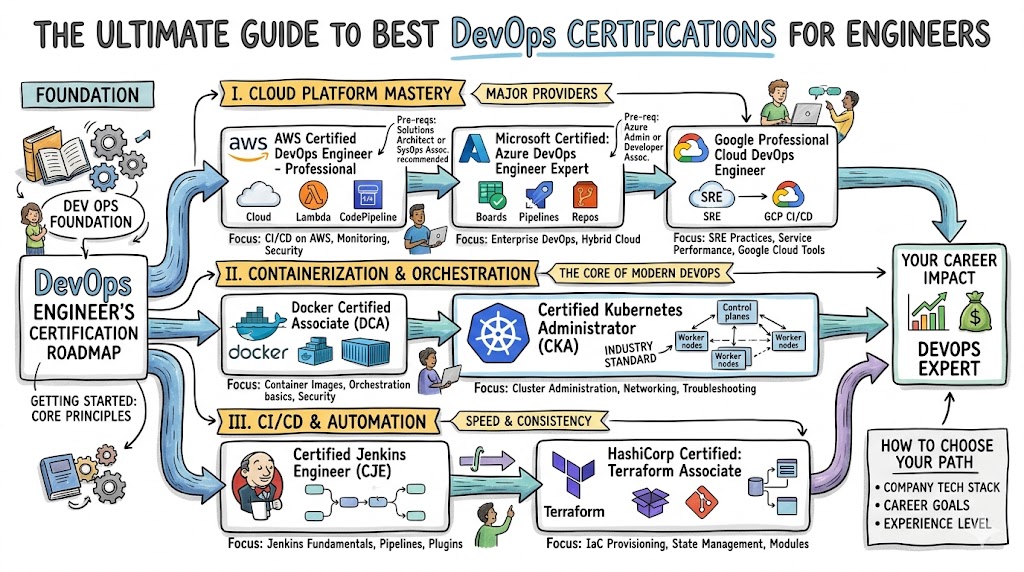
Choosing the right certifications depends heavily on your professional goals. The table below outlines tailored paths to guide your technical journey.
Table 2 – Strategic Certification Roadmap
| Career Goal | Recommended Certification Path | Why It Fits |
| Get Started in DevOps | DevOps Certified Professional (DCP) $\rightarrow$ Docker Certified Associate (DCA) $\rightarrow$ Terraform Associate | Builds a rock-solid foundation by combining core DevOps concepts with essential containerization and infrastructure skills. |
| Cloud Infrastructure Expert | Terraform Associate $\rightarrow$ AWS Certified DevOps Professional OR Master in Azure DevOps | Combines flexible, cloud-agnostic infrastructure-as-code mastery with deep, platform-specific automation skills. |
| Cloud-Native & Platform Specialist | Docker Certified Associate (DCA) $\rightarrow$ Certified Kubernetes Administrator (CKA) $\rightarrow$ GitOps Certified Professional (GOCP) | Provides the complete toolkit needed to build, manage, and scale secure, automated container platforms. |
| Security First (DevSecOps) | DevOps Certified Professional (DCP) $\rightarrow$ DevSecOps Certified Professional (DSOCP) $\rightarrow$ Envoy Istio Training | Focuses on shifting security left by embedding automated scanning and secure service meshes into delivery pipelines. |
| Enterprise Reliability & Metrics | SRE Certified Professional $\rightarrow$ Prometheus with Grafana $\rightarrow$ Master in AppDynamics | Focuses entirely on system uptime, deep infrastructure observability, application performance metrics, and incident control. |
| Data Science & AI Delivery | Master in Python $\rightarrow$ Master in Machine Learning $\rightarrow$ MLOps Certification Training | Bridges the gap between data science and operational engineering, allowing you to deploy and monitor AI models reliably. |
Types of DevOps Certifications
Certification Path by Role
To help you target your specific career interests, certifications can be grouped into clear, specialized roles:
- Foundational & Generalist: Programs like the DevOps Certified Professional (DCP) and Master in DevOps Engineering (MDE) offer a broad, multi-tool approach. They are excellent for understanding how the entire ecosystem connects.
- Cloud-Specific Mastery: Certifications backed directly by cloud providers—such as the AWS Certified DevOps Professional or Master in Azure DevOps—dive deep into vendor-specific tools like AWS CloudFormation, Azure Pipelines, and managed cloud architectures.
- Cloud-Native & Container Specialist: Core open-source programs like CKA, DCA, and GitOps Certified Professional focus purely on managing container runtimes, Kubernetes environments, and automated continuous deployments.
- Security & Reliability Specialist: The DevSecOps Certified Professional (DSOCP) and SRE Certified Professional programs focus on specialized engineering goals: shifting security tests left into early stages or designing highly stable, self-healing platforms.
- Data & AI Operations: The MLOps Certification along with specialized paths in Python, Machine Learning, and Deep Learning cater directly to modern data engineering teams tasked with automating the lifecycle of intelligent systems.
Common Mistakes to Avoid
- Collecting Badges Without Hands-On Practice: Relying on brain dumps or multiple-choice memorization without spinning up live tools will leave you unprepared for technical interviews and real-world production tasks.
- Ignoring Programming and Scripting Basics: Trying to master complex tools like Kubernetes or Terraform without a foundational grasp of shell scripting or a language like Python makes debugging incredibly difficult.
- Chasing Too Many Advanced Certifications At Once: Attempting to study for AWS, Azure, and Google Cloud certifications simultaneously leads to burnout. Focus on mastering one platform before branching out.
- Focusing on Tooling While Ignoring the Cultural Mindset: Forgetting that DevOps is fundamentally about collaboration, shared responsibility, and breaking down engineering silos, not just writing automation scripts.
- Neglecting Logging and System Observability: Concentrating entirely on code deployment pipelines while failing to learn how to monitor, log, and troubleshoot applications once they are live in production.
5 Real-Life Examples
- Enterprise E-Commerce Transformation: A major retail brand used a certified team to convert their legacy platform into optimized Docker containers managed by Kubernetes, successfully surviving a 400% traffic surge during Black Friday without a single minute of downtime.
- Automated Financial Security Audit: A global fintech firm integrated automated security scanning tools into their Jenkins pipelines using DevSecOps principles, cutting their compliance audit review times from three weeks down to just fifteen minutes per release.
- SRE Reduction in Down Time: A SaaS streaming platform applied explicit SLO metrics and Prometheus alerting strategies, enabling their engineering team to catch memory leaks early and reduce unexpected application downtime by over 85%.
- Multi-Cloud Infrastructure Delivery: A healthtech startup used Terraform modules to spin up identical, HIPAA-compliant patient portals across both AWS and Azure simultaneously, cutting their manual setup time down from several days to under ten minutes.
- Automated Medical MLOps Pipeline: An AI-driven healthcare provider set up an automated MLOps pipeline that securely retrained, tested, and updated skin cancer detection models across global hospitals without requiring any manual engineering intervention.
Frequently Asked Questions (FAQs)
Q1: Which certification is best for an absolute beginner?
A: The DevOps Certified Professional (DCP) is an excellent starting point. It provides a comprehensive, multi-tool overview of the entire lifecycle without overwhelming you with advanced vendor configurations. It introduces you to foundational automation concepts, making it easier to pick up specialized tools later.
Q2: Are performance-based exams like the CKA harder than multiple-choice exams?
A: Yes, performance-based exams are generally more challenging because they require you to solve real problems in a live terminal window. However, they carry far more weight with hiring managers because they prove you can configure and troubleshoot real systems under pressure, rather than just memorizing answers.
Q3: Can I build a career in DevOps without learning how to code?
A: While you do not need to be a full-stack software developer, a basic understanding of programming is essential. Mastering a language like Python and understanding how to read JSON or YAML structures is critical for writing automation scripts, configuring pipelines, and managing infrastructure as code.
Q4: What is the difference between DevOps and DevSecOps?
A: Traditional DevOps focuses primarily on breaking down walls between development and operations teams to ship software faster and more reliably. DevSecOps takes this a step further by integrating security checks directly into every stage of that automated delivery pipeline, making security a shared responsibility from day one.
Q5: How long does it typically take to prepare for an advanced certification?
A: For comprehensive, professional-grade certifications like the AWS DevOps Professional or CKA, plan for 3 to 6 months of consistent study and hands-on practice. This timeline assumes you already have a basic understanding of cloud concepts and comfortable familiarity with the Linux command line.
Q6: Is it better to learn AWS DevOps or Azure DevOps?
A: Both are excellent choices with high market demand. If your target organizations rely heavily on enterprise Microsoft systems and .NET environments, choose Azure DevOps. If you are targeting a broader mix of startups and cloud-native enterprises, AWS DevOps is generally the safer bet.
Q7: Why is GitOps becoming so popular in modern engineering teams?
A: GitOps simplifies infrastructure management by using Git as the single source of truth for your entire system configuration. When you use pull requests to manage infrastructure changes, you get automated version control, clear compliance histories, and trivial rollbacks if a deployment goes wrong.
Q8: Do these certifications expire, and how do I renew them?
A: Most major IT and cloud certifications expire after 2 to 3 years to ensure your skills keep pace with technology updates. You can typically renew them by passing the latest version of the exam, earning a higher-level certification in the same track, or completing continuing education credits.
Q9: What exactly does an MLOps certification cover?
A: An MLOps certification focuses on the automated lifecycle of machine learning models. It covers data versioning, automating training pipelines, managing model registries, deploying models safely to production clusters, and continuously monitoring them for performance drift.
Q10: Can a certification replace real-world on-the-job experience?
A: No certification replaces the nuanced problem-solving skills gained from working on a live production team. However, a high-quality, hands-on certification acts as a powerful accelerator, proving you have the foundational skills needed to hit the ground running and handle real project work safely.
Conclusion
Building a successful career across the DevOps, Cloud, and Automation space requires a deliberate balance of theoretical principles, tool-specific competence, and structured validation. Rather than attempting to learn every open-source tool simultaneously, you should map your educational choices directly to your immediate career goals using a role-based roadmap. Combining foundational generalist programs with rigorous, hands-on validations ensures you build an industry-ready portfolio.
True expertise is developed by actively building, breaking, and fixing applications within simulated sandbox environments. By choosing a clear certification path, dedicating time to intensive practical labs, and continually updating your skill set, you position yourself as an invaluable asset to any modern engineering team. Take the next step in your professional growth by exploring the comprehensive training programs and expert-led pathways available on the official BestDevOps Certification platform to secure your future in the tech economy.
