Introduction
Imagine an Indian IT professional or engineer with a Master’s degree, six years of experience, and fluent English speaking skills. They want to move to Canada, but they are unsure whether their background meets immigration requirements or how the selection process works. Moving to a new country involves significant planning. Understanding official rules before spending money on tests, assessments, or consultants is essential.
Canada Express Entry is a structured online immigration system designed to manage applications from skilled workers under eligible economic programs. However, navigating eligibility rules, scoring frameworks, documentation standards, and invitation rounds requires careful preparation.
Before creating a profile or paying for professional services, applicants should understand how the system operates from start to finish. Readers can use Desinri’s Canada PR points calculator as an early planning tool to estimate their potential Comprehensive Ranking System score, provided they check the tool’s current features.
An estimated score serves as a planning guide and does not constitute an official immigration decision, guarantee an invitation, or promise permanent residence.
What Is Canada Express Entry?
Canada Express Entry is an electronic application management system introduced by Immigration, Refugees and Citizenship Canada (IRCC) to handle permanent residence applications for qualified skilled workers.
Instead of a traditional first-come, first-served queue, Express Entry uses a points-based framework to evaluate candidates based on human capital attributes such as age, education, language proficiency, and work experience.
To participate, eligible candidates create an online profile detailing their credentials. Those who meet the criteria of at least one federal economic immigration stream enter a candidate pool.
Once in the pool, profiles are assigned a score using the Comprehensive Ranking System. IRCC periodically holds invitation rounds where candidates ranking above a specified threshold receive an Invitation to Apply for permanent residence. Entering the pool or holding a profile does not guarantee that an applicant will receive an invitation or secure permanent residence.
The Main Immigration Programs Under Express Entry
Express Entry acts as an umbrella system managing three primary federal economic immigration programs. Each stream targets distinct types of professional experience, and applicants must meet the specific criteria of the individual program under which they apply.
The Federal Skilled Worker Program is tailored for skilled workers with qualifying foreign or Canadian work experience who meet language and education standards.
The Canadian Experience Class is built for individuals who have accumulated skilled work experience inside Canada.
The Federal Skilled Trades Program caters to qualified tradespeople who possess valid certification or job offers in specific skilled industrial or craft trades.
Meeting the definition of a skilled occupation does not automatically qualify an applicant; every program has distinct pass marks and qualifying criteria.
Express Entry Program Comparison Table
| Program | General Purpose | Key Points to Check |
| Federal Skilled Worker Program | Skilled workers with qualifying foreign or Canadian work experience | Skilled work history, language requirements, education, and program selection criteria |
| Canadian Experience Class | Skilled workers with qualifying Canadian work experience | Eligible Canadian work experience, occupation classification, and language requirements |
| Federal Skilled Trades Program | Qualified workers in eligible skilled trades | Qualifying trade experience, language requirements, and job offer or qualification certificate requirements where applicable |
Note: This table provides a high-level overview. Candidates must verify exact program criteria against current official government rules.
Express Entry Eligibility for Indian Professionals
Reviewing general eligibility factors is the first critical step for Indian professionals exploring Canada immigration for skilled workers. Eligibility depends on several core pillars, including qualifying work experience, verified language proficiency, recognized educational credentials, and correct occupation classification.
Foreign work experience gained in India counts toward immigration applications if it satisfies specific regulatory standards. An applicant’s job title alone does not determine whether their employment qualifies.
Immigration authorities evaluate actual job duties, paid hours, employment dates, remuneration, and supporting employer reference letters. Applicants should carefully review official guidelines before building a profile to ensure their background aligns with program definitions.
Understanding the Comprehensive Ranking System (CRS)
The Comprehensive Ranking System is the points-based mechanism used to rank eligible candidates within the Express Entry pool. The scoring grid evaluates human capital factors combined with spouse or partner attributes, skill transferability combinations, and additional criteria such as provincial nominations or valid job offers.
The total score reflects an applicant’s overall profile strength. Core human capital factors award points for age, education, official language proficiency, and Canadian work experience.
Skill transferability factors reward combinations of education and language or work experience. Because scoring rules interact dynamically, applicants should consult the current official scoring grid to understand how individual changes impact their overall standing.
How Age Affects Your CRS Score
Age plays a notable role in CRS calculations. Younger candidates generally receive maximum core points for age, while points gradually decrease as applicants grow older.
When estimating scores using a Canada PR points calculator, applicants must input their accurate date of birth. Age should never be evaluated in isolation.
While older applicants may receive fewer points for age, a strong combination of advanced language test scores, higher educational credentials, and extensive skilled work experience can effectively balance out age-related deductions. Age does not determine program eligibility; it only affects ranking points within the pool.
How Education and an ECA Affect Your Profile
Education is a foundational component of the Express Entry framework. To claim points for foreign educational credentials obtained outside Canada, applicants typically need an Educational Credential Assessment (ECA).
An ECA report establishes the Canadian equivalency of foreign degrees, diplomas, or certificates. Depending on the chosen immigration program—such as the Federal Skilled Worker Program—an ECA is often mandatory to meet baseline educational requirements even before claiming CRS points.
Obtaining an ECA requires submitting academic transcripts and credentials to a designated assessment organization approved by IRCC. An ECA confirms immigration equivalency only; it does not grant professional licensure or guarantee admission to Canadian universities.
Language Tests Accepted for Express Entry
Demonstrating strong communication abilities in English or French is compulsory for Express Entry. Candidates must take an approved language test and achieve minimum scores corresponding to their immigration program.
Accepted English tests include IELTS General Training and CELPIP-General, alongside PTE Core as permitted under current guidelines. For French, TEF Canada and TCF Canada are accepted.
Candidates must note that IELTS Academic does not fulfill Express Entry language testing requirements. Test results map directly to Canadian Language Benchmark levels for English or Niveaux de compétence linguistique canadien levels for French. Every language ability—reading, writing, listening, and speaking—is assessed independently, and test results remain valid for a limited period from the test date.
How Indian Work Experience Is Assessed
Work experience gained in India contributes significantly to both program eligibility and CRS scoring. Immigration authorities assess employment history based on duties performed, compensation, and hours worked rather than job titles alone. Canada classifies occupations using the National Occupational Classification system, which organizes jobs based on training, education, experience, and responsibilities (TEER categories).
Applicants must identify the TEER category and occupation code whose main duties match their actual day-to-day employment history. Securing detailed, accurate reference letters from past employers in India is vital to substantiate skilled work experience during post-invitation verification stages.
How Job Offers and Provincial Nominations Affect Immigration
While many candidates enter the Express Entry pool without Canadian job offers, valid employment offers supported by a Labour Market Impact Assessment or eligible provincial nominations can influence an application.
A Provincial Nominee Program nomination can award significant additional CRS points, effectively boosting a candidate’s ranking in upcoming draws. However, provincial nominations are subject to specific provincial labor market needs and stream criteria.
Candidates must distinguish between standard CRS point enhancements and mandatory program eligibility thresholds. Employment offers require formal verification and compliance with federal immigration standards.
How Category-Based Selection Works
In addition to general invitation rounds, IRCC utilizes category-based selection to target candidates with specific attributes, skills, or language proficiencies needed in the Canadian labor market.
Categories may focus on specific priority sectors such as healthcare, STEM fields, trades, transportation, agriculture, or French-language proficiency.
Eligibility for category-based draws depends on meeting official criteria, such as accumulating a specified amount of recent work experience in an eligible occupation. Candidates should verify active category lists rather than assuming all occupations receive equal invitation priority.
How to Calculate Your CRS Score
Accurate estimation of a CRS score helps applicants gauge their competitiveness before entering the pool. Estimations rely on exact inputs, including marital status, precise age, verified ECA outcomes, official language test scores, and documented work history.
Candidates can utilize Desinri’s Canada PR points calculator to estimate their potential CRS score, provided the tool reflects current verified features. Comparing calculated results against the official government CRS tool ensures greater accuracy.
An estimated score provides directional guidance for early planning but does not guarantee an invitation to apply.
How Indian Professionals Can Improve Their CRS Profile
Candidates seeking to enhance their competitive standing can pursue several lawful, realistic strategies to improve their profile over time.
Improving language test scores by retaking exams can yield higher Canadian Language Benchmark levels and unlock substantial CRS points. Learning French and passing an approved French test provides additional points.
Securing a higher educational credential, gaining extra months of skilled work experience, or exploring provincial nomination pathways are effective optimization methods. Candidates must avoid dishonest practices, fabricated documentation, or misleading representations of their personal history.
Is There a Fixed CRS Cut-Off for Canada PR?
A common misconception is that a permanent, predictable CRS cut-off score exists for Canadian permanent residence. In practice, invitation cut-offs fluctuate with every draw.
Cut-off scores are determined dynamically based on the number of invitations issued, the size and composition of the candidate pool, and the specific rules governing each round.
Historical draw results offer useful retrospective insights, but past scores do not dictate future cut-off thresholds.
Documents Indian Applicants Should Prepare
Preparing documentation systematically prevents delays after receiving an invitation. Candidates manage different document stages, separating profile creation requirements from post-ITA document submissions.
Essential items include valid passports, official language test results, ECA reports, detailed employment reference letters, police clearance certificates, medical examination records, and proof of funds. Documents in regional Indian languages require certified translations performed by authorized translators adhering to official guidelines.
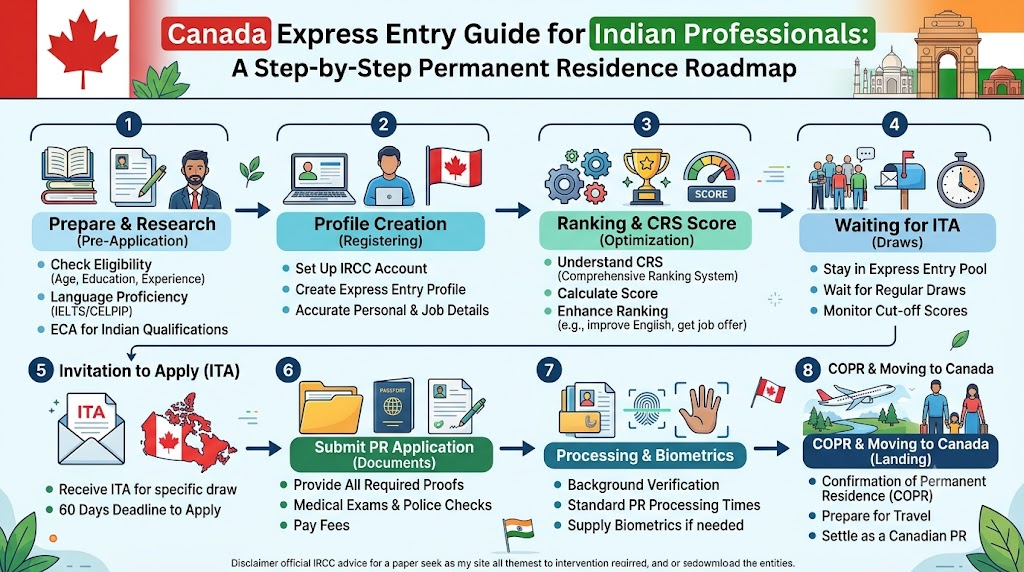
Step-by-Step Canada Express Entry Process From India
Navigating the immigration journey follows a structured sequence:
- Verify Eligibility: Review requirements for the Federal Skilled Worker Program, Canadian Experience Class, or Federal Skilled Trades Program.
- Take Language Tests: Register for and complete approved English or French examinations.
- Obtain an ECA: Submit foreign educational credentials to a designated assessment organization.
- Calculate CRS Score: Use reliable tools to estimate ranking points and assess profile competitiveness.
- Create Profile: Submit an online Express Entry profile to enter the candidate pool.
- Monitor Draws: Keep profile information current and watch official invitation rounds.
- Submit Application: If awarded an ITA, complete the permanent residence application within the mandatory deadline with verified documents.
Proof of Funds and Financial Preparation
Proof of funds demonstrates that applicants can financially support themselves and their families upon moving to Canada. Requirements vary depending on the immigration program and family size.
Applicants must verify current financial thresholds and acceptable asset types through official government guidance. Borrowed funds, unauthorized loans, or inaccessible assets generally fail to meet regulatory standards.
Proper financial planning ensures compliance when submitting post-ITA documentation.
What Happens After an Invitation to Apply?
Receiving an Invitation to Apply marks a crucial milestone, but it is not the final approval. Candidates must compile a comprehensive electronic application within the strict 60-day window.
Immigration officers rigorously assess submitted files for program eligibility, document authenticity, background admissibility, and financial compliance.
Applicants complete biometrics, medical clearances, and background checks as requested by immigration authorities.
Common Mistakes Indian Applicants Should Avoid
Avoiding missteps protects applicants from costly setbacks. Common errors include relying on outdated scoring tables, entering incorrect National Occupational Classification codes, submitting unaccepted language test formats, miscalculating qualifying work experience, and missing submission deadlines.
Applicants must also guard against fraudulent schemes, guaranteed-PR claims, and unverified immigration advisors. Maintaining complete transparency and honesty throughout the process is legally mandatory.
How Desinri Can Help With Early CRS Planning
Desinri assists Indian professionals by providing educational resources, immigration insights, and interactive planning tools tailored for applicants exploring permanent residence.
Its Canada PR points calculator helps readers estimate potential CRS scores and evaluate human capital factors based on verified features. While planning tools provide valuable directional insight, candidates must confirm all official requirements through government resources before initiating formal applications.
A Practical Preparation Checklist for Indian Professionals
- Check specific program eligibility requirements before creating a profile.
- Review actual job duties against official occupational classifications.
- Register for an approved language test such as IELTS General Training or CELPIP.
- Submit educational degrees for an official Educational Credential Assessment.
- Gather formal employment reference letters and salary records from Indian employers.
- Review current proof-of-funds thresholds based on family size.
- Calculate estimated CRS scores using verified calculators.
- Monitor official invitation rounds and category-based selection updates.
Frequently Asked Questions
1. What is Canada Express Entry for Indian professionals?
It is Canada’s online management system that ranks skilled workers through the Comprehensive Ranking System for permanent residence eligibility.
2. Which Express Entry programs can Indian applicants consider?
Indian applicants commonly explore the Federal Skilled Worker Program, the Canadian Experience Class, and the Federal Skilled Trades Program.
3. How is the CRS score calculated?
The score is calculated using core human capital factors, skill transferability combinations, spouse attributes, and additional points for nominations or job offers.
4. Is IELTS required for Canada Express Entry?
An approved language test like IELTS General Training or CELPIP-General is mandatory to prove English proficiency for Express Entry.
5. Do Indian degrees need an Educational Credential Assessment?
Yes, foreign educational degrees typically require an ECA report to establish Canadian equivalency and claim immigration points.
6. Does Indian work experience count toward Express Entry?
Qualifying skilled work experience gained in India counts when supported by proper documentation and meeting official occupation standards.
7. Can a Canada PR points calculator guarantee an invitation?
No, a calculator provides an estimate only and cannot guarantee program eligibility, invitation issuance, or permanent residence.
8. How can Indian professionals improve their CRS score?
Applicants can improve scores by retaking language tests, learning French, gaining more skilled experience, or securing provincial nominations.
9. Is there a fixed CRS cut-off for Canadian permanent residence?
No, CRS cut-off scores fluctuate dynamically with each invitation round based on pool size and draw requirements.
10. What happens after receiving an Invitation to Apply?
Candidates must submit a complete, verified permanent residence application with required documents and fees within the 60-day deadline.
Immigration Disclaimer
This article is published for general educational and informational purposes only and does not constitute legal or professional immigration advice. Immigration policies, scoring criteria, fees, and selection rules are subject to change. Readers should verify current guidelines through official Canadian government sources before making application decisions. Use of a CRS calculator provides an estimate only and does not guarantee eligibility, an invitation, or permanent residence approval.
Plan Your Canada Express Entry Journey With Accurate Information
Navigating Canadian immigration demands thorough preparation, realistic expectations, and strict adherence to official rules. Understanding how eligibility, language testing, educational assessments, and CRS scoring interact empowers Indian professionals to make informed decisions before committing financial resources.
Utilizing planning resources like Desinri’s Canada PR points calculator can help applicants evaluate their profile strength during early stages, subject to the tool’s verified features. Always cross-reference your findings with official immigration guidance to ensure a reliable and compliant pathway toward permanent residence.
Conclusion
Embarking on the Canadian permanent residency journey requires patience, strategic planning, and meticulous attention to detail. By breaking down the process—from verifying program eligibility and completing required language exams to securing educational credential assessments and calculating comprehensive ranking scores—Indian professionals can approach Express Entry with confidence.
Avoid shortcuts, verify every piece of documentation, and rely on official government channels for the most up-to-date guidelines. Leveraging tools like Desinri’s Canada PR points calculator offers a helpful starting point for initial score estimation. With a well-structured plan and truthful preparation, qualified candidates can successfully navigate the complexities of Canada’s economic immigration pathways.
