Introduction
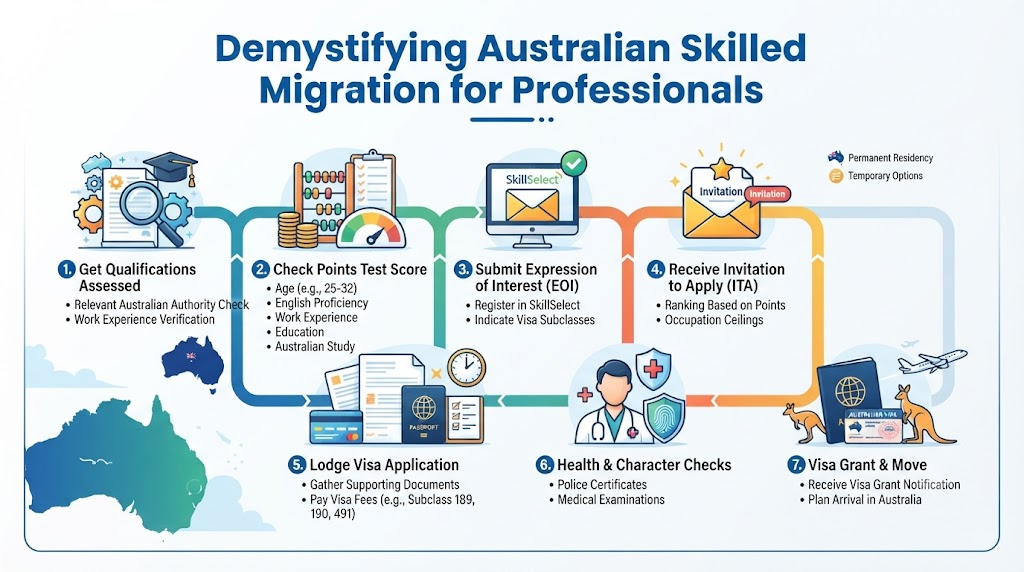
Exploring skilled migration to Australia opens up exciting career and lifestyle opportunities, but the journey often begins with a maze of information. When researching online, prospective applicants frequently encounter varying points scores, complex eligibility criteria, and multiple visa options. This can feel overwhelming, especially for first-time applicants unfamiliar with Australian immigration terminology. To manage skilled migration applications efficiently, the Australian Government uses an online management system called SkillSelect. This system handles Expressions of Interest (EOIs) for specific skilled migration pathways. Understanding how the points system works within SkillSelect is a crucial first step before submitting an EOI. However, it is important to remember that a points score is only one part of the skilled migration process. Meeting a points threshold does not automatically guarantee an invitation or visa approval. Applicants must also satisfy separate legal requirements, health and character checks, and occupation-specific criteria.
What Is SkillSelect in Australia?
SkillSelect is an online service provided by the Australian Government designed to manage skilled migration applications. Instead of submitting a direct visa application immediately, eligible applicants register their interest by lodging an Expression of Interest. Through this system, the Department of Home Affairs and state or territory governments can view candidate profiles. SkillSelect helps manage the invitation process for relevant skilled visa subclasses by matching available candidates with labor market needs and regional requirements. An EOI is not a formal visa application. Submitting an EOI does not grant a bridging visa, legal permission to remain in Australia, or a guarantee of an invitation. It simply serves as an expression of your desire to be considered for a skilled migration visa based on your declared credentials.
What Is the Australia SkillSelect Points Test?
The points test is an objective scoring mechanism used within Australia’s skilled migration framework. Its primary purpose is to assess and rank candidates based on employability and economic contribution factors. The test evaluates various attributes, including age, English language proficiency, educational qualifications, skilled employment history, and partner or nomination circumstances. Each category awards a specific number of points based on verified documentation. It is vital to distinguish between a points score and overall visa eligibility. While you may achieve a high points score, you must still meet all basic statutory requirements for your chosen visa subclass, such as holding a positive skills assessment and satisfying health criteria. The relevant points-tested visas maintain a minimum legislative threshold—currently set at 65 points for standard points-tested skilled visas. However, reaching this minimum threshold only makes you eligible to submit an EOI; it does not guarantee that you will receive an invitation to apply for a visa.
Which Australian Visas Use the SkillSelect Points System?
Australia’s points-tested skilled migration system primarily supports three main visa subclasses. Each visa serves a distinct purpose and carries separate conditions.
Skilled Independent Visa (Subclass 189)
This is a permanent residency visa that does not require sponsorship by an employer, family member, or state government. Applicants qualify based on their own merits, occupation demand, and points score.
Skilled Nominated Visa (Subclass 190)
This permanent residency visa requires nomination by an Australian state or territory government. Each state maintains its own occupation lists and selection criteria, aligning with local economic needs.
Skilled Work Regional (Provisional) Visa (Subclass 491)
This is a provisional visa designed to help fill skill shortages in regional Australia. It requires either nomination by a state or territory government or sponsorship by an eligible family member living in a designated regional area. Holders must live, work, and study in regional areas for a specified period before qualifying for permanent residence.
How the Australia SkillSelect Points System Works
Calculating your points correctly requires a systematic, step-by-step approach. Here is how the process generally unfolds:
- Identify Eligible Categories: Review the official points categories to determine which areas apply to your personal and professional profile.
- Assess Your Circumstances: Gather documentary evidence for your age, English test results, educational degrees, and employment history before calculating any points.
- Calculate Your Estimated Score: Use a reliable calculator to tally your points. Ensure that every claim is backed by verifiable proof.
- Declare Your Claims in an EOI: Submit your details accurately through SkillSelect. Inconsistencies between your EOI and your final visa application can lead to refusal.
The Department of Home Affairs rigorously assesses all claims against strict legal evidentiary requirements at the time of invitation.
Australia SkillSelect Points Breakdown
The points test rewards attributes that contribute to Australia’s workforce. Below is a structured overview of the primary points categories.
| Points Category | What It Covers | What Applicants Should Check |
| Age | Age at the time of the invitation | Applicable age brackets and visa age requirements |
| English Proficiency | Demonstrated English language ability | Accepted tests, required score thresholds, and test validity |
| Educational Qualifications | Recognised post-secondary degrees and diplomas | Qualification level and formal Australian study equivalence |
| Skilled Employment | Qualifying Australian and overseas work experience | Occupation relevance, qualifying weekly hours, and formal evidence |
| Australian Study | Eligible academic study completed in Australia | Course duration, study location, and institutional registration |
| Specialist Education | Masters by research or doctorate from an Australian institution | Specific STEM or research qualification criteria |
| Partner Qualifications | Partner’s age, English level, and skills assessment | Relationship status, partner English scores, and skills criteria |
| Other Eligible Factors | Professional Year, community language credentials | Current official guidelines and accreditation validity |
| Nomination or Sponsorship | State nomination or regional family sponsorship | Subclass conditions, regional commitments, and state criteria |
Age Points in Australia’s Skilled Migration System
Age plays a significant role in the points calculation, reflecting the government’s focus on long-term workforce participation. Points are awarded based on your age at the exact time an invitation is issued.
The age brackets and their general points distribution are structured to favor younger professionals:
- 18 to 24 years: 25 points
- 25 to 32 years: 30 points
- 33 to 39 years: 25 points
- 40 to 44 years: 15 points
- 45 to 49 years: 0 points
Applicants must be under 45 years of age at the time of receiving an invitation for subclasses 189, 190, and 491. Always verify your exact age eligibility against the specific date of potential invitation rounds.
English Language Points and Their Importance
Communication skills are vital for integration into the Australian workforce. The points test recognizes three tiers of English proficiency: competent, proficient, and superior.
- Competent English: Required as a baseline threshold for most skilled visas (e.g., IELTS score of 6.0 in each component), but awards 0 points.
- Proficient English: Awards 10 points (e.g., IELTS score of 7.0 in each component, or equivalent PTE Academic scores).
- Superior English: Awards 20 points (e.g., IELTS score of 8.0 in each component, or equivalent PTE Academic scores).
Accepted tests include IELTS, PTE Academic, TOEFL iBT, and Cambridge English (C1 Advanced). Applicants must check current test validity rules and score equivalencies before claiming points.
Educational Qualification Points
Your highest recognised educational qualification can substantially boost your points score. The system evaluates whether your overseas or Australian qualification meets educational standards comparable to an Australian Qualifications Framework (AQF) standard.
- Doctorate (PhD) from an Australian university or recognized overseas equivalent: 20 points
- Bachelor’s degree or higher: 15 points
- Diploma or trade qualification completed in Australia: 10 points
- Award or qualification recognised by the relevant assessing authority: 10 points
Obtaining a formal skills assessment and educational equivalence evaluation is essential before claiming these points.
Skilled Employment Points
Work experience must be highly relevant to your nominated skilled occupation to qualify for points. The system distinguishes between Australian and overseas skilled employment.
- Overseas Employment Experience (gained outside Australia in the last 10 years):
- 3 to less than 5 years: 5 points
- 5 to less than 8 years: 10 points
- 8 or more years: 15 points
- Australian Employment Experience (gained in Australia in the last 10 years):
- 1 to less than 3 years: 5 points
- 3 to less than 5 years: 10 points
- 5 to less than 8 years: 15 points
- 8 or more years: 20 points
A maximum of 20 combined employment points can generally be claimed. Employment must meet minimum weekly hours and be supported by tax records, employment contracts, and reference letters.
Australian Study and Specialist Education Points
Studying in Australia provides additional opportunities to earn points through specific academic achievements.
- Australian Study Requirement: Completing one or more degrees, diplomas, or trade qualifications in Australia as a result of a course of at least two academic years study awards 5 points.
- Specialist Educational Qualification: Holding a masters degree by research or a doctoral degree from an Australian educational institution that included at least two academic years of study in a specified science, technology, engineering, or mathematics (STEM) field awards 10 points.
Applicants must ensure their course meets all institutional registration and study duration criteria outlined by immigration authorities.
Partner Skills and Single Applicant Points
Partner circumstances can influence your total score in specific ways, acknowledging the presence or independence of a secondary applicant.
- Single Applicant: An applicant who does not have a partner, or whose partner is an Australian citizen or permanent resident, receives 10 points.
- Partner with Competent English and Suitable Skills Assessment: An applicant with a partner who holds competent English and a valid skills assessment for an occupation on the relevant skilled list receives 10 points.
- Partner with Competent English Only: An applicant whose partner has at least competent English (but no skills assessment) receives 5 points.
These rules ensure fairness while encouraging secondary applicants to maintain active workforce credentials.
Other Additional Points Categories
Beyond core professional attributes, several additional factors can contribute to your overall points score:
- Professional Year: Completing an approved Professional Year program in Australia in accounting, engineering, or IT fields awards 5 points.
- Credentialed Community Language: Passing a credentialing test (such as a NAATI accreditation) in an eligible community language awards 5 points.
- State Nomination or Regional Sponsorship: Receiving a nomination from an Australian state or territory government for subclass 190 awards 5 points, while regional nomination or family sponsorship for subclass 491 awards 15 points.
Always confirm that additional credentials remain valid and officially recognised at the time of your EOI submission.
Difference Between Subclass 189, 190, and 491 Points
While all three visas use the SkillSelect points framework, their invitation dynamics and nomination rules differ significantly.
| Visa Subclass | General Pathway | Key Feature | Important Consideration |
| Subclass 189 | Skilled Independent | Does not require state or family nomination | Requires an invitation based on competitive points and occupation ceilings |
| Subclass 190 | Skilled Nominated | Requires eligible state or territory nomination | Awards 5 bonus points; applicants must commit to living in the nominating state |
| Subclass 491 | Skilled Work Regional | Regional provisional skilled migration pathway | Awards 15 bonus points; strict regional residency and work conditions apply |
Understanding these distinctions helps applicants target the appropriate pathway based on their occupation and lifestyle preferences.
How to Calculate Your Australia SkillSelect Points
Estimating your points score involves a methodical review of your credentials. Follow these practical steps:
- Verify Your Age: Note your age as of the current date and check your bracket limits.
- Assess English Results: Check official score reports from accepted English language tests.
- Review Qualifications: Confirm your degree recognition and Australian study duration.
- Audit Work History: Count only formal, paid, full-time equivalent employment that aligns with your nominated occupation.
- Add Bonus Points: Include partner criteria, state nomination, or professional year credentials if fully verified.
Illustrative Calculation Example
Consider a hypothetical applicant, Rohan, aged 29 (30 points), with a Bachelor’s degree (15 points), 4 years of overseas skilled employment (10 points), and a PTE score yielding Superior English (20 points). As a single applicant (10 points), his estimated total score equals 85 points. This is purely a hypothetical example; actual scores depend entirely on verified personal documents.
How Desinri’s Australia PR Points Calculator Can Help
Navigating complex calculations can be challenging for first-time applicants. Desinri’s Australia PR Points Calculator serves as a helpful online resource for exploring an estimated points score. The calculator allows you to input your credentials across various categories to understand how different factors contribute to your potential score. It helps identify strengths and highlights areas that require closer verification. While a calculator provides a useful preliminary estimate, it cannot predict invitation outcomes, confirm official eligibility, or guarantee visa approval. It should be used as an educational starting point alongside official government guidelines.
Understanding the Expression of Interest (EOI) Process
Submitting an EOI is a critical milestone in the migration journey. The process requires careful attention to detail:
- Select the Correct Visa Subclass: Choose between independent, nominated, or regional pathways based on your eligibility.
- Nominate an Appropriate Occupation: Ensure your nominated occupation matches your skills assessment and is listed on the relevant skilled migration occupation list.
- Ensure Consistency: Verify that every claim made in your EOI matches the supporting documents you plan to upload later.
Submitting an EOI is free of government charges, but accuracy is paramount to avoid delays or administrative complications.
How SkillSelect Invitations Work
Receiving an invitation to apply for a skilled visa depends on several dynamic factors managed through periodic invitation rounds.
- Points Ranking: Applicants with higher points scores are generally prioritized within their respective occupation groups.
- Occupation Ceilings and Priorities: Government economic priorities and labor market demands dictate how many invitations are issued for specific occupations.
- Tie-Break Rules: When multiple candidates hold the same points score, date-and-time stamps of EOI submission may be used to manage allocations.
Invitation dynamics vary considerably between independent, state-nominated, and regional subclasses. Meeting the minimum points threshold does not guarantee an invitation.
What Happens After Receiving an Invitation?
Receiving an invitation letter through SkillSelect marks the beginning of the formal visa application stage.
- Review Invitation Details: Carefully check the nominated occupation, visa subclass, and personal details listed on your invitation.
- Prepare Supporting Evidence: Compile certified copies of identity documents, English test score reports, skills assessments, employment references, and police clearances.
- Lodge the Visa Application: Submit your formal application and pay the required visa application charges within the strict timeframe specified in your invitation (usually 60 days).
Substantiating every claim made in your EOI with verifiable evidence is mandatory for successful visa processing.
Common Mistakes When Calculating SkillSelect Points
Applicants often encounter pitfalls that lead to miscalculated points or refused applications. Avoiding these common mistakes is essential:
- Using Outdated Points Tables: Relying on old rules or unverified online forums can result in inaccurate score assumptions.
- Claiming Ineligible Employment: Counting informal work, part-time hours below threshold requirements, or unverified experience.
- Misunderstanding English Test Levels: Assuming partial scores meet superior or proficient thresholds without official grade conversions.
- Assuming All Qualifications Qualify: Claiming points for degrees that lack proper Australian educational equivalence or relevant skills assessments.
- Overlooking Partner Conditions: Claiming partner points without ensuring the partner holds valid English test results and a positive skills assessment.
Double-checking your credentials against official criteria safeguards the integrity of your migration profile.
Practical Ways to Review Your SkillSelect Points Profile
Reviewing your profile proactively helps maintain accuracy before and after submitting an EOI:
- Audit Your Documents: Inspect your certificates, reference letters, and passport validity dates.
- Identify Gaps: Determine if improving your English test score or completing a professional year could enhance your profile.
- Track Personal Changes: Keep track of milestones such as birthdays or work anniversary dates that might affect your age points or employment tiers.
Updating your EOI promptly when personal circumstances change ensures your profile remains accurate and compliant with official rules.
Australia SkillSelect Points System for Indian Applicants
Indian graduates, tech professionals, and families frequently explore Australian skilled migration pathways due to strong career prospects. When preparing an application, Indian applicants should carefully review how overseas degrees and professional experience are evaluated. Indian academic qualifications must be assessed by the relevant Australian assessing authority to determine formal comparability. Similarly, work experience must be substantiated with official tax documents, employer reference letters, and salary statements. Obtaining the correct skills assessment for your specific ANZSCO occupation code is a vital prerequisite. Indian applicants do not receive special points solely based on nationality; all applications are assessed against uniform federal standards.
How Desinri Helps Readers Explore Australian PR Information
Desinri functions as a dedicated immigration information platform designed to help readers explore PR points calculators and migration-related educational guidance. Through its Australia PR points calculator and detailed articles, the platform breaks down complex immigration policies into digestible steps. It empowers readers to understand how the points system operates and encourages thorough preparation. Always use educational resources like Desinri alongside official Australian Government sources to ensure complete accuracy in your migration planning.
Frequently Asked Questions
1. What is Australia’s SkillSelect points system?
SkillSelect is an online management system used by the Australian Government to process Expressions of Interest for skilled migration visas based on a points-tested framework.
2. How many points are required for Australian skilled migration?
The minimum legislative threshold is 65 points for standard points-tested skilled visas, though competitive invitation scores often require higher totals depending on the occupation.
3. Which factors affect the SkillSelect points score?
Key factors include age, English language proficiency, educational qualifications, skilled employment history, Australian study, partner attributes, and state or regional nomination.
4. How are age points calculated for Australian PR?
Points are awarded based on your age at the time an invitation is issued, with the highest points awarded to applicants aged between 25 and 32 years.
5. Do English test results increase SkillSelect points?
Yes. Achieving Proficient English awards 10 points, while Superior English awards 20 points, compared to Competent English which awards no additional points.
6. What is the difference between subclass 189, 190, and 491?
Subclass 189 is an independent permanent visa, subclass 190 requires state nomination for permanent residency, and subclass 491 is a provisional regional visa requiring regional residency.
7. Does reaching the minimum points score guarantee an invitation?
No. Meeting the minimum threshold only allows you to submit an EOI; invitations depend on occupation ceilings, government priorities, and competitive ranking.
8. How can I calculate my Australia SkillSelect points?
You can calculate your estimated points by evaluating your credentials against official criteria or by using online tools like Desinri’s Australia PR Points Calculator.
9. Can Indian work experience and qualifications earn Australian PR points?
Yes, provided they are officially assessed and verified as comparable to Australian standards by the relevant assessing authority and supported by formal documentation.
10. How can Desinri’s Australia PR Points Calculator help applicants?
It helps applicants explore an estimated points score, understand contributing categories, and identify areas that require further verification before submitting an EOI.
Conclusion
Navigating Australia’s SkillSelect points system requires careful planning, accurate self-assessment, and a clear understanding of how different professional and personal factors contribute to your score. While calculating your estimated points is a vital first step, remember that a points score is only one part of the broader skilled migration process. Invitations depend on competitive selection rounds, occupation demands, and specific visa pathways. Utilizing educational resources like Desinri can help you explore PR points information effectively alongside official Australian Government guidelines. Take the next step in your research today by reviewing your estimated points profile, verifying your supporting evidence, and preparing responsibly for your skilled migration journey.
