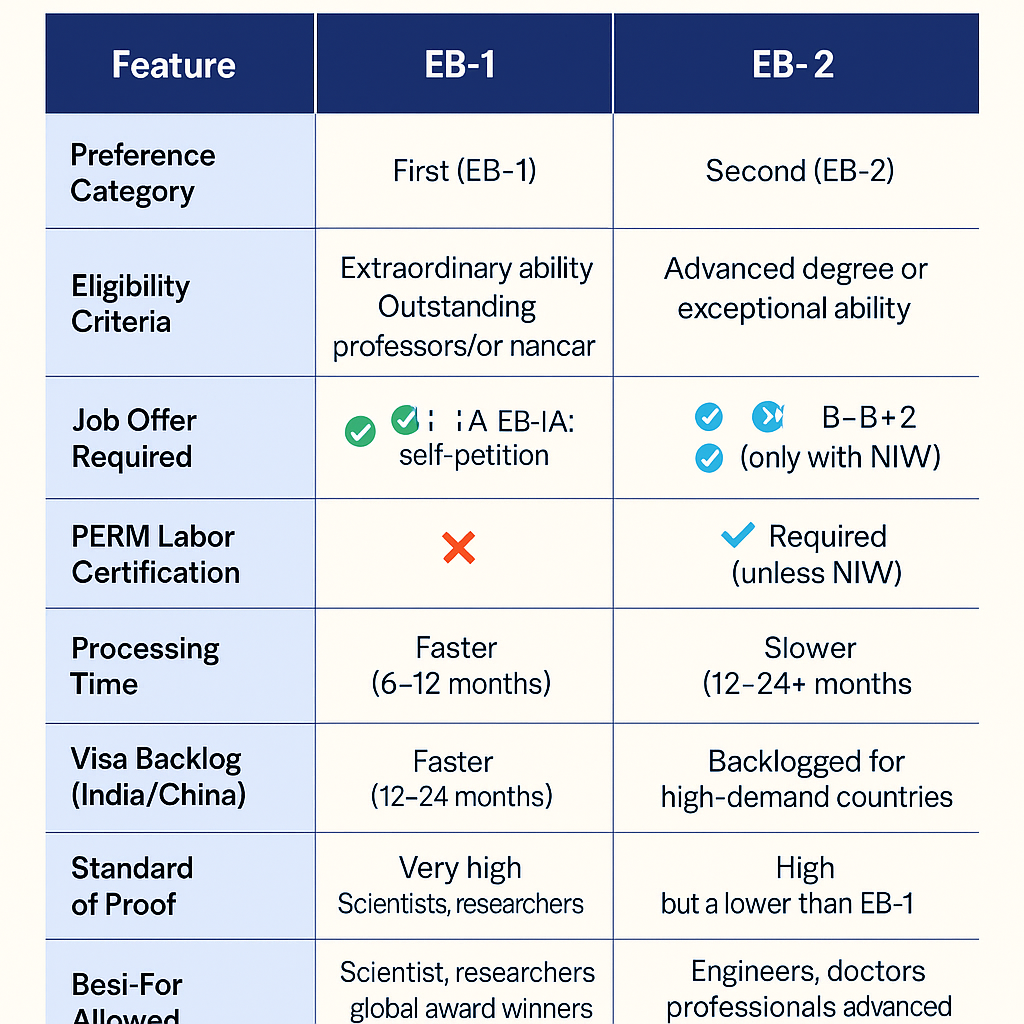
Here is a comprehensive breakdown of the difference between the EB-1 and EB-2 immigrant visas for the United States, including eligibility, processing, advantages, and a full comparison table.
The EB-1 and EB-2 visas are both employment-based immigrant visas that lead to a U.S. Green Card (permanent residency). However, they differ in eligibility, preference level, priority dates, and documentation requirements.
🥇 EB-1 Visa: First Preference
🔹 What is EB-1?
EB-1 is an employment-based first preference visa for individuals with extraordinary ability, outstanding researchers/professors, or multinational executives/managers.
✅ Key EB-1 Subcategories:
| Subcategory | Description |
|---|---|
| EB-1A Extraordinary Ability | For individuals in sciences, arts, education, business, or athletics with national/international acclaim (e.g., Nobel, Olympic medalists). No employer needed. |
| EB-1B Outstanding Professors/Researchers | Requires international recognition and job offer from U.S. employer. |
| EB-1C Multinational Managers/Executives | For managers/executives transferring to U.S. branch of international company. |
📌 Advantages:
- No PERM labor certification required
- Faster processing and often no visa backlog
- EB-1A does not require a job offer
🥈 EB-2 Visa: Second Preference
🔹 What is EB-2?
EB-2 is an employment-based second preference visa for individuals with:
- Advanced degrees (Master’s or higher)
- Or exceptional ability in sciences, arts, or business
✅ Key EB-2 Subcategories:
| Subcategory | Description |
|---|---|
| EB-2A Advanced Degree Professionals | Requires a job offer and labor certification |
| EB-2B Exceptional Ability | Similar to EB-1A but with lower threshold. Requires job offer and PERM |
| EB-2 NIW (National Interest Waiver) | No job offer or PERM required if work is in the national interest |
📌 Advantages:
- Easier eligibility than EB-1
- NIW allows self-petitioning (no job offer)
🔍 Detailed Comparison Table
| Feature | EB-1 | EB-2 |
|---|---|---|
| Preference Category | First (EB-1) | Second (EB-2) |
| Eligibility Criteria | Extraordinary ability, Outstanding professor, or Multinational manager | Advanced degree or exceptional ability |
| Job Offer Required | EB-1A: ❌ (self-petition) EB-1B/EB-1C: ✅ | EB-2A/2B: ✅ EB-2 NIW: ❌ (self-petition) |
| PERM Labor Certification | ❌ Not required | ✅ Required (unless NIW) |
| Processing Time | Faster (6–12 months) | Slower (12–24+ months) |
| Visa Backlog (India/China) | Often no backlog (esp. EB-1A) | Backlogged for high-demand countries |
| Standard of Proof | Very high (national/international recognition) | High (but lower than EB-1) |
| Best For | Scientists, researchers, global award winners, execs | Engineers, doctors, professionals with advanced degrees |
| Self-Petition Allowed | ✅ EB-1A only | ✅ Only with NIW |
🧪 Real Examples
| Occupation/Background | Likely Visa Route |
|---|---|
| PhD Scientist with global publications | EB-1A or EB-2 NIW |
| Indian Software Engineer with M.S. in U.S. | EB-2 with PERM |
| Olympic Medalist Coach | EB-1A |
| Postdoc Researcher with citations | EB-1B or EB-2 NIW |
| Executive of multinational company | EB-1C |
💡 Tips for Choosing Between EB-1 and EB-2
- If you qualify for EB-1A, it is much faster and avoids labor certification.
- If EB-1A is not feasible, EB-2 NIW is a strong alternative without needing employer sponsorship.
- For candidates from India or China, EB-1 usually has shorter wait times than EB-2.
📚 Final Notes
- Both EB-1 and EB-2 lead to green cards, but EB-1 is more prestigious and faster.
- EB-2 has broader eligibility and includes the NIW option to self-petition.
- You can apply for both EB-1 and EB-2 simultaneously (dual filing) to improve your chances.
