Introduction
Moving to Canada is more than just a change of address; it is a profound step toward a life defined by global opportunity, career security, and long-term prosperity. Whether you are an IT professional looking to join the tech boom in Toronto or a healthcare worker ready to serve communities in the provinces, your journey begins with the Canada PR Points Calculator.
The immigration landscape is competitive, but it is also transparent. By understanding the Comprehensive Ranking System (CRS), you transition from a passive observer to a strategic applicant. This guide serves as your authoritative resource for the 2026 Express Entry system, providing the technical insights, scoring frameworks, and actionable strategies you need to maximize your potential for a permanent residence invitation.
What Is the Canada PR Points Calculator?
The Canada PR Points Calculator is a specialized tool that evaluates your profile against the CRS. The CRS is the backbone of Canada’s economic immigration strategy—a merit-based system that ranks candidates in the Express Entry “pool” to ensure the country attracts talent that can immediately contribute to the economy.
How It Works
When you submit an Express Entry profile, the system assigns you a CRS score out of 1,200 points. This score is dynamic; it reflects your age, education, language ability, and work history. IRCC regularly conducts “draws,” where they issue Invitations to Apply (ITA) to candidates who meet or exceed the cut-off score for that specific round.
- Eligibility vs. Competitiveness: You may meet the minimum eligibility requirement (67 points for Federal Skilled Worker) but still fall short of the competitive CRS cut-off. Your goal is to maximize your CRS score to ensure your profile sits comfortably above the thresholds seen in recent draws.
How the Canada PR Points System Works
Your CRS score is built upon four foundational pillars. Each factor is weighted to prioritize candidates who are best positioned for long-term integration into Canada.
Table 1: Core CRS Score Breakdown
| Factor Category | Focus Area | Max Potential Points |
| Core Human Capital | Age, Education, Language, Work Exp | 500 |
| Skill Transferability | Education/Language combinations | 100 |
| Spouse Factors | Spouse’s language/education/work | 40 |
| Additional Points | PNP, Job Offer, Sibling in Canada | 600 |
Scoring Breakdown
- Age: The system favors youth, with maximum points awarded between the ages of 20 and 29. After 30, you lose roughly 5–6 points annually.
- Education: An Educational Credential Assessment (ECA) is non-negotiable for degrees earned outside Canada. A PhD or Master’s provides the highest ceiling for points.
- Language Proficiency: This is your strongest lever. Higher CLB levels (Canada Language Benchmark) directly correlate to significant point increases in both your human capital and skill transferability scores.
Canada Express Entry System Explained
Express Entry is the digital gateway to three major federal programs, plus the Provincial Nominee Program (PNP):
- Federal Skilled Worker Program (FSWP): For international professionals with skilled work experience.
- Canadian Experience Class (CEC): For those who have already established a work history within Canada.
- Federal Skilled Trades Program (FSTP): For qualified tradespeople in fields like construction or manufacturing.
- Provincial Nominee Program (PNP): Provinces “nominate” candidates who match specific local labor shortages. A nomination is a “game-changer,” adding 600 points to your profile.
Step-by-Step Example Calculation
Consider a 29-year-old candidate with a Master’s degree and CLB 9 English skills:
- Age (29): 110 points.
- Education (Master’s): 135 points.
- Language (CLB 9): 124 points.
- Foreign Work (3 years): 60 points.
- Skill Transferability (Education + Language): 50 points.Estimated Total: 479 points.
How to Improve Your CRS Score
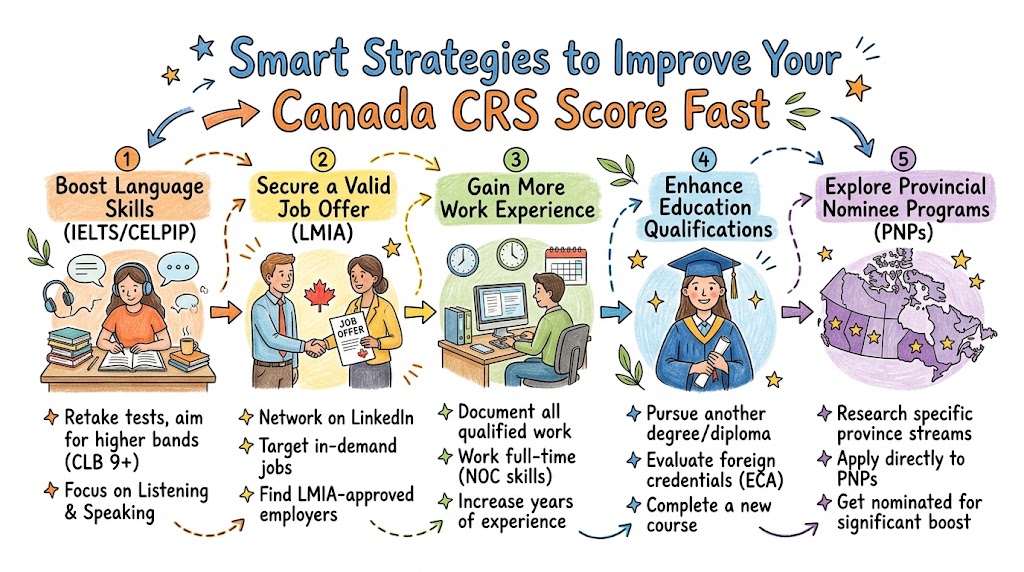
In 2026, the strategy has shifted from “general” draws to “targeted” category-based draws. If your score is under 500, focus on these tactical improvements:
- Retake Language Tests: Moving from CLB 8 to CLB 9 can add over 30 points to your total.
- Learn French: Achieving NCLC 7 in French grants a 50-point bonus and opens the door to French-specific draws, which often have significantly lower cut-offs.
- Targeted Provincial Nominations: Research provinces that prioritize your specific NOC code. A PNP nomination is the most reliable way to secure an ITA.
- Gain Experience: If you are already working in Canada, every year of additional experience adds to your score.
Table 2: Strategies for Rapid Score Improvement
| Strategy | Potential Gain | Difficulty Level |
| Provincial Nomination | +600 points | High |
| French Proficiency (NCLC 7) | +50 points | Medium |
| Language Test (IELTS/CELPIP upgrade) | +20 to +40 points | Low/Medium |
| Sibling in Canada | +15 points | Fixed |
| Additional Degree/ECA | +15 to +30 points | Medium |
Common Mistakes to Avoid
- Incorrect NOC Code: Choosing the wrong National Occupation Classification can lead to your application being rejected for misrepresentation.
- Ignoring Spousal Points: Failing to include your spouse’s education or language credentials can cost you up to 40 valuable points.
- Expired Results: Ensure your IELTS/CELPIP and ECA results are valid before hitting “Submit.”
- Misunderstanding Draw Types: Don’t wait for a general draw if your profile aligns with a specific category (e.g., Healthcare, STEM, or French-speaking).
Real-Life Case Studies
Case 1: The IT Professional
A 27-year-old developer with a Bachelor’s degree.
- Initial Score: 430.
- Strategy: Spent three months improving English to CLB 10.
- Result: Score rose to 465, resulting in an ITA through a tech-focused category draw.
Case 2: The Healthcare Specialist
A nurse with a stable but average score.
- Initial Score: 390.
- Strategy: Targeted a healthcare-specific PNP stream in a western province.
- Result: Received a provincial nomination; final score reached 990.
Case 3: The Married Duo
A couple with moderate individual profiles.
- Initial Score: 410.
- Strategy: Used the spouse’s Master’s degree and English proficiency.
- Result: Added 30 points combined, crossing the threshold for their required program.
FAQs
- What is a good CRS score in 2026? Aim for 480+, though category-based draws for French or Healthcare candidates often occur in the 390–470 range.
- Can I apply without a job offer? Yes, under FSWP, a job offer is not strictly required, though it can provide extra points.
- Is IELTS mandatory? Yes, or CELPIP for English and TEF/TCF for French.
- Does age affect my score negatively? Yes, after age 30, points decrease annually.
- Which province is the easiest for PR? There is no “easiest”; focus on provinces with streams that value your specific NOC code.
- How do I get an extra 600 points? You must secure a Provincial Nomination.
- Is work experience outside Canada counted? Yes, but Canadian work experience is weighted more heavily.
- Can I update my profile after submission? Yes, you can update your profile as your credentials change.
- What is the minimum language level? CLB 7 is typically the baseline for eligibility.
- How long does the process take? Most Express Entry applications are processed within 6–8 months after receiving an ITA.
- Do I need a consultant? It’s not mandatory, but professional guidance can ensure your NOC selection and document preparation are error-free.
- What if my PR application is returned? Review the rejection letter carefully; most often, it is due to missing documents or fees.
Conclusion: Taking Control of Your Future
The path to Canadian permanent residence is a journey of precision and preparation. While the Express Entry system may appear complex, it is ultimately a logical, data-driven process. By mastering the variables—improving your language proficiency, strategic degree assessment, and exploring targeted provincial streams—you transform your application from a “hopeful” entry into a “highly competitive” one.
Do not be discouraged by the fluctuations in cut-off scores; instead, let them serve as a roadmap for your own growth. Your effort today is an investment in a future where you, your family, and your career can flourish. The system is designed for those who demonstrate intent, competence, and readiness. Start your evaluation today, refine your profile, and move forward with confidence. The doors to Canada are open for those who prepare.
