Introduction
Are you dreaming of building a professional life in the heart of Europe? Austria, with its breathtaking alpine landscapes, world-class social security, and a robust, stable economy, is one of the most sought-after destinations for global professionals. However, navigating the Austrian immigration landscape can feel like trying to solve a complex puzzle.
The key to unlocking your future in Austria lies in the Austria PR Points Calculator. This system is not just a hurdle; it is a transparent roadmap that dictates your eligibility for the famous Red-White-Red (RWR) Card. Whether you are a software developer, an engineer, a healthcare professional, or an ambitious entrepreneur, this guide will serve as your expert companion in deciphering the points-based system and securing your place in Austria.
What Is the Austria PR Points Calculator?
The Austria PR Points Calculator is an official-style assessment tool designed to evaluate your profile against the labor market needs of Austria. It serves as the preliminary gatekeeper for the Red-White-Red Card.
Purpose and Functionality
Austria utilizes a points-based immigration system to ensure that new residents can contribute meaningfully to the country’s economic growth. When you use the calculator, you are essentially quantifying your “human capital”—your education, professional experience, age, and language proficiency.
Eligibility vs. Approval
It is vital to distinguish between a calculator estimate and formal approval. The calculator acts as your “personal audit.” By inputting your credentials, you get a realistic view of where you stand. However, the final decision rests with the Public Employment Service (AMS) and the immigration authorities, who verify your documents against the Austrian legal requirements.
Understanding the Red-White-Red Card System
The Red-White-Red Card is your primary gateway to working and living in Austria. Unlike generic work visas, the RWR Card is a personalized permit that ties you to a specific employer while eventually granting you a pathway to permanent residency.
Key Categories of the RWR Card
| Category | Target Audience | Primary Requirement |
| Very Highly Qualified | Top-tier professionals, researchers, academics | High qualification points, no initial job offer needed |
| Skilled Workers in Shortage Occupations | Nurses, engineers, IT experts, specialized trades | Job offer in an occupation currently on the national shortage list |
| Other Key Workers | Skilled professionals in any sector | Specific job offer with a minimum salary threshold |
| Startup Founders | Innovative entrepreneurs | A viable, scalable business plan approved by the government |
The Core Scoring Pillars: How Points Are Awarded
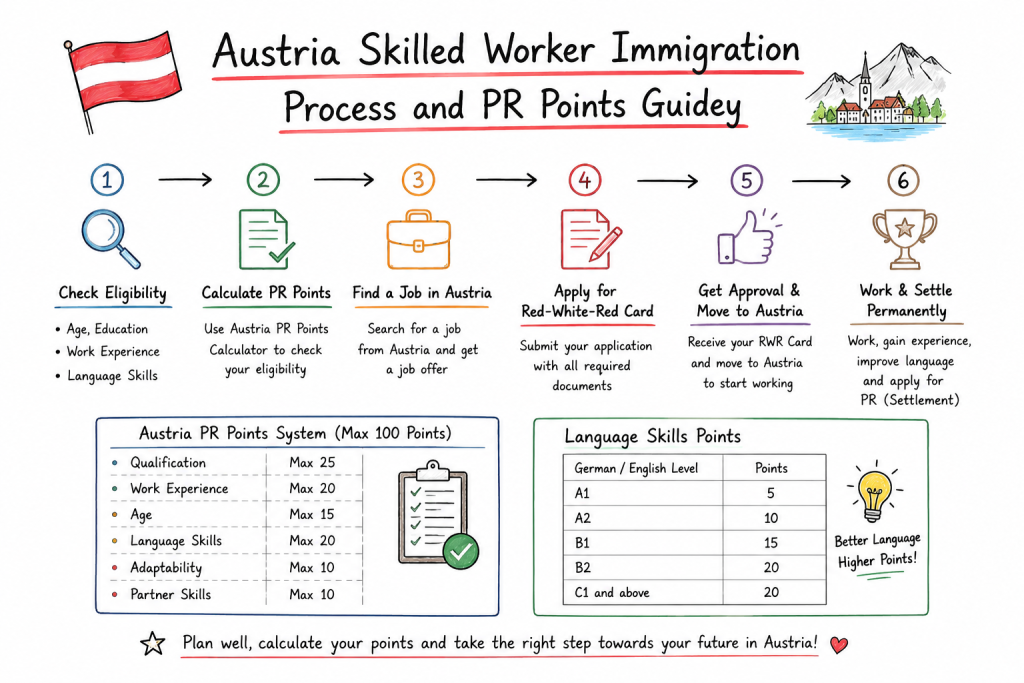
To secure an RWR Card, you must reach a minimum number of points (usually 55 or 70 depending on the category). Here is how the points system breaks down:
1. Education (Up to 30 Points)
Your academic background is the bedrock of your score. A Bachelor’s degree typically fetches 20 points, while a Master’s or a PhD can push you to the maximum.
2. Work Experience (Up to 20 Points)
Experience is valued at roughly 2 points for every full year of relevant service. The beauty of this system is that it rewards consistency.
3. Language Skills (Up to 25 Points)
Austria places high value on integration. German language certificates (A1, A2, B1, etc.) can significantly boost your total. English proficiency is also acknowledged, especially in international industries like IT.
4. Age (Up to 20 Points)
The system favors younger professionals who have a longer career runway ahead of them. Those under 30 usually receive the maximum points in this category.
5. Bonus Points (Up to 20 Points)
These are your “game-changers.” You can earn bonus points for studying in Austria, having a high-earning job offer, or being in a high-demand shortage occupation.
Detailed Points Breakdown for Aspiring Applicants
To better understand how these pieces fit together, consider the following structural breakdown of a typical application:
| Factor | Points Calculation Logic |
| Education | 20 points for Bachelor’s / 30 points for Master’s/PhD |
| Age | 20 points (<30 years) / 15 points (30–40 years) |
| Experience | 2 points per year of relevant experience |
| Language | 10–25 points depending on certification level |
| Shortage Occupation | +30 points if the job is on the official national list |
Step-by-Step Application Process
Moving to Austria is a journey, not a sprint. Follow these steps to keep your progress on track:
- Self-Assessment: Use the PR points calculator to determine if you meet the minimum threshold (e.g., 55/70 points).
- Document Verification: Gather your academic transcripts, reference letters, and language certificates. Ensure they are apostilled or translated if necessary.
- Job Hunting: For most categories, you need a valid employment contract from an Austrian company. Tailor your CV to meet the specific requirements of the Austrian market.
- Submission: Submit your application through the Austrian embassy in your home country.
- AMS Evaluation: The AMS will review your credentials to ensure your skills meet the requirements for your specific visa category.
- Visa Issuance: Once approved, you will receive a D-visa to enter Austria, where you will eventually collect your RWR Card.
Strategies to Maximize Your Points
If you find yourself slightly below the required threshold, do not lose hope. Here is how you can proactively increase your score:
- Elevate Your German: Even moving from A1 to A2 proficiency can bridge the gap in your points total. It demonstrates genuine intent to integrate.
- Target Shortage Occupations: Review the official Austrian shortage list. If your skillset is in demand, you can earn significant bonus points.
- Upskill: Sometimes, taking a short-term certification course or a postgraduate degree can add the extra points needed to qualify.
- Secure a Competitive Offer: Since salary levels are tied to points, negotiating a higher starting salary can sometimes unlock bonus points for “Key Workers.”
Real-Life Examples: From Calculation to Residency
Example 1: The Tech Specialist
- Profile: 29-year-old Software Developer from India, 5 years of experience, Bachelor’s degree, German A1.
- Calculation: Age (20) + Education (20) + Experience (10) + Language (5) + Shortage Occupation Bonus (30) = 85 Points.
- Outcome: Well above the threshold for the “Shortage Occupations” category. Approval is highly likely.
Example 2: The Marketing Professional
- Profile: 35-year-old Marketing Manager, 8 years of experience, Master’s degree, No German skills.
- Calculation: Age (15) + Education (30) + Experience (16) + Language (0) = 61 Points.
- Outcome: Eligible under the “Key Worker” category if they can secure an offer that meets the salary requirements.
Addressing Common Mistakes
- Failing to Verify Documents: Many applicants fail because their academic credentials were not officially recognized or translated.
- Ignoring the Shortage List: Many miss out on 30 bonus points simply because they didn’t check if their specific job title was on the shortage list.
- Underestimating Language: Assuming that English is enough is a common pitfall. While possible for high-level IT roles, German is almost always a requirement for long-term residency.
FAQs: Your Burning Questions Answered
- What is the Austria PR Points Calculator? An estimation tool to assess eligibility for the RWR card.
- Is German required for PR? Yes, B1/B2 level is usually needed for long-term integration and eventual PR (RWR Plus).
- How many points are needed? Typically 55 for Skilled Workers and 70 for Highly Qualified.
- Can I apply without a job offer? Only as a “Very Highly Qualified” worker for a six-month job seeker visa.
- How long does the RWR Card take? Generally 8 to 12 weeks after submission.
- Can I convert RWR to PR? Yes, after 24 months of working under the RWR system, you can transition to RWR Plus (PR).
- Is age a disadvantage? It is a factor, but not a dealbreaker if you have high education and experience points.
- Does my family get to move with me? Yes, the RWR system allows for family reunification.
- What if I change jobs? You must notify the authorities and ensure your new job meets the criteria.
- Is the cost high? The application fees are reasonable, but you must prove financial stability.
Conclusion: Take Control of Your Austrian Journey
The decision to migrate is a monumental step in your personal and professional journey. Austria offers more than just a job; it offers a culture of excellence, safety, and a standard of living that is the envy of the world. By mastering the Austria PR Points Calculator today, you are shifting from a passive dreamer to an active architect of your future.
Remember, the immigration process rewards those who are prepared, organized, and proactive. Don’t let the complexity of the points system overwhelm you. Instead, view it as a clear set of requirements—a ladder that you can climb one step at a time. Whether it is improving your German, gaining that extra year of experience, or targeting a high-demand shortage occupation, every action you take now brings you closer to your goal.
The doors to Austria are open to those with the right skills and the determination to succeed. Start your assessment, organize your documentation, and set your sights on the Alps. Your new life in Europe is closer than you think.
