Introduction
Planning to move to Canada as a permanent resident is a big life step. For many skilled professionals and graduates in India, the journey starts with the Express Entry system. When you begin researching this path, you will quickly hear about the Comprehensive Ranking System and the need to calculate your score. Understanding how your profile matches up before you submit an application can save you time, money, and effort. Many people want to know their possible score before starting official paperwork. Using an online tool like a Canada PR points calculator can give you a clear, early idea of where you stand. Your total score depends on several personal and professional details, including your age, level of education, language abilities, work experience, and spouse details if applicable.
The DesiNRI Canada PR Points Calculator is a useful tool designed to help Indian applicants estimate their Comprehensive Ranking System score quickly. While official invitations and final rules are managed by Immigration, Refugees and Citizenship Canada, using a reliable estimator is a smart first step to understand your profile.
What Is the Canada PR Points Calculator?
A Canada PR points calculator is an online tool that estimates your Comprehensive Ranking System score. It takes the information you provide about your background and applies the official scoring rules set by the Canadian government. When you use a calculator, you input details such as your age, highest education degree, test scores in English or French, years of skilled work experience, and information about your partner if you are married. The tool then calculates an estimated score.
It is important to understand the difference between an estimate and an official score. An online calculator gives you a preliminary number based on the details you enter. Your official score is determined only after you submit your profile into the Express Entry pool and the government reviews your verified documents.
The DesiNRI calculator is designed to provide an instant score estimate by following the current scoring grid closely. It breaks down your points into different categories so you can see which areas of your profile are strong and which ones might need improvement.
What Is CRS in Canada Express Entry?
CRS stands for Comprehensive Ranking System. It is the points-based system that the Canadian government uses to score and rank profiles of candidates who want to immigrate through Express Entry.
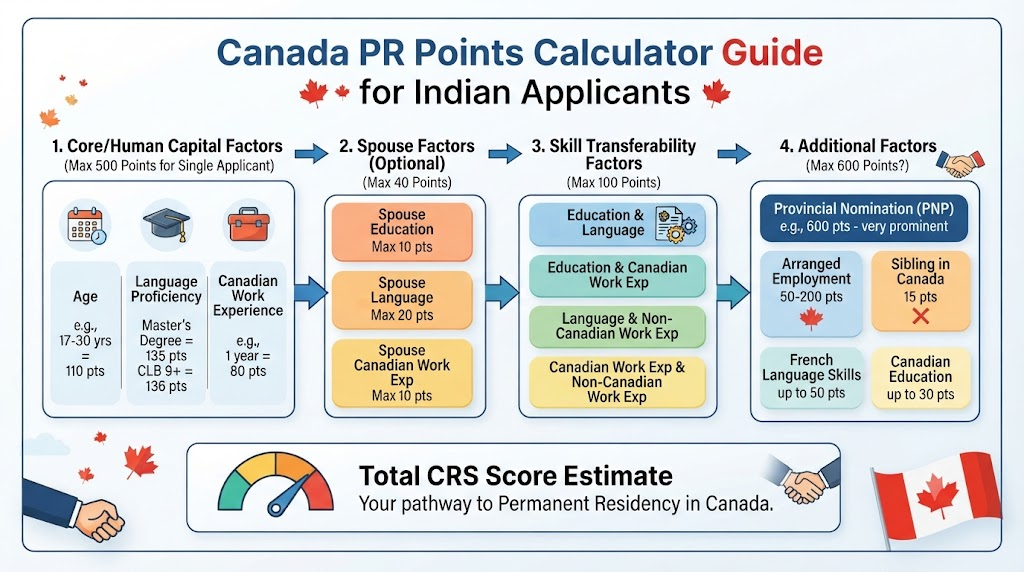
When you create an Express Entry profile, you enter the pool of eligible candidates. The government does not look only at whether you qualify; it also ranks everyone in the pool using their CRS score. Under the current system, the total score can go up to 1,200 points. These points are divided into core factors for the principal applicant, spouse factors if applicable, skill transferability combinations, and additional points for specific achievements like provincial nominations or Canadian study.
Candidates who hold the highest-ranking scores in the pool are the ones who receive an Invitation to Apply for permanent residence during regular invitation rounds.
CRS Score vs Express Entry Eligibility
One of the most common confusions for beginners is mixing up Express Entry eligibility with CRS scoring. They are two entirely different steps in the immigration process.
Before your CRS score even matters, you must first qualify for one of the main federal immigration programs managed through Express Entry. These programs include the Federal Skilled Worker program, the Federal Skilled Trades program, and the Canadian Experience Class. Each program has its own minimum requirements for work experience, language proficiency, and education.
Meeting the minimum program requirements allows you to enter the Express Entry pool. Once you are inside the pool, the Comprehensive Ranking System is applied to give you a score. Having a high CRS score is wonderful, but it does not let you bypass the basic program eligibility rules. You must meet both requirements to successfully immigrate.
How the Canada PR Points Calculator Works
Using an online calculator is straightforward when you have your basic documents and test results ready. The process usually involves moving through a series of simple sections where you select or type your personal details.
To get an accurate estimate, you typically need to provide:
- Your current marital status and whether your partner will move with you
- Your exact date of birth to calculate your age points
- Your highest level of education and whether you have completed an educational credential assessment
- Your language test results for English or French across all four abilities
- Your number of years of skilled work experience inside Canada and outside Canada
- Any additional factors, such as having a sibling living in Canada, a provincial nomination, or a degree from a Canadian institution
The DesiNRI calculator organizes these inputs into clear sections covering core human capital factors, spouse factors, skill transferability, and additional points. Once you fill in all the correct fields, the tool instantly totals your points and displays your estimated CRS score.
CRS Points for Age
Age plays a major role in how the Comprehensive Ranking System calculates your core points. The scoring system favors younger applicants who have more potential working years ahead of them in the Canadian labor market.
Under current official rules, candidates receive the highest number of points for age if they are between 20 and 29 years old. If you are a single applicant, you can earn up to 110 core points for your age during this window. If you apply with a spouse, the maximum core points for age is 100.
As you grow older past age 29, your age points begin to reduce gradually with every passing year. By the time you reach 45 years or older, your core points awarded for age drop to zero. This is why many young Indian professionals prefer to start their immigration research early rather than waiting. When using a calculator, make sure to enter your exact birthdate so your age points are calculated correctly.
CRS Points for Education
Your educational background helps determine your core human capital score. The points awarded depend on the highest level of education you have completed and whether that education is recognized in Canada.
Education levels range from a high school diploma to a doctoral degree. Intermediate levels include one-year post-secondary programs, two-year diplomas, bachelor’s degrees, and master’s degrees. If you have more than one post-secondary credential, you may receive extra points for having a combination of degrees or diplomas.
If you completed your education outside of India or outside of Canada, you generally need to obtain an Educational Credential Assessment from a designated organization to prove that your foreign degree is equivalent to a Canadian credential. Do not assume that every degree automatically receives maximum points. A professional evaluation is usually necessary to claim points for foreign education in Express Entry.
CRS Points for IELTS, CELPIP and Other Language Tests
Language ability is one of the most powerful ways to influence your CRS score. Strong communication skills in English or French show that you can integrate smoothly into the Canadian workplace and daily life.
To claim language points, you must take an approved language test. For English, tests like IELTS General Training or CELPIP are widely accepted. For French, tests like TEF Canada or TCF Canada are used.
Language test results are measured against the Canadian Language Benchmark levels. You receive separate scores for reading, writing, listening, and speaking. It is important to enter your test scores correctly for each individual section rather than just looking at an overall average band score.
Improving your language test results can have a dramatic effect on your profile. Because language points also interact with other scoring categories, moving up even one or two benchmark levels can boost your score significantly.
How English Language Scores Affect CRS
English language proficiency is tested through approved exams, and the results map directly to Canadian Language Benchmark levels. Reaching higher benchmark levels opens up significantly more points in the core scoring grid.
For example, achieving a score that aligns with Canadian Language Benchmark level 9 across all four abilities gives you maximum core language points for a single applicant. Even a small difference in your test results can change your points balance.
Consider an applicant who initially scores lower and struggles with writing or speaking. By spending a few weeks preparing and retaking the test to reach a higher benchmark level, they can see a noticeable jump in their points. Furthermore, strong English skills support your skill transferability points, meaning a better language result helps you in more than one part of the calculator.
How French Language Skills Can Add CRS Points
While English is the dominant language in most of Canada, French proficiency offers a unique advantage for Express Entry candidates. The Canadian government actively encourages French-speaking or bilingual immigration.
If you have strong skills in French, you can earn additional CRS points even if English is your primary language. Under current rules, candidates who achieve strong French language test results alongside a moderate English result can receive up to 50 additional points.
For applicants who have studied French or have strong second-language abilities, taking a French test can be a great way to boost a profile that falls just short of the typical invitation cut-offs.
CRS Points for Work Experience
Work experience is evaluated based on whether it was gained inside Canada or outside Canada, as well as the skill level of the job under the National Occupational Classification system.
Canadian work experience is valued very highly in the CRS system. However, foreign work experience—such as professional experience gained in India—also contributes meaningfully to your score, especially when combined with your education and language skills.
To count for Express Entry, your work experience must meet specific criteria regarding job duties, paid hours, and skill type. Casual jobs, volunteer work, or self-employment that does not meet standard documentation requirements generally do not qualify. When using a calculator, ensure you count only full-time equivalent years of skilled employment.
Spouse or Common-Law Partner CRS Points
Deciding whether to include a spouse or common-law partner in your application changes how your points are calculated. The total available core points for a single applicant is 1,200, but when applying with a spouse, the points distribution shifts.
When you include a partner, points are divided among core human capital factors for the principal applicant, spouse education, spouse language ability, and spouse Canadian work experience. In some cases, having a spouse with a lower education level or weak language skills can reduce your total score compared to applying as a single person. Conversely, if your partner has a master’s degree and strong English test results, they can add valuable points to your shared profile.
Evaluating both scenarios—applying alone versus applying with your spouse—using a calculator is a wise step for married applicants.
Skill Transferability Points
Skill transferability points can feel complicated at first glance, but they are simply combination points. The system rewards candidates who possess a combination of strong education, language skills, and work experience.
For example, having a post-secondary degree combined with high language test scores can unlock additional points. Similarly, combining foreign work experience with Canadian work experience or strong language skills gives you extra credit.
The system allows up to 100 points in total for skill-transferability factors. These points act as a bonus for well-rounded profiles, helping skilled professionals bridge gaps that might exist in other areas of their score.
Additional CRS Points
Beyond core human capital and skill transferability, certain specific achievements can add substantial points to your profile. These additional points can make a massive difference in helping you receive an invitation.
Important additional factors include:
- Provincial or territorial nominations
- Completed post-secondary education credentials in Canada
- Strong French language skills
- Having a qualifying brother or sister living in Canada as a citizen or permanent resident
It is also worth noting recent policy adjustments. The Canadian government removed CRS points for arranged job offers. While a job offer can still help you qualify for certain immigration programs or provincial streams, it no longer directly adds points to your CRS score. Always make sure your calculator is up to date and does not give outdated points for job offers.
Provincial Nomination and CRS Points
A provincial or territorial nomination is one of the most powerful ways to boost your standing in the Express Entry pool. Canadian provinces run their own immigration streams to find workers who match local economic needs.
If a province nominates you through an Express Entry-aligned stream, you receive 600 additional CRS points. Receiving 600 points practically guarantees that you will receive an Invitation to Apply in the very next Express Entry draw.
However, provincial nomination is a selective process. Each province has its own criteria, priority occupations, and application intakes. Not every Indian applicant will qualify for a provincial nomination, so applicants should research individual provincial programs rather than relying on a nomination as a certainty.
Canadian Education and CRS Points
Studying in Canada is a popular pathway for international students who eventually want to transition to permanent residence. Completing a qualifying program at a Canadian designated learning institution can add valuable points to your CRS profile.
Depending on the length and level of your program—such as a one-year diploma, a two-year post-secondary program, or a master’s degree—you can earn extra CRS points for Canadian education. In addition to points, studying in Canada often helps you gain valuable Canadian work experience through the Post-Graduation Work Permit program, which further strengthens your profile.
Sibling in Canada and CRS Points
Having close family members already settled in Canada can provide a helpful scoring advantage. If you or your accompanying spouse have a brother or sister who is a citizen or permanent resident of Canada and is 18 years of age or older, you can claim additional points.
This factor adds specific points to your core total. However, the rules are strict. You must be able to prove the sibling relationship through official birth certificates or adoption records, and your sibling must genuinely live in Canada. Cousins, aunts, uncles, and parents do not qualify for this specific sibling points category.
How Indian Applicants Can Use the Calculator
Using the calculator effectively requires honesty and accuracy. Start by gathering your basic documents, such as your university degree certificates, your passport, and any draft or completed language test scorecards.
Open the calculator and step through each category one by one. Select your correct age, specify whether you are applying alone or with a partner, and enter your exact education level. Next, input your language test scores carefully for all four modules. If you have valid work experience in India or elsewhere, enter the exact number of years you worked in skilled roles. Finally, check if any additional factors apply to you, such as having a sibling in Canada or holding a Canadian degree.
Once all fields are filled, review your summary. A good calculator will show you a breakdown of where your points came from, allowing you to see which factors contributed the most to your estimate.
Example of a CRS Calculation
To see how the numbers come together, let us look at a fictional example of an Indian applicant named Rahul.
Fictional Example:
- Age: 28 years old (earns high core points for age)
- Education: Holds a four-year bachelor’s degree from an Indian university, backed by an educational credential assessment
- Language: Takes the IELTS General test and achieves CLB 9 across listening, reading, writing, and speaking
- Work Experience: Has 3 years of continuous full-time skilled IT work experience in Bangalore
When Rahul enters these details into the calculator, his score combines core human capital points for his age, degree, and high language scores, along with skill-transferability points for his degree and language combination. Because he has no Canadian work experience and no family in Canada, his estimate reflects a strong standard profile for a skilled professional applying from abroad.
This fictional example shows how a strong combination of youth, education, and language test results can build a competitive profile even without prior Canadian experience.
How Indian Applicants Can Improve Their CRS Score
If your estimated CRS score falls below recent invitation averages, do not be discouraged. There are several practical steps you can take to strengthen your profile over time.
- Retake Language Tests: If you missed a higher benchmark by a narrow margin, preparing further and retaking your English or French exam can yield a higher score.
- Gain More Work Experience: Completing another full year of skilled work experience can add core points if you are below the maximum work experience threshold.
- Pursue Higher Education: Completing an additional post-secondary degree or a postgraduate credential can improve your education points and unlock multiple-credential bonuses.
- Learn French: Investing time in learning French and achieving intermediate proficiency can open up significant additional points under bilingual or French-targeted streams.
- Explore Provincial Streams: Look into various provincial nominee programs that match your specific occupation, as a provincial nomination adds 600 points.
Is There a Fixed CRS Score for Canada PR?
One common misconception is that there is a single permanent passing score for Canada PR. Many beginners search for a fixed number, expecting that scoring above that number guarantees permanent residence.
In reality, there is no fixed passing score. The minimum CRS score required to receive an Invitation to Apply changes with every single draw. The government holds different types of invitation rounds—some are general draws covering all Express Entry programs, while others target specific categories like healthcare workers, STEM professionals, or French speakers.
Because cut-off scores fluctuate based on the volume of applicants in the pool and labor market needs, applicants should view their calculator score as a flexible estimate rather than a fixed guarantee.
CRS Score and Invitation to Apply
Entering the Express Entry pool with a calculated CRS score is an exciting milestone, but it is important to understand what happens next. Being in the pool means your profile is active and eligible for ranking, but it does not guarantee an invitation.
When the government conducts an invitation round, it sets a minimum CRS cut-off score. Candidates who meet or exceed that cut-off score receive an official Invitation to Apply for permanent residence. If your score is below the cut-off for a particular round, your profile remains in the pool for future draws, provided it has not passed its one-year validity window.
Common Mistakes When Using a Canada PR Points Calculator
Using an online calculator is simple, but small errors can lead to inflated or incorrect score estimates. Being aware of common mistakes helps you get a realistic picture of your profile.
- Entering Incorrect Age: Failing to update your birthdate or entering the wrong year can skew your age points since points decrease as you age.
- Misunderstanding CLB Levels: Mixing up raw test scores with Canadian Language Benchmark levels can give you false points. Always use official conversion charts.
- Overcounting Work Experience: Counting part-time work incorrectly, including informal jobs, or counting experience that does not fall under eligible National Occupational Classification skill levels.
- Using Outdated Calculators: Using old tools that still include job-offer bonus points or outdated scoring rules.
- Assuming Foreign Degrees Count Without Assessment: Entering a master’s degree or bachelor’s degree without realizing that an educational credential assessment is mandatory to claim those points.
Documents Indian Applicants Should Keep Ready
While an online calculator only asks for your basic details, preparing for Express Entry requires careful document gathering. Having your paperwork organized early makes the transition from estimating your score to building your official profile much smoother.
Key documents to keep ready include:
- Valid passports for yourself and any accompanying family members
- Educational degree certificates and transcripts from universities or colleges
- Official Educational Credential Assessment reports where required
- Official language test scorecards from approved testing bodies
- Detailed employment reference letters, salary slips, and tax documents proving your work history
- Police clearance certificates and medical exam records when requested later in the process
Exact document requirements depend on your chosen immigration pathway and personal background.
Why Accurate Information Matters
The accuracy of your estimated CRS score depends entirely on the truthfulness and precision of the information you input into the calculator. If you guess your language scores or overestimate your work experience, your estimated score will not match reality.
Treat a calculator as a helpful guide for general planning. When you eventually create your official Express Entry profile or submit an application, every single claim you make must be fully backed by verifiable legal documents. Entering false information in an official immigration profile can lead to severe penalties, including application refusal or a ban from entering Canada.
Canada PR Points Calculator vs Official IRCC CRS Calculator
It helps to know the difference between third-party calculators and official government tools. Third-party tools, such as the DesiNRI calculator, offer a convenient and user-friendly way to estimate your score, understand the point breakdown, and explore different scenarios quickly.
On the other hand, the official tool provided by Immigration, Refugees and Citizenship Canada serves as the primary government reference. While both calculators use the same underlying CRS rules, your official score is ultimately determined when you submit your profile into the live Express Entry system. Use third-party estimators for early research and scenario planning, but rely on official government portals when you are ready for formal steps.
Frequently Asked Questions
What is a Canada PR points calculator?
A Canada PR points calculator is an online tool that estimates your Comprehensive Ranking System score based on details like your age, education, language test results, and work experience.
How is the CRS score calculated?
The CRS score is calculated using core human capital factors, spouse factors if applicable, skill transferability combinations, and additional points for elements like provincial nominations or Canadian study.
How does my age affect my CRS score?
Younger applicants between the ages of 20 and 29 receive the highest core points for age. Points begin to decrease gradually after age 29 and reach zero at age 45 or older.
Do IELTS or other language test results change my points?
Yes, achieving higher language benchmark levels across listening, reading, writing, and speaking increases your core score and improves your skill-transferability points.
Does my work experience from India count?
Skilled work experience gained in India counts toward your profile through skill-transferability factors when combined with your education and language results or Canadian work experience.
How do spouse factors work in the calculator?
Including a spouse changes your points distribution. You can calculate your score with or without a partner to see whether their education, language skills, and work experience help or hinder your total score.
Does a job offer give CRS points?
No. Current immigration rules do not award CRS points for arranged job offers, though a job offer can still help with eligibility under certain specific programs.
How does a provincial nomination affect my score?
Receiving a provincial nomination adds 600 points to your CRS score, which practically guarantees an Invitation to Apply in subsequent invitation rounds.
Is there a fixed CRS cut-off score for everyone?
There is no fixed permanent passing score. The minimum CRS score required to receive an invitation changes with every draw based on pool conditions and government priorities.
Does using the calculator guarantee an Invitation to Apply?
No. An online calculator provides an estimate for guidance only. Entering the Express Entry pool does not guarantee that you will receive an Invitation to Apply.
Conclusion
Estimating your standing is a great way to begin your journey toward permanent residence in Canada. A Canada PR points calculator helps you understand how different personal and professional factors shape your Comprehensive Ranking System score without needing to navigate complex legal documents right away. By reviewing your age, education, language test results, work experience, and potential additional points, you can build a realistic roadmap for your immigration goals. Always verify your profile against the latest official rules before making major decisions. The DesiNRI Canada PR Points Calculator provides a practical and straightforward way to estimate and understand your CRS score, helping Indian applicants take their first confident step toward planning a future in Canada.
