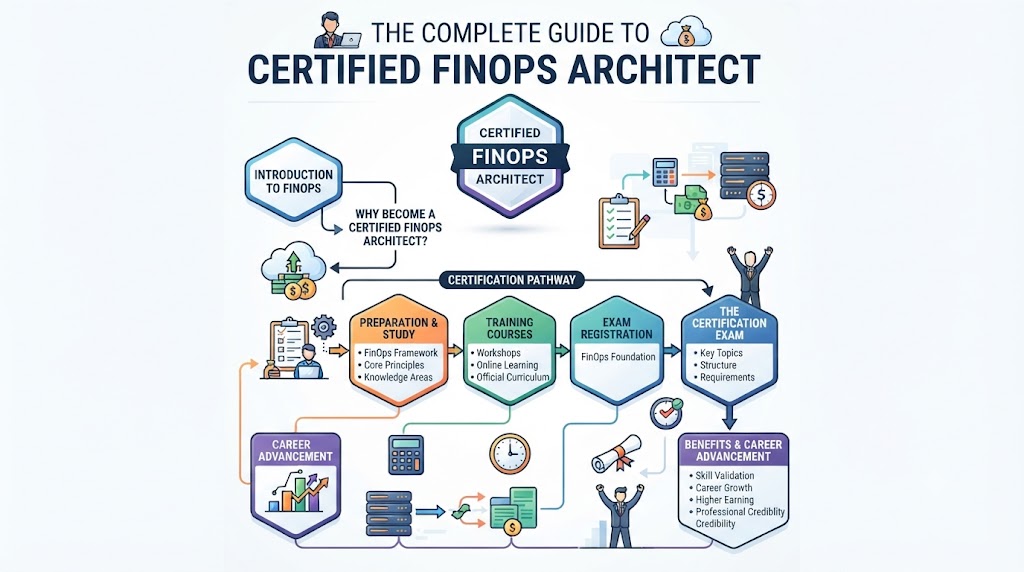
Introduction
Let me level with you about the reality of modern infrastructure. Earning the Certified FinOps Architect designation is one of the smartest strategic moves a technical professional can make right now. I have spent two decades watching brilliant engineers build incredibly scalable platforms, only to see those same platforms bleed their companies dry due to unchecked cloud sprawl. This definitive career roadmap, supported by the curriculum at FinOpsSchool, is designed to help you stop that bleeding. By mastering these exact disciplines, you elevate your standing from a standard operational worker to a strategic powerhouse who directly protects the company bottom line.
What is the Certified FinOps Architect?
The Certified FinOps Architect is a specialized technical credential proving you know how to build cloud infrastructure that does not bankrupt the business. It strips away theoretical fluff and forces you to confront the financial consequences of architectural decisions in production environments. This certification exists because the traditional gap between engineering teams and billing departments has become a massive liability for modern enterprises. By completing this program, you demonstrate the ability to weave financial constraints natively into your engineering pipelines and deployment strategies.
Who Should Pursue Certified FinOps Architect?
If your daily work involves provisioning, scaling, or securing cloud resources, this credential belongs on your resume. Platform engineers, infrastructure developers, and reliability specialists gain immense leverage by understanding the cost implications of their code. It is equally critical for engineering directors and technical managers who are tired of explaining massive budget overruns to the executive board every single quarter. Whether you are operating out of a major tech hub in India or managing a globally distributed workforce, these principles are universal and mandatory for large-scale operations.
Why Certified FinOps Architect
Cloud providers continuously roll out opaque pricing structures and complex discount tiers that confuse even veteran engineers. The Certified FinOps Architect validates your ability to cut through that noise and extract maximum compute value for minimum corporate spend. Tools, orchestrators, and deployment methodologies will inevitably change, but the underlying need to run profitable software never goes out of style. Professionals who can demonstrably lower their own operational footprint essentially pay for their own salaries, making them untouchable during industry downturns.
Certified FinOps Architect Certification Overview
The structured learning material is delivered via and is officially hosted on. The program is distinctly broken down into progressive validation levels to ensure a grounded, practical mastery of the subject. Instead of testing your ability to memorize documentation, the assessment approach forces you to solve messy, realistic scenarios involving legacy code and budget constraints. Ownership of this credential clearly signals to the market that you have survived rigorous technical scrutiny regarding enterprise-grade resource optimization.
Certified FinOps Architect Certification Tracks & Levels
The curriculum starts with a foundation level to establish baseline definitions before aggressively ramping up to professional and advanced tiers. The foundation tier gets your communication skills aligned with business stakeholders, while the professional tier focuses on the hardcore engineering automation required to enforce limits. Advanced practitioners tackle massive, multi-cloud enterprise agreements and the cultural transformations required to change how hundreds of developers think about money. Distinct specialization tracks are also available, ensuring the material remains deeply relevant whether your background is in reliability, data warehousing, or software delivery.
Complete Certified FinOps Architect Certification Table
| Track | Level | Who it’s for | Prerequisites | Skills Covered | Recommended Order |
| Core Strategy | Foundation | System Administrators, Tech Leads | Cloud Fundamentals | Billing models, baseline visibility | 1 |
| Core Strategy | Professional | Infrastructure Engineers, SREs | Foundation Pass | Automated lifecycle rules, scaling limits | 2 |
| Core Strategy | Advanced | Enterprise Architects, Directors | Professional Pass | Multi-region cost routing, culture shifts | 3 |
| Analytics | Professional | Big Data Engineers | Foundation Pass | Storage tiering, query cost reduction | Parallel path |
| Reliability | Professional | Platform Engineers, SREs | Foundation Pass | Risk vs cost balancing, traffic shaping | Parallel path |
Detailed Guide for Each Certified FinOps Architect Certification
Certified FinOps Architect – Foundation
What it is
This starting credential proves you understand the baseline mechanics of cloud billing and resource tagging. It confirms you know how to read an invoice and translate those line items back to technical components.
Who should take it
Junior to mid-level operators, technical project managers, and transitioning systems administrators. It is meant for anyone who has deployed a server but never actually paid the monthly bill for it.
Skills you’ll gain
- Mapping technical resource usage to specific business units.
- Decoding complex vendor invoices and usage reports.
- Establishing standardized tagging taxonomies across teams.
- Pinpointing massive areas of immediate, obvious waste.
Real-world projects you should be able to do
- Audit an existing cloud account and flag untagged virtual machines.
- Generate a digestible dashboard showing daily spend trends.
- Implement a basic showback model for a small engineering squad.
Preparation plan
A 7 to 14 days run requires blocking out evenings to strictly memorize billing structures and pricing models. A 30 days plan gives you time to build small test environments to see how usage translates to the billing console. A 60 days strategy is ideal if you are learning cloud basics simultaneously, allowing time to absorb both operations and finance.
Common mistakes
Candidates routinely underestimate the complexity of cloud networking charges, focusing too heavily on compute costs. Another trap is ignoring the business context of why certain expensive resources are kept running.
Best next certification after this
- Same-track option: The Professional level within the same core curriculum.
- Cross-track option: A vendor-specific associate architecture credential.
- Leadership option: A foundational IT service management certification.
Certified FinOps Architect – Professional
What it is
This is where the actual engineering happens, validating your ability to write code that controls budget sprawl. It proves you can automate the shutdown of idle environments and enforce programmatic spending limits.
Who should take it
Senior developers, platform engineers, and operations specialists responsible for large clusters. You need to be deeply comfortable with command-line tools and infrastructure as code frameworks.
Skills you’ll gain
- Building deployment pipelines with hard financial guardrails.
- Designing highly resilient systems using cheap, preemptible compute instances.
- Automating the cleanup of orphaned storage and unattached IPs.
- Refactoring legacy monoliths to consume fewer underlying resources.
Real-world projects you should be able to do
- Write scripts that automatically tear down staging environments on Friday nights.
- Inject cost-estimation steps directly into pull request workflows.
- Migrate a stateful application to leverage heavily discounted spot capacity.
Preparation plan
A 7 to 14 days sprint is only for veterans who already manage massive cloud footprints daily. A 30 days strategy should be spent heavily in the terminal, writing and testing automation policies. A 60 days approach allows you to thoroughly master container right-sizing and complex auto-scaling rules.
Common mistakes
Engineers often try to solve every financial problem with manual intervention instead of writing resilient automation. Candidates also frequently misunderstand the hidden costs associated with managing their own aggressive automation scripts.
Best next certification after this
- Same-track option: The Advanced level architecture credential.
- Cross-track option: Deep-dive certifications in container orchestration.
- Leadership option: Team leadership and agile delivery frameworks.
Certified FinOps Architect – Advanced
What it is
This capstone credential proves you can orchestrate financial strategy across massive, deeply siloed organizations. It demonstrates your ability to align executive goals with ground-level engineering realities across multiple cloud vendors.
Who should take it
Principal cloud architects, engineering directors, and senior technical consultants. You should be the person driving the architectural vision for the entire technology department.
Skills you’ll gain
- Architecting workload placement strategies across competing cloud providers.
- Overhauling corporate engineering culture to embrace financial accountability.
- Modeling complex unit economics to tie infrastructure costs to business revenue.
- Designing custom metric pipelines for granular anomaly detection.
Real-world projects you should be able to do
- Lead a migration strategy that maximizes bulk commitment discounts.
- Implement a company-wide gamification system for cost reduction.
- Build an arbitration engine that routes traffic based on real-time cloud pricing.
Preparation plan
A 14 days preparation is strictly for principal engineers with a decade of architectural experience. A 30 days plan should focus heavily on executive reporting and cross-cloud networking traps. A 60 days schedule is necessary to deeply grasp unit economic modeling and large-scale cultural psychology.
Common mistakes
Senior technical people often fail by focusing too much on scripts and ignoring the human element of change management. Another fatal error is failing to grasp the intricacies of enterprise discount program negotiations.
Best next certification after this
- Same-track option: Highly specialized data or machine learning financial tracks.
- Cross-track option: Industry-standard enterprise architecture frameworks.
- Leadership option: Executive strategy or business administration credentials.
Choose Your Learning Path
DevOps Path
This route targets engineers who want to embed financial governance directly into the delivery pipeline. You will learn to treat cost as a functional requirement, testing for budget overruns just as you would test for software bugs. The focus is strictly on using automation to prevent expensive mistakes before they hit the production environment. This ensures your delivery speed never compromises the financial health of the organization.
DevSecOps Path
Security tooling can rapidly become the most expensive line item on a cloud bill if not architected correctly. This path teaches you to build robust defensive perimeters without paying for redundant logging or over-scaled threat detection appliances. You will master the art of achieving stringent compliance mandates while keeping infrastructure overhead shockingly low. It proves you can protect the company data without draining its operational runway.
SRE Path
Reliability engineers are constantly fighting the friction between system stability and hardware costs. This track shows you how to design highly available systems that do not rely on massive, idle standby servers. You will learn to correlate your service level agreements directly with financial expenditures. This enables you to justify exactly why a system needs specific resources to maintain its error budgets.
AIOps Path
Using artificial intelligence to manage operations is brilliant until the monitoring tools cost more than the servers. This specific track focuses on deploying intelligent operational agents efficiently. You will learn to filter telemetry data aggressively so you do not pay massive ingestion fees to third-party vendors. The goal is to build self-healing infrastructure that is inherently aware of its own operating expenses.
MLOps Path
Training machine learning models will consume an infinite budget if you let it run unchecked. This path targets the unique financial challenges of managing GPU clusters and massive training datasets. You will learn how to orchestrate training jobs using discounted compute capacity and shut them down instantly upon completion. This track is mandatory for anyone looking to scale data science teams profitably.
DataOps Path
Data gravity and storage sprawl are silent killers of enterprise cloud budgets. This route teaches you how to design efficient data lakes and optimize wildly expensive analytical queries. You will master data lifecycle policies, moving cold logs to the cheapest possible storage tiers automatically. It ensures your big data initiatives generate actual business value rather than just massive vendor invoices.
FinOps Path
This is the purist track for professionals who sit directly at the intersection of the CFO and the engineering teams. It focuses heavily on building communication frameworks, establishing centers of excellence, and driving organizational change. You will learn the nuances of bulk purchasing agreements and how to hold developers accountable without destroying morale. This route turns you into the ultimate financial authority within the technology division.
Role → Recommended Certified FinOps Architect Certifications
| Role | Recommended Certifications |
| DevOps Engineer | Foundation, Professional |
| SRE | Professional, Reliability Track |
| Platform Engineer | Professional, Advanced |
| Cloud Engineer | Foundation, Professional |
| Security Engineer | Foundation, DevSecOps Path |
| Data Engineer | Professional, Analytics Track |
| FinOps Practitioner | Foundation, Professional, Advanced |
| Engineering Manager | Foundation, Advanced |
Next Certifications to Take After Certified FinOps Architect
Same Track Progression
Once you have the baseline, the next logical move is to drill down into the deep, vendor-specific optimization tracks. Mastering the exact quirks of how AWS provisions capacity versus how GCP routes traffic makes you a dangerous optimization expert. This keeps you firmly planted as the ultimate authority on cloud efficiency inside your engineering organization.
Cross-Track Expansion
If you want to widen your blast radius, start attacking advanced networking or security architecture certifications. Knowing exactly how zero-trust perimeters or global transit gateways function allows you to optimize them far more aggressively. This expansion turns you from a specialized cost cutter into a fully rounded, elite systems architect.
Leadership & Management Track
For those tired of fighting with YAML files, transitioning to enterprise strategy is the definitive next step. Certifications focusing on high-level organizational design and technology business management will leverage your new financial knowledge perfectly. This is the path you take when you want to become the Vice President of Cloud Operations or a Chief Technology Officer.
Training & Certification Support Providers for Certified FinOps Architect
DevOpsSchool
I have recommended DevOpsSchool to countless engineers because they do not waste time on academic theory; they focus on the brutal reality of production environments. When you are preparing for the Certified FinOps Architect, you need instructors who have actually broken production systems and had to explain the massive bills to their bosses. This provider excels at showing you how to wire cost-control mechanisms directly into your Jenkins pipelines or GitHub Actions. Their labs force you to write the exact automation scripts you will need on Monday morning at your real job. They understand that financial optimization is just another branch of reliable systems engineering, making them an unparalleled resource for technical professionals looking to level up their careers without enduring boring, slide-heavy lectures.
Cotocus
If you are dealing with massive legacy migrations or enterprise-scale digital transformations, Cotocus is the training partner you want in your corner. They approach the Certified FinOps Architect curriculum from the perspective of high-end architectural consulting, which is exactly how you need to think at the advanced levels. Cotocus instructors have walked the halls of Fortune 500 companies, fighting the exact political and technical battles you are preparing for. Their training emphasizes the heavy lifting of multi-cloud strategy, teaching you how to build cost-routing architectures that span multiple vendors. They provide intense, scenario-based workshops where you are forced to untangle complex billing structures and present coherent technical strategies, ensuring you are fully prepared to lead organizational change.
Scmgalaxy
Scmgalaxy has deep, historically proven roots in configuration management and source code control, making them a fantastic bridge for traditional sysadmins entering the modern financial operations space. For the Certified FinOps Architect, their training focuses heavily on treating your budget constraints exactly like you treat your application code. They excel at teaching you how to maintain massive repositories of cost-control policies and deploy them consistently across hundreds of cloud accounts. Because they are deeply embedded in the open-source community, they expose you to a massive variety of free tools and scripts that can augment your cost management strategies. Scmgalaxy ensures your financial governance is fully version-controlled, auditable, and automated to the highest engineering standards.
BestDevOps
BestDevOps caters specifically to senior talent—the seasoned engineers and architects who are tired of basic tutorials and want to tackle complex, systemic issues. Their approach to the Certified FinOps Architect credential is uncompromising and highly analytical, demanding that students dig deeply into metrics, logs, and telemetry. They teach you how to build custom cost-dashboards that pull data directly from your underlying infrastructure APIs. BestDevOps focuses heavily on the feedback loops required to make engineering teams care about the money they are spending. If you want a rigorous training experience that treats financial optimization as a hardcore, data-driven engineering discipline, this provider will push your technical boundaries and refine your strategic execution.
devsecopsschool.com
Security teams often have a blank check when it comes to infrastructure, which leads to massive waste, and devsecopsschool.com is dedicated to fixing that exact problem. For professionals chasing the Certified FinOps Architect, this provider offers a highly unique lens: how to build impenetrable systems without going bankrupt. They teach you the hidden costs of massive log aggregation, redundant threat detection, and sprawling compliance architectures. The curriculum shows you how to implement security guardrails that inherently respect the corporate budget. By training here, you become a rare breed of architect who can confidently secure the perimeter while actively optimizing the underlying compute costs, making you an incredibly valuable asset to both the CISO and the CFO.
sreschool.com
Site Reliability Engineering can quickly become an expensive endeavor if teams just throw massive amounts of hardware at every latency problem. sreschool.com teaches Certified FinOps Architect candidates how to achieve five-nines of reliability using highly optimized, cost-aware architectures. Their curriculum is phenomenal at translating error budgets into actual dollar amounts, allowing you to have mathematically sound arguments about when to scale up and when to hold the line. They provide deep, technical labs on traffic shaping, intelligent load balancing, and right-sizing database clusters to survive massive spikes without over-provisioning. If your job is to keep the site up, sreschool.com will teach you how to do it efficiently.
aiopsschool.com
As the industry pivots hard toward artificial intelligence, aiopsschool.com provides critical training on how to operate AI-driven infrastructure profitably. Future Certified FinOps Architect professionals must understand that machine learning workloads are fundamentally different from standard web applications, and this provider covers those differences flawlessly. They teach you how to analyze the cost-benefit ratio of deploying intelligent monitoring agents versus standard deterministic alerting. You will learn to spot runaway algorithms before they generate massive compute charges. aiopsschool.com ensures that as your company adopts cutting-edge automated operations, you have the exact frameworks needed to keep those advanced systems financially constrained and highly optimized.
dataopsschool.com
Ask any seasoned cloud veteran what scares them most about their monthly bill, and they will tell you it is the data warehouse footprint. dataopsschool.com specializes in teaching Certified FinOps Architect candidates how to tame massive, sprawling data ecosystems. Their training focuses relentlessly on optimizing storage tiers, reducing cross-zone data transfer penalties, and structuring massive queries to run cheaply. You will run complex lab scenarios where you must refactor terrible database schemas strictly to reduce their operational burn rate. For anyone working in big data, machine learning, or enterprise analytics, this provider offers the specialized knowledge required to stop data pipelines from silently draining the corporate technology budget.
finopsschool.com
When you want to master a subject, you go directly to the source, and finopsschool.com is the definitive authority for the Certified FinOps Architect path. They have built their entire platform around the intersection of engineering execution and financial strategy, providing the most rigorous and globally recognized curriculum available. Their instructors are the industry pioneers who literally wrote the playbooks on cloud cost optimization. They provide access to high-fidelity billing simulators and enterprise architecture labs that you simply cannot find anywhere else. Training directly with finopsschool.com guarantees that you are absorbing the absolute bleeding-edge techniques in cloud financial management, directly from the practitioners who defined the entire movement.
Frequently Asked Questions
1. Is this credential suitable for independent freelance consultants?
Absolutely. Freelance architects who can audit a client’s environment and instantly identify thirty percent cost savings are heavily sought after. This certification gives you a structured methodology to deliver immediate, measurable ROI to your consulting clients.
2. Does the curriculum cover strategies to avoid vendor lock-in?
Yes, avoiding lock-in is a massive part of maintaining financial leverage. The advanced modules heavily cover building portable architectures that allow you to threaten migration if a specific vendor refuses to offer competitive pricing discounts.
3. What is the passing score like for the final examinations?
The exams are notoriously rigorous, typically requiring a score of eighty percent or higher to pass. The questions are designed to trick candidates who only memorized terms, forcing you to apply logic to multi-layered technical problems.
4. Do I need to build a massive lab environment at home to practice?
No, but you do need access to a sandbox cloud environment where you can provision and destroy resources. Most providers offer free-tier access, which is usually sufficient for testing basic tagging and automation scripts safely.
5. How does this material help with legacy on-premise migrations?
It teaches you how to accurately forecast the cost of a workload before you move it. This prevents the classic disaster where a company lifts-and-shifts a legacy monolith into the cloud and immediately sees their monthly infrastructure bill quadruple.
6. Is this credential recognized globally across different tech markets?
Yes, cloud sprawl is a universal problem regardless of geography. Whether you are applying for a lead architect role in Silicon Valley, London, or Bangalore, the ability to control infrastructure spending is universally respected.
7. Do heavily funded startup companies actually value this skill set?
More than ever. The era of startups burning endless venture capital on bloated infrastructure is over. Modern startups demand lean operations to extend their runway, making these skills highly attractive to early-stage technical founders.
8. Can I completely skip the foundation level if I am a senior engineer?
It is highly discouraged. While the technical concepts might seem basic to a veteran, the foundation level standardizes the financial vocabulary you need to communicate effectively with the CFO and business stakeholders.
9. Does the certification expire or require continuous renewal?
Because public cloud pricing models and optimization strategies evolve rapidly, the credential typically requires renewal every two to three years. This ensures your knowledge remains relevant to the current state of enterprise cloud computing.
10. Will the training teach me aggressive contract negotiation tactics?
The advanced levels cover the exact data points and historical metrics you need to bring to the negotiation table. It prepares you to argue effectively with vendor sales representatives regarding custom enterprise discount programs.
11. Is the material mostly theoretical business management concepts?
Absolutely not. While it covers business alignment, the core of the curriculum is heavily grounded in technical execution, infrastructure as code, and architectural design patterns. It is an engineering credential at its core.
12. How does this relate to traditional ITIL or service management?
It modernizes those traditional frameworks for the cloud era. Where ITIL focuses on broad service delivery processes, this discipline provides the specific, high-speed guardrails required to manage financial risk in rapid deployment environments.
FAQs on Certified FinOps Architect
1. How do I handle the massive costs associated with serverless architectures?
Serverless functions are heavily marketed as cheap, but at enterprise scale, they can generate shocking bills due to concurrency and heavy execution times. The Certified FinOps Architect curriculum teaches you to deeply analyze execution profiles and memory allocations for serverless workloads. You will learn exactly when it makes financial sense to abandon serverless and move a high-throughput workload back to standard container clusters. The training ensures you understand the break-even points of different compute models based on millions of invocations.
2. What is the best strategy for identifying orphaned resources in legacy accounts?
Orphaned resources like unattached storage volumes and idle load balancers are silent budget killers. The certification forces you to master automated discovery tools and write custom scripts that cross-reference active compute instances against allocated storage. You will learn how to build aggressive garbage collection pipelines that notify owners and then terminate untouched resources after a strict grace period. This practical knowledge allows you to immediately clean up years of technical debt and show instant financial returns.
3. How do I effectively implement chargeback versus showback models?
Moving a company from zero visibility to a strict chargeback model usually results in a political nightmare. The Certified FinOps Architect path teaches you how to start with a showback model, simply exposing the cost data to engineering teams to drive behavioral change through peer pressure. You will learn how to transition smoothly to a hard chargeback model only after your tagging taxonomy is flawless and teams trust the data. This phased approach prevents massive internal friction while driving accountability.
4. How difficult is it to integrate these cost controls into existing CI/CD tools?
It is entirely straightforward if you know how to write proper policy as code. The curriculum covers integrating specialized cost-estimation plugins directly into tools like Jenkins, GitLab, or GitHub Actions. You will learn how to configure these pipelines to automatically block pull requests that exceed predefined budgetary limits. This ensures that expensive architectural mistakes are caught by the build server before they ever reach the production environment, enforcing financial hygiene automatically.
5. Does the curriculum address tracking third-party SaaS spending alongside cloud costs?
Yes, modern infrastructure relies heavily on third-party telemetry, logging, and security tools that run adjacent to the cloud provider. The advanced levels teach you how to normalize billing data from tools like Datadog or Snowflake and ingest it into your primary cost dashboards. You will learn how to spot redundant spending where a cloud-native tool might achieve the same result as an expensive external SaaS product. This holistic view is critical for true enterprise architecture.
6. How do I deal with the aggressive interruption rates of spot instances?
Running production workloads on spot instances saves massive amounts of money, but the instances can be terminated with a two-minute warning. The certification dives deeply into the architectural patterns required to survive this chaos. You will learn to decouple state from compute, implement rapid node draining, and mix spot instances with on-demand nodes in your auto-scaling groups. This allows you to leverage massive discounts while maintaining strict reliability targets for your user base.
7. What is the best way to automate budget alerts without causing alert fatigue?
If you alert an engineering team every time they spend a dollar, they will immediately route those emails to the trash folder. The Certified FinOps Architect curriculum teaches you how to build anomaly detection systems that only trigger when spending aggressively breaks historical baselines. You will learn to route these high-signal alerts directly into the incident management systems like PagerDuty or Slack, treating a massive budget spike with the same severity as a site outage.
8. How do I align engineering metrics with high-level finance goals?
Engineers care about latency and deployment frequency; finance cares about gross margins and unit costs. This credential teaches you how to bridge that gap by defining unit economics for your specific application. You will learn how to instrument your code so you can track exactly how much infrastructure cost is generated by a single user transaction or API call. By translating technical telemetry into business metrics, you allow executives to make informed decisions about product profitability.
Final Thoughts: Is Certified FinOps Architect Worth It?
Look, the days of throwing endless compute resources at sloppy code are over. Companies are demanding that their engineering leaders understand how to build systems that are financially sustainable. Earning the Certified FinOps Architect credential proves you have evolved past just writing configurations and have stepped into the realm of strategic technical leadership. It is a grueling, complex discipline, but mastering it gives you an undeniable edge in salary negotiations, job security, and architectural influence. If you are serious about controlling your career trajectory in modern infrastructure, this is the exact path you need to take.
