Introduction
Pushing new code to live servers feels rewarding until an unseen flaw triggers an outage. Many software teams ship features fast, yet they skip vital system checks before launch day. One missing setting or weak limit can slow apps down and frustrate real users.
Today, software runs across cloud platforms, containers, and dozens of connected services. This setup offers great flexibility, but it also creates more places where things can fail. Teams without clear operational habits often spend their days fixing surprises instead of building new value.
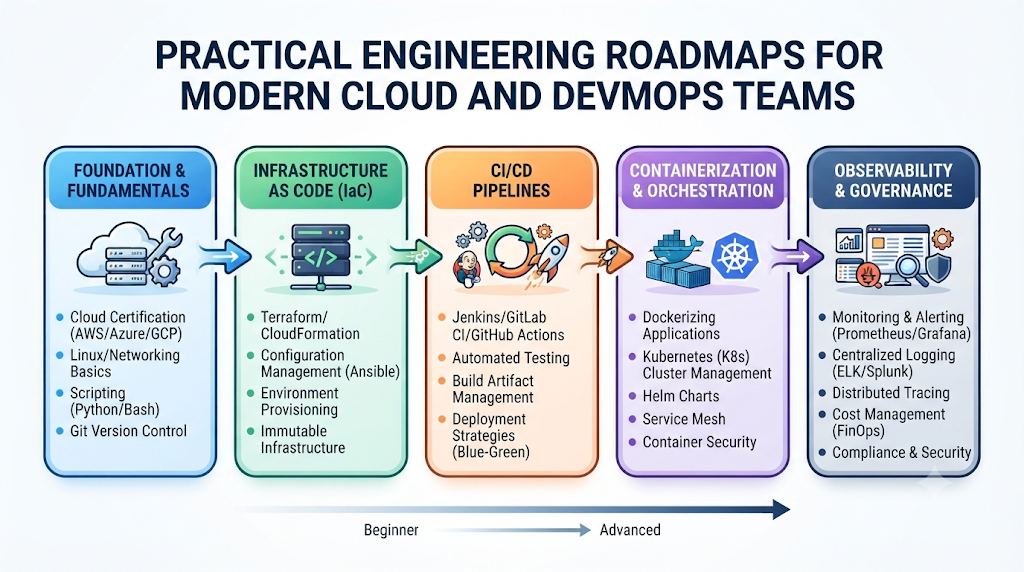
This article explains how engineering groups strengthen their systems through clear, step-by-step plans. We explore launch reviews, delivery maturity, container care, internal platforms, reliability engineering, incident response, built-in security, system visibility, and smart cloud spending. You will also learn how OpsRoadmaps helps teams turn complex operational goals into steady progress.
Understanding a Production Readiness Assessment
A production readiness assessment is a structured check that verifies if an application can safely serve real traffic. Engineering teams run this review before releasing a new service or a major system upgrade. It examines both the application code and the infrastructure supporting it.
Strong teams treat readiness as a living habit rather than a single pre-launch hurdle. Applications and cloud setups change constantly, so checks must stay active over time. While no checklist guarantees a flawless launch, thoughtful reviews catch costly blind spots before users notice them.
Checking Application Stability and Infrastructure
Start by testing how your software behaves under realistic user traffic and sudden load spikes. Confirm that the code handles errors gracefully and recovers cleanly without losing customer data. Make sure servers, clusters, and databases have enough room to scale when demand grows.
Verify backup schedules and test full recovery steps before opening traffic to users. Ensure your deployment steps rely on tested scripts rather than manual clicks. Repeatable releases lower stress and reduce human mistakes during busy launch windows.
Reviewing Access Controls and Support Plans
Check that only approved engineers and automated tools can reach production environments. Store passwords, API keys, and tokens in dedicated secret managers instead of code files. Confirm that logs, health metrics, and alert rules work properly from day one.
Prepare clear runbooks so on-call responders know how to handle common failures. Well-written notes save precious minutes when an alert wakes someone up at night.
How a DevOps Maturity Assessment Improves Delivery
A DevOps maturity assessment helps organizations evaluate how smoothly they build, test, and release software. It examines teamwork, version control, automation, and feedback habits across engineering groups. Understanding your current stage makes it easier to choose realistic improvements.
Teams usually grow from manual workflows toward steady, automated delivery over time. At an early stage, deployments may depend on manual steps or a few key individuals. Growing teams store code and infrastructure rules in shared repositories and run automated tests on every change.
More advanced teams deploy small updates frequently and catch problems minutes after writing code. They use Infrastructure as Code to keep environments consistent across testing and production. Every company has unique goals, so use maturity reviews to guide your own path rather than copying others blindly.
Building Fast Feedback and Shared Ownership
Reliable software delivery thrives when developers and operations engineers work toward shared goals. Keep application code, scripts, and configuration files in version control with peer review rules. Automated pipelines should compile, verify, and package every update in the exact same way.
Quick test feedback lets developers fix bugs while the context is still fresh. Smaller, more frequent releases also make it much easier to trace what caused a sudden change.
| Delivery Area | Early Team Habits | Advanced Team Habits |
|---|---|---|
| Release Process | Infrequent, manual deployments | Frequent, small, automated rollouts |
| Environment Setup | Manual server changes and local scripts | Version-controlled Infrastructure as Code |
| Quality Checks | Manual testing right before launch | Automated unit, integration, and security tests |
| System Feedback | Slow discovery of live issues | Fast alerts and regular team retrospectives |
Kubernetes Readiness and Crash Troubleshooting
Running containers in production requires disciplined cluster and workload configuration. A Kubernetes production readiness checklist helps teams verify stability, security, and recovery settings before serving live users. Careful preparation keeps minor configuration mistakes from causing cluster-wide disruptions.
Essential Kubernetes Production Controls
Define CPU and memory requests and limits for every container running in your cluster. Requests help Kubernetes place workloads on healthy nodes, while limits stop one busy container from starving others. Configure liveness and readiness probes so the platform knows when to restart broken pods or pause traffic.
Run multiple pod replicas across separate availability zones to survive node or zone failures. Use network policies to restrict traffic between services so pods only talk to approved neighbors. Protect sensitive values with proper secret management, back up persistent data, and collect cluster-wide metrics and logs.
Kubernetes CrashLoopBackOff Troubleshooting
Effective Kubernetes CrashLoopBackOff troubleshooting begins with knowing what the status actually tells you. CrashLoopBackOff means a container starts up, exits with an error, and Kubernetes waits progressively longer before restarting it. It signals repeated crashes rather than pointing to one single cause.
Never treat pod restarts or replica scaling as a permanent fix for crashing containers. Containers will keep failing until you resolve the underlying bug or configuration error. Frequent causes include startup code crashes, wrong entry commands, missing environment variables, bad config files, memory limit kills, failing health probes, or missing external dependencies.
Begin by running kubectl get pods to check restart counts, pod status, and uptime. Next, run kubectl describe pod to inspect recent cluster events, exit codes, and termination reasons. Read active container output with kubectl logs and check previous crash output using kubectl logs --previous.
You can also run kubectl get events to spot image pull failures, volume errors, or scheduling blocks. Review recent code commits, config edits, and memory limits before changing live settings. Fix the root issue in your code or manifest, deploy cleanly, and confirm the pod remains stable.
Shaping a Platform Engineering Adoption Roadmap
As engineering organizations expand, individual teams often waste time rebuilding the same pipelines and cloud setups. Platform engineering addresses this friction by offering shared tools and paved paths for developers. A thoughtful platform engineering adoption roadmap keeps platform work aligned with real daily problems.
Small organizations with only a few services rarely need a complex internal developer platform. Simple shared templates and clear documentation often work better in early stages. Invest in broader platform tooling only when repeated friction slows multiple product teams down.
Growing an Internal Platform Step by Step
Start by observing how developers currently create, test, and deploy their applications. Interview team members to uncover painful bottlenecks, repetitive ticket requests, and confusing tools. Define clear platform goals focused on speed, safety, and developer ease.
Create a small starting foundation, such as standard service templates or reusable deployment workflows. Introduce self-service portals and a simple service catalog as teams ask for more autonomy. Gather regular feedback from internal users and refine tools based on real usage.
Combining Developer Freedom with Safe Guardrails
Effective self-service lets engineers launch test environments or new services without waiting in long approval queues. At the same time, built-in guardrails enforce security rules, tagging standards, and safe defaults automatically. When platform builders collaborate closely with product developers, adoption grows naturally.
Creating an SRE Adoption Roadmap for Dependable Services
Site Reliability Engineering applies software engineering discipline to daily operations and system reliability. An SRE adoption roadmap helps teams measure service health objectively instead of relying on gut feelings. It creates a clear, shared framework for balancing new features against system stability.
Begin by identifying your most critical services and key customer journeys. Choose Service Level Indicators, or SLIs, that reflect real user experience, such as request speed and success rates. Set Service Level Objectives, or SLOs, to define realistic reliability targets for each indicator.
Organizations often tie external customer promises to a Service Level Agreement, or SLA. The difference between your SLO target and actual reliability forms an error budget. Teams can release features faster when budget remains, or pause risky launches to fix stability when budget runs low.
Reducing Manual Toil Over Time
SRE teams actively measure and cut toil, which is repetitive, manual operational work that scales with service growth. Automating routine maintenance, rollbacks, and health checks frees engineers for higher-value engineering projects. Regular capacity reviews and reliability checkups also help systems handle future growth smoothly.
SRE practices do not eliminate all outages or promise complete perfection. Instead, they help engineering teams make smart risk choices and recover faster when failures occur.
Advancing Along an Incident Management Maturity Model
Even carefully built systems experience unexpected failures in production. An incident management maturity model helps teams replace chaotic firefighting with calm, structured recovery habits. Clear routines reduce confusion and shorten the time users experience downtime.
Less mature incident handling often suffers from noisy alerts, unclear ownership, and scattered communication. Mature teams refine alerts so pages trigger only when real user experience degrades. They classify incidents by severity levels and assign clear response roles right away.
Structured Response and Blameless Learning
During an active outage, one incident lead coordinates efforts while technical responders investigate and apply fixes. Clear communication updates keep stakeholders informed without distracting engineers working on recovery. Defined escalation paths ensure specialists join quickly when a problem crosses team boundaries.
Once service returns to normal, teams hold a blameless post-incident review to understand what happened. They document root causes, create concrete follow-up actions, and share findings across the company. While no process stops every failure, disciplined learning prevents the same outage from repeating.
Building a DevSecOps Implementation Roadmap
Checking security only right before launch creates delays and leaves dangerous gaps in live systems. DevSecOps weaves security checks directly into everyday coding, building, and deployment workflows. A practical DevSecOps implementation roadmap helps teams improve protection without slowing software releases.
Security works best when developers, operations engineers, and security specialists share responsibility together. Start by auditing current habits and identifying your highest-priority risks. Select automated tools that fit your workflow, including static code analysis, dependency checks, container image scans, and secret detection.
Embedding Security into Daily Workflows
Integrate security scans into CI/CD pipelines so developers spot issues right after committing code. Combine automated checks with strict access permissions, cloud configuration reviews, and clear policy rules. Assign clear owners to triage findings and patch high-risk vulnerabilities promptly.
Review compliance posture regularly and update security rules as architectures change. Automated scanners catch many common flaws early, yet they cannot replace thoughtful threat modeling, peer code reviews, and human judgment.
Progressing Through an Observability Maturity Model
Traditional monitoring alerts you when known limits break, whereas observability helps you investigate unknown failures. An observability maturity model guides engineering teams from simple server checks to deep behavioral insight across distributed apps. Strong visibility helps responders pinpoint root causes quickly during complex incidents.
Observability brings together three core telemetry types: metrics, logs, and traces. Metrics track numeric measurements over time, like request volume, latency, and memory usage. Logs capture timestamped event details, while distributed traces follow individual requests across multiple services.
Moving Toward Actionable System Insight
Teams typically begin with basic infrastructure metrics, centralized log search, and overview dashboards. As architectures grow more distributed, adding application telemetry, service dependency maps, and distributed tracing speeds up debugging. Tracking real user experience also reveals slowdowns that server metrics alone might miss.
Adding endless charts or noisy alerts rarely improves true system understanding. Focus on meaningful signals connected to user health and clear alert routing so engineers diagnose issues rapidly.
| Engineering Discipline | Core Practices | Operational Value |
|---|---|---|
| Platform Engineering | Paved paths, reusable templates, self-service | Boosts developer speed with built-in standards |
| SRE | SLIs, SLOs, error budgets, toil automation | Aligns release velocity with reliability targets |
| Incident Management | Severity tiers, clear roles, blameless reviews | Cuts recovery time and stops repeat failures |
| DevSecOps | Pipeline scans, secret checks, least privilege | Catches security flaws early in delivery |
| Observability | Metrics, logs, distributed traces, user signals | Accelerates root-cause analysis across services |
Planning a Cloud Cost Optimization Roadmap
Cloud spending can climb steadily when teams leave test servers running or request more capacity than needed. A cloud cost optimization roadmap helps organizations control cloud bills while protecting speed and reliability. Disciplined cost habits free budget for new product work without risky shortcuts.
Begin by auditing current cloud invoices to see which services and teams drive the highest spend. Hunt for idle compute instances, unattached storage disks, outdated snapshots, and unused network gateways. Compare allocated capacity against actual CPU, memory, and storage usage so you can right-size oversized resources.
Tagging, Alerts, and Continuous Cost Care
Apply consistent resource tags so every workload maps clearly to an owner, team, or environment. Configure budget alerts early to catch unusual spending spikes before billing cycles close. Use autoscaling, scheduled off-hours shutdowns for test environments, and reserved capacity commitments where usage stays predictable.
Always balance cost reductions against performance, resilience, and security requirements. Never guess future savings or strip away vital redundancy just to shrink a monthly bill. Review cloud usage regularly as traffic patterns and architectures evolve.
Turning Technical Assessments into Actionable Plans
Assessments only create value when teams turn insights into focused daily improvements. Begin by reviewing your current engineering environment honestly and listing your biggest operational risks. Choose a small set of goals that match team capacity and business priorities.
Focus first on changes that remove painful bottlenecks or prevent recurring outages. Assign a clear owner and realistic timeline to each improvement task. Resist the urge to adopt every new tool simultaneously, since rapid tool sprawl often confuses teams and stalls progress.
Measure outcomes using clear milestones and adjust your plan every quarter as needs evolve. Engineers often explore OpsRoadmaps to study structured paths across DevOps, cloud infrastructure, platform engineering, Kubernetes, SRE, DevSecOps, and observability.
Using OpsRoadmaps as an educational guide helps teams compare engineering practices and sequence improvements logically. Because every organization operates under different constraints, adapt each roadmap step to fit your own team size and goals. Consistent, modest improvements build lasting operational strength over time.
Frequently Asked Questions
When should engineering teams run a production readiness assessment? Teams should run a production readiness assessment before launching new applications, major features, or infrastructure migrations. Reviewing core checks periodically also keeps existing services aligned with changing traffic and security needs.
How does a DevOps maturity assessment help growing teams? A DevOps maturity assessment highlights manual bottlenecks across coding, testing, deployment, and operations. It gives leaders clear visibility into current habits so they can prioritize automation where it helps most.
What core items belong in a Kubernetes production readiness checklist? A solid checklist includes resource requests and limits, health probes, multi-replica availability, network policies, and secure secret handling. It also covers persistent storage backups, access permissions, and centralized logging and metrics.
What is the right way to approach Kubernetes CrashLoopBackOff troubleshooting? Start by checking pod status and exit codes with kubectl get pods and kubectl describe pod. Then inspect kubectl logs and kubectl logs --previous to identify the exact startup error before changing any configuration.
Do small engineering teams need a platform engineering adoption roadmap? Small teams usually benefit more from lightweight shared templates and clear scripts than a full internal developer platform. A platform engineering adoption roadmap becomes valuable once multiple squads face repeated setup and deployment friction.
How does an SRE adoption roadmap improve service reliability? An SRE adoption roadmap introduces measurable targets like SLIs, SLOs, and error budgets to guide engineering decisions. It also encourages teams to automate repetitive operational toil so systems stay dependable as they scale.
Why should teams follow an incident management maturity model? An incident management maturity model helps teams replace ad-hoc firefighting with clear severity levels, defined roles, and calm communication. Structured post-incident reviews also ensure teams learn from failures and prevent repeat outages.
How do you start a DevSecOps implementation roadmap without blocking developers? Begin by adding fast, automated checks like dependency, secret, and code scans directly into existing CI/CD pipelines. Pair those scans with clear ownership rules so teams fix critical risks steadily without halting normal releases.
What makes an observability maturity model useful for distributed systems? An observability maturity model helps teams combine metrics, logs, and distributed traces into a clear view of system health. Better telemetry lets engineers trace complex requests across microservices and find root causes faster.
How can teams follow a cloud cost optimization roadmap safely? Start by removing idle resources, right-sizing underused servers, and setting early budget alerts. Always verify latency, failover capacity, and security controls before shrinking or shutting down any production resource.
Conclusion
Strong cloud operations grow from steady, practical habits across readiness, delivery, security, visibility, and cost management. When teams assess their gaps honestly and tackle high-impact improvements first, deployments become safer and incidents become easier to resolve. Clear roadmaps turn complex technical goals into manageable steps that teams can execute with confidence.
OpsRoadmaps provides structured roadmap insights to help engineering professionals navigate DevOps, cloud operations, Kubernetes, SRE, platform engineering, DevSecOps, and observability. Focus on steady learning, clear ownership, and thoughtful improvements that keep your systems reliable for the people who depend on them.
