Introduction
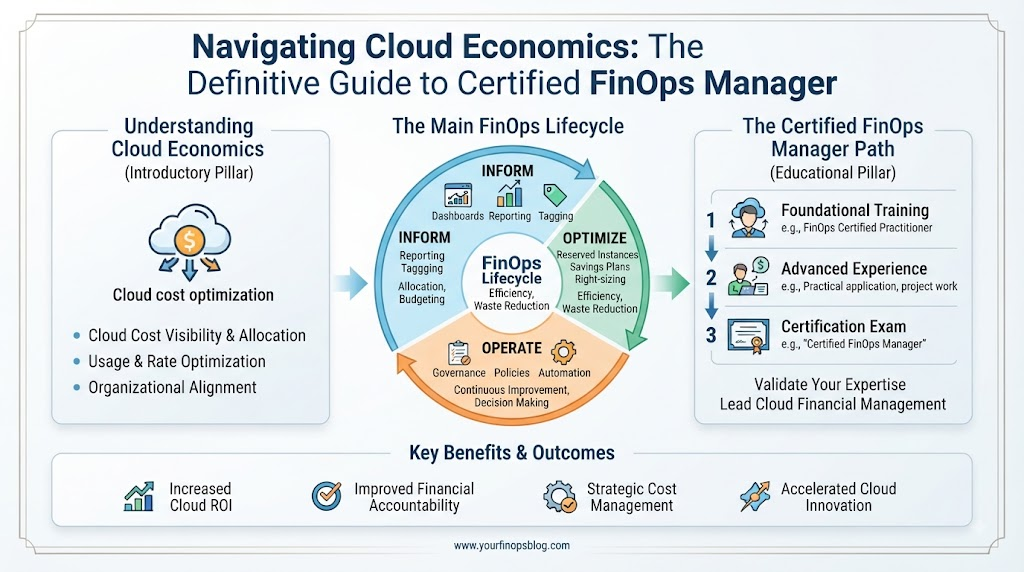
As organizations scale their footprint across distributed cloud environments, keeping infrastructure costs aligned with business revenue has evolved from a back-office accounting task into an essential engineering discipline. Unmonitored cloud sprawl and unoptimized compute allocation can quickly drain operational budgets, making financial accountability just as critical as system uptime. The Certified FinOps Manager credential steps into this exact industry gap, offering a robust framework that bridges traditional finance with high-velocity engineering workflows. Tailored for software architects, site reliability specialists, infrastructure engineers, and financial leaders, this guide dives deep into the value, core competencies, and career impact of mastering cloud financial operations. By breaking down progressive learning tracks and hands-on implementation methodologies, professionals can make confident decisions that optimize cloud spending without sacrificing innovation. For comprehensive details on course tracks and enrollment paths, you can explore the official curriculum at Certified FinOps Manager hosted on finopsschool.com.
What is the Certified FinOps Manager?
The Certified FinOps Manager program is built for practitioners who want to take charge of cloud financial governance with practical, field-tested methodologies rather than abstract theory. Rather than treating cost management as an afterthought, this credential validates a professional’s ability to embed financial awareness directly into everyday software delivery and architecture design. The curriculum focuses heavily on real-world challenges—such as multi-cloud cost visibility, container billing granularity, anomaly detection, and automated resource cleanup. By aligning cost data with operational metrics, engineers and financial leaders learn how to foster a culture of shared responsibility where everyone from developers to executives treats cloud dollars like their own.
Who Should Pursue Certified FinOps Manager?
This professional certification serves a wide spectrum of technology and business roles navigating modern cloud ecosystems. Software engineers and cloud architects leverage the program to understand how design choices directly influence operational expenditures and corporate margins. Reliability and infrastructure professionals gain advanced proficiency in capacity planning, autoscaling cost tuning, and resource tracking. Security and compliance practitioners learn how to govern cloud environments efficiently without introducing operational bottlenecks or compromising safety postures. Furthermore, engineering managers and financial controllers use this credential to establish unified reporting frameworks that foster transparency across departments. The certification delivers immense value for both Indian organizations undergoing rapid digital expansion and global enterprises managing complex multi-region architectures.
Why Certified FinOps Manager is Valuable in Today’s Enterprise Ecosystem
The relentless shift toward cloud-native infrastructure has created an unprecedented shortage of professionals who speak both engineering and finance fluently. Traditional static budgeting models cannot keep pace with dynamic, on-demand resource provisioning, leading to significant financial leakage across enterprise accounts. Earning this credential equips practitioners with enduring skills that remain highly relevant regardless of which cloud provider or proprietary tool dominates the market. By mastering unit economics and proactive cost optimization strategies, certified experts deliver immediate, measurable ROI for their employers while significantly elevating their own market value and leadership potential.
Certified FinOps Manager Certification Overview
Delivered through official training channels and hosted on finopsschool.com, the Certified FinOps Manager program provides a structured, modular journey from foundational cost awareness to advanced multi-cloud governance. The evaluation model tests both conceptual mastery and practical execution through scenario-based assessments, architectural case studies, and hands-on simulation labs. Achieving this certification serves as verifiable proof that a professional can implement scalable cost-control practices that resonate across large, cross-functional engineering teams.
Certified FinOps Manager Certification Tracks & Levels
The certification structure is methodically organized into progressive tiers that align seamlessly with professional growth. The foundation tier establishes core competencies in cloud billing meters, tagging taxonomies, and basic reporting. The professional tier dives deep into rate optimization, commitment management, automated anomaly detection, and architectural refactoring. Finally, advanced specialization tiers target specialized domains such as Kubernetes cluster billing, serverless financial governance, and enterprise-wide organizational transformation. Each level provides a clear stepping stone for career progression.
Complete Certified FinOps Manager Certification Table
| Track | Level | Who it’s for | Prerequisites | Skills Covered | Recommended Order |
| FinOps Foundation | Foundation | Engineers and Analysts | Basic Cloud Literacy | Cost Visibility, Tagging, Reporting | 1 |
| FinOps Professional | Professional | Senior Engineers and SREs | Foundation Track | Rate Optimization, Anomaly Detection | 2 |
| FinOps Architect | Advanced | Cloud Architects and Leads | Professional Track | Unit Economics, Governance, Multi-Cloud | 3 |
Detailed Guide for Each Certified FinOps Manager Certification
Certified FinOps Manager – Foundation Level
What it is
This credential validates essential working knowledge of cloud pricing models, billing data structures, and foundational resource allocation reporting.
Who should take it
Ideal for junior engineers, financial analysts, and cloud administrators establishing their initial expertise in cloud financial management.
Skills you’ll gain
- Designing clean and effective resource tagging strategies
- Generating clear monthly expenditure reports
- Spotting unattached storage volumes and idle instances
- Setting up early warning budget alerts
Real-world projects you should be able to do
- Build a consolidated cost tracking dashboard for a staging cloud environment
- Enforce automated tagging policies across organizational teams
- Audit and clean up orphaned cloud assets
Preparation plan
- Days 1 to 7: Review basic cloud billing terminology and provider documentation.
- Days 8 to 14: Complete hands-on tagging and reporting labs.
- Days 15 to 30: Practice sample assessment questions and review case studies.
Common mistakes
- Relying exclusively on manual spreadsheets instead of automated tools
- Failing to communicate tagging standards clearly to developers
- Creating overly complex tagging schemas that are hard to maintain
Best next certification after this
- Same-track option: Certified FinOps Manager – Professional Level
- Cross-track option: Cloud DevOps Engineer Certification
- Leadership option: Enterprise Cloud Governance Manager
Certified FinOps Manager – Professional Level
What it is
This credential validates advanced capability in rate optimization, commitment planning, anomaly tracking, and building cross-functional FinOps habits.
Who should take it
Built for experienced DevOps engineers, SREs, and financial operations specialists managing active production environments.
Skills you’ll gain
- Managing reserved instances and savings plans strategically
- Building automated detection workflows for sudden cost spikes
- Calculating accurate unit economic metrics tied to business output
- Leading collaborative cost-reduction reviews with engineering teams
Real-world projects you should be able to do
- Execute a multi-region commitment strategy to lower baseline compute expenses
- Implement automated Slack alerts for unusual resource consumption spikes
- Model cost per active user for a containerized web application
Preparation plan
- Days 1 to 14: Study advanced pricing structures and commitment frameworks.
- Days 15 to 30: Practice setting up anomaly detection and unit economic models.
- Days 31 to 60: Tackle complex enterprise scenarios and finish advanced labs.
Common mistakes
- Purchasing long-term commitments without consulting engineering roadmaps
- Isolating financial metrics from daily engineering key performance indicators
- Neglecting namespace-level cost granularity in shared container clusters
Best next certification after this
- Same-track option: Certified FinOps Manager – Architect Level
- Cross-track option: Certified SRE Practitioner
- Leadership option: Director of Cloud Operations
Certified FinOps Manager – Architect Level
What it is
This certification validates expert mastery in designing enterprise-grade financial governance frameworks, multi-cloud optimization, and executive reporting.
Who should take it
Designed for principal engineers, enterprise cloud architects, and senior technical leaders driving organization-wide financial change.
Skills you’ll gain
- Architecting decentralized cost accountability models for large enterprises
- Designing unified multi-cloud financial data pipelines
- Driving cultural shifts toward continuous cloud cost awareness
- Developing high-level executive ROI scorecards
Real-world projects you should be able to do
- Deploy a comprehensive FinOps governance framework across an entire enterprise
- Aggregate multi-cloud financial data into a single executive dashboard
- Lead an organization-wide optimization initiative with measurable savings
Preparation plan
- Days 1 to 20: Master enterprise governance frameworks and multi-cloud topologies.
- Days 21 to 40: Build end-to-end financial reporting pipelines.
- Days 41 to 60: Prepare for board-level architectural evaluations.
Common mistakes
- Imposing strict top-down rules without engineering feedback
- Focusing solely on cost cutting while hurting delivery speed
- Designing cost tracking systems that fail to scale with organizational growth
Best next certification after this
- Same-track option: Certified FinOps Executive Master
- Cross-track option: Enterprise Platform Engineering Lead
- Leadership option: Chief Technology Officer Advisory Track
Choose Your Learning Path
DevOps Path
The DevOps path focuses on embedding cost visibility directly into continuous integration and delivery pipelines. Engineers learn to evaluate infrastructure-as-code scripts for financial efficiency before pushing changes to production environments. This guarantees that system performance and cost implications are evaluated side-by-side throughout the software lifecycle. Practitioners master provisioning tools that treat budget constraints as core operational parameters. Ultimately, this journey empowers developers to become active participants in cloud financial strategy.
DevSecOps Path
The SecSecOps path addresses the intersection of secure infrastructure design and financial governance. Professionals learn how security logging pipelines, vulnerability scanning tools, and compliance storage rules can be optimized to prevent runaway data transfer costs. This track strikes a delicate balance between maintaining rigorous security postures and keeping operational expenses under control. Candidates explore efficient methods for managing compliance data retention without incurring massive storage penalties. It successfully bridges the gap between risk mitigation and budget management.
SRE Path
The Site Reliability Engineering path centers on harmonizing system uptime, performance optimization, and operational expenditure. SRE professionals learn how over-provisioning for high availability impacts budgets and how smart autoscaling can maintain SLAs efficiently. This track evaluates error budgets alongside financial budgets to ensure optimal resource allocation during high-traffic windows. Engineers build deep expertise in capacity planning, load testing cost analysis, and disaster recovery financial modeling, empowering reliability leaders to defend infrastructure choices with concrete business metrics.
AIOps / MLOps Path
The AIOps and MLOps path targets the heavy computing costs associated with training and running large-scale machine learning models. Practitioners learn how to optimize GPU utilization, manage distributed training clusters, and select cost-effective instance types for live inference workloads. This specialized curriculum covers dataset lifecycle management, model pruning, and spot instance strategies for fault-tolerant AI pipelines. Engineers learn how to calculate true return on investment for artificial intelligence initiatives, making it an indispensable discipline for sustainable data science operations.
DataOps Path
The DataOps path focuses on managing the financial lifecycle of massive data pipelines, data lakes, and analytical warehouses. Professionals learn how to optimize query performance, implement intelligent data tiering policies, and eliminate redundant storage across enterprise environments. This track solves the unique cost challenges presented by real-time stream ingestion, heavy ETL processing, and large analytics engines. Practitioners gain skills in attributing data warehouse expenses directly to business units, ensuring data-driven growth remains profitable.
FinOps Path
The dedicated FinOps path provides comprehensive mastery of cloud financial management as a standalone organizational discipline. Professionals explore advanced allocation methodologies, rate optimization frameworks, and unit economic modeling techniques. This curriculum prepares candidates to establish and lead internal FinOps practices, smoothing out communication barriers between engineering, finance, and executive leadership. Practitioners learn how to drive lasting cultural change and measure ongoing improvement, representing the ultimate career path for cloud financial optimization specialists.
Role → Recommended Certifications
| Role | Recommended Certifications |
| DevOps Engineer | Certified FinOps Manager – Professional Level |
| SRE | Certified FinOps Manager – Professional Level |
| Platform Engineer | Certified FinOps Manager – Architect Level |
| Cloud Engineer | Certified FinOps Manager – Foundation Level |
| Security Engineer | Certified FinOps Manager – Professional Level |
| Data Engineer | Certified FinOps Manager – Professional Level |
| FinOps Practitioner | Certified FinOps Manager – Architect Level |
| Engineering Manager | Certified FinOps Manager – Architect Level |
Next Certifications to Take After Certified FinOps Manager
Same Track Progression
Progressing along the same track involves earning advanced master-level credentials focused on complex multi-cloud financial orchestration, sophisticated unit economics, and executive governance. Practitioners deepen their expertise in algorithmic cost allocation, container-level chargeback models, and automated policy enforcement, positioning themselves to lead enterprise-wide FinOps centers of excellence.
Cross-Track Expansion
Broadening technical horizons through cross-track expansion enables FinOps specialists to master adjacent disciplines like platform engineering, site reliability engineering, or artificial intelligence operations. Grasping the nuances of container orchestration, infrastructure automation, and automated remediation empowers financial leaders to collaborate fluently with core engineering teams and eliminate operational silos.
Leadership & Management Track
Transitioning into leadership tracks allows senior professionals to pivot from tactical cost control to strategic organizational transformation. Leaders learn how to align technology budgets with corporate growth goals, oversee large-scale cloud investments, and mentor cross-functional teams, ensuring financial optimization remains a core pillar of competitive advantage.
The Core Platform Authority
The core platform authority behind modern cloud financial training represents a pinnacle of technical excellence and industry leadership. Organizations seeking rigorous, production-focused education rely on established institutions that combine decades of practical engineering expertise with comprehensive curriculum design. These platforms deliver structured learning pathways that empower engineers, architects, and technical leaders to master complex cloud financial operations. By emphasizing real-world problem solving, hands-on lab environments, and unbiased architectural guidance, authorized training providers ensure that candidates are fully prepared for the demands of modern enterprise environments. The commitment to maintaining updated, high-quality course material guarantees that professionals stay ahead of rapidly evolving cloud technologies and industry standards, driving sustained career growth and organizational success.
Training & Certification Support Providers for Certified FinOps Manager
DevOpsSchool
DevOpsSchool is a premier global institution recognized for delivering comprehensive training and certification programs across all major cloud, DevOps, and platform engineering disciplines. With over two decades of practical industry experience, DevOpsSchool offers meticulously structured courses designed by principal engineers and seasoned practitioners. The platform emphasizes real-world, hands-on learning experiences that equip professionals with the production-grade skills required by leading enterprises worldwide. Through rigorous mentorship, up-to-date curricula, and dedicated career support, DevOpsSchool empowers thousands of software engineers, SREs, and technical leaders to achieve professional excellence and drive digital transformation successfully.
Cotocus
Cotocus stands as a trusted provider of specialized technology training, focusing on open-source ecosystems, cloud-native architectures, and modern engineering practices. The organization bridges the gap between theoretical knowledge and practical execution by offering immersive, interactive training sessions led by industry veterans. Cotocus caters to working professionals and enterprise teams seeking to modernize their infrastructure workflows, enhance system reliability, and optimize operational efficiency. Their commitment to high instructional standards and practical applicability makes them a preferred partner for organizations pursuing advanced technical competencies and continuous professional development.
Scmgalaxy
Scmgalaxy is a specialized learning ecosystem dedicated to software configuration management, continuous integration, and modern DevOps tooling workflows. It provides targeted educational resources, expert-led workshops, and comprehensive certification guides designed for infrastructure and development professionals. Scmgalaxy focuses on mastering the intricate mechanics of software delivery pipelines, version control strategies, and release automation. By breaking down complex technical challenges into digestible, practical modules, Scmgalaxy enables engineers to streamline their development processes and build robust, scalable software delivery systems.
BestDevOps
BestDevOps offers a curated selection of professional training programs and certification pathways tailored for the modern cloud-native engineering landscape. The platform prides itself on delivering no-nonsense, practical instruction that avoids marketing fluff and focuses entirely on real-world utility. BestDevOps covers a broad spectrum of topics including containerization, infrastructure automation, continuous monitoring, and cloud financial management. Through structured modules and expert guidance, BestDevOps helps engineers and technical managers bridge skill gaps and accelerate their career progression in competitive technology markets.
devsecopsschool.com
devsecopsschool.com provides specialized education at the intersection of software development, security operations, and modern cloud infrastructure. The platform focuses on embedding security practices early in the software development lifecycle, ensuring that modern engineering teams build resilient and compliant applications. With expert instructors and hands-on lab environments, devsecopsschool.com equips security professionals and developers with the advanced skills needed to mitigate vulnerabilities, automate security checks, and govern cloud environments effectively without sacrificing deployment speed or operational agility.
sreschool.com
sreschool.com is a dedicated learning portal focused exclusively on site reliability engineering, distributed systems resilience, and high-availability architecture. The institute offers rigorous training programs designed to teach engineers how to build, monitor, and scale fault-tolerant systems in complex cloud environments. By emphasizing practical incident management, observability best practices, and error budget implementation, sreschool.com prepares reliability professionals to maintain optimal system performance and operational stability under demanding enterprise conditions.
aiopsschool.com
aiopsschool.com delivers specialized training focused on artificial intelligence operations, machine learning lifecycle management, and intelligent automation frameworks. The platform addresses the unique challenges of deploying, monitoring, and scaling AI models in production environments. Through structured courses and hands-on labs, aiopsschool.com equips data scientists, machine learning engineers, and operations professionals with the skills required to manage high-performance computing clusters and optimize AI workloads efficiently.
dataopsschool.com
dataopsschool.com offers comprehensive educational programs tailored for data engineers, analysts, and platform architects managing large-scale data ecosystems. The institute focuses on streamlining data pipeline development, automated data quality testing, and scalable data storage management. By combining data engineering best practices with modern operations workflows, dataopsschool.com empowers professionals to build reliable, high-throughput analytical architectures that drive informed enterprise decision-making.
finopsschool.com
finopsschool.com serves as the definitive authority for cloud financial management training, cost optimization, and unit economic governance. The platform provides rigorous certification programs designed to align engineering agility with financial accountability. Through expert-led instruction, real-world case studies, and practical cost-modeling exercises, finopsschool.com equips cloud professionals, financial analysts, and technical leaders with the specialized expertise required to control cloud spending and maximize organizational value.
Frequently Asked Questions (General)
1. How challenging are these certification exams for working professionals?
The certification exams are designed to be rigorous yet entirely attainable for professionals with relevant hands-on experience, emphasizing practical problem-solving over rote memorization.
2. What is the average study duration required to prepare?
Most working candidates dedicate between four to eight weeks, spending roughly five to ten hours weekly on coursework and labs.
3. Are there strict prerequisites before starting?
Foundation tiers require basic cloud literacy, whereas professional and advanced tiers call for demonstrable hands-on cloud administration or engineering experience.
4. What kind of career return on investment can one expect?
Certified professionals frequently experience improved job mobility, higher earning potential, and increased confidence when leading major organizational transformations.
5. What is the recommended certification sequencing?
Candidates should begin with foundational levels to solidify core concepts before moving into specialized professional and architectural tiers.
6. Are these credentials recognized globally?
Yes, the certifications carry strong international recognition, validating standardized expertise across multinational corporations and startups alike.
7. How frequently is the course curriculum refreshed?
Training materials and exam standards are updated continuously to reflect evolving pricing models, new tools, and modern industry best practices.
8. Can engineering managers benefit without writing code daily?
Absolutely. Managers gain strategic visibility into cloud architectures, helping them govern budgets effectively and converse fluidly with technical teams.
9. What type of lab environment is provided?
Students receive access to fully guided, cloud-hosted laboratory simulations mirroring authentic enterprise production scenarios.
10. How do these certifications change daily engineering workflows?
Certified practitioners implement proactive cost tracking and automated governance that eliminate waste while speeding up project delivery.
11. What kind of learner support is available?
Enrollees enjoy access to comprehensive documentation, discussion forums, regular Q&A sessions, and dedicated technical assistance.
12. How do employers verify certificate authenticity?
Every completed certification generates a secure digital badge and unique verification code shareable across professional platforms.
FAQs on Certified FinOps Manager
1. What core competencies are tested in this specific certification?
The credential validates practical mastery in cloud cost allocation, rate optimization, budget forecasting, anomaly detection, and unit economic modeling.
2. How does this differ from generic cloud vendor badges?
Unlike vendor-specific foundational certificates, this program concentrates strictly on multi-cloud financial governance, organizational culture, and business value alignment.
3. Is coding proficiency mandatory?
While light scripting helps automate reporting, the curriculum focuses primarily on architectural comprehension, financial analysis, and operational governance.
4. How does the training handle multi-cloud environments?
The program includes dedicated modules covering cost data aggregation and uniform governance enforcement across AWS, Azure, and Google Cloud.
5. What role do unit economics play?
Unit economics serve as a foundational pillar, teaching practitioners how to tie cloud expenses directly to business revenue and user growth metrics.
6. How is the final evaluation structured?
Assessments blend rigorous scenario-based multiple-choice questions with practical architectural case studies testing real-world analytical skills.
7. How does the program bridge finance and engineering?
It equips technical staff with financial terminology and gives financial analysts engineering context, fostering mutual accountability.
8. Are there ongoing maintenance requirements?
Yes, certified individuals complete periodic continuing education activities to keep their credentials active and up-to-date.
Final Thoughts: Is Certified FinOps Manager Worth It?
Navigating modern cloud expenses requires far more than basic spending alerts and surface-level dashboards. Earning formal recognition in cloud financial operations gives engineers and technical leaders the structural discipline required to balance speed with fiscal responsibility. By mastering unit economics, cross-functional collaboration, and strategic governance, professionals position themselves as invaluable assets within their enterprises. The journey requires dedication and practical application, but the resulting career growth and organizational impact make it an exceptionally worthwhile investment for serious technology practitioners.
