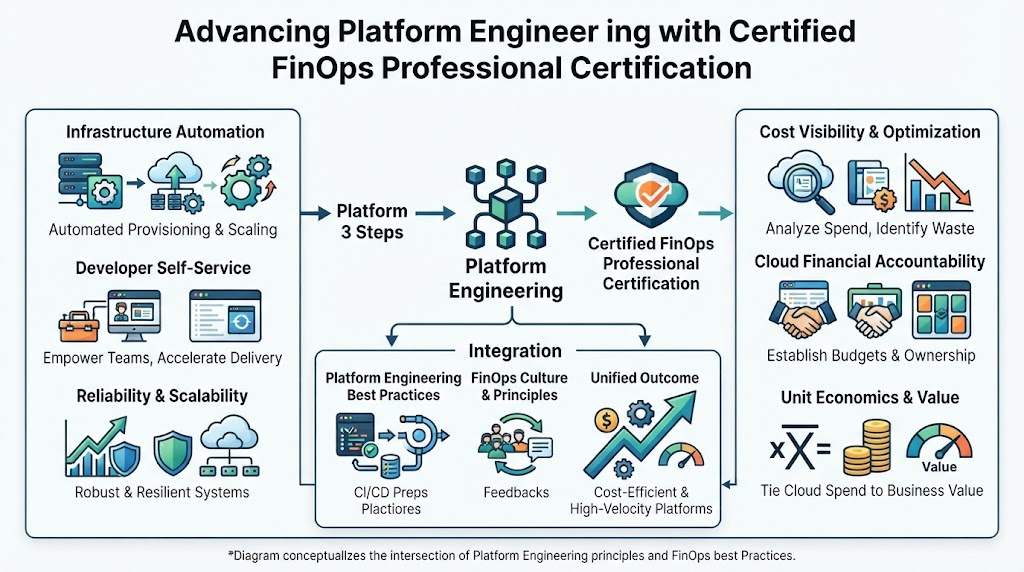
Introduction
Modern enterprise engineering requires technical teams to manage computing environments with strict financial accountability alongside high operational performance. The Certified FinOps Professional program hosted by FinOpsSchool equips cloud engineers, platform architects, and engineering leaders with the capabilities needed to bridge engineering velocity and cost governance. This guide breaks down the core architecture, preparation roadmap, enterprise utility, and career milestones associated with mastering cloud financial operations across multi-cloud environments.
Whether you are scaling Kubernetes clusters, deploying multi-region architectures, or auditing enterprise infrastructure expenses, understanding financial engineering principles ensures your technical decisions remain economically viable. This comprehensive analysis outlines the prerequisites, real-world competencies, progression paths, and strategic trade-offs required to successfully evaluate and navigate this professional milestone.
What is the Certified FinOps Professional?
The Certified FinOps Professional credential validates an engineer’s ability to operationalize cloud financial management across large-scale distributed architectures. Rather than approaching cost as an isolated accounting task, the certification anchors cost optimization directly into the core engineering and infrastructure lifecycle. It teaches practitioners how to measure unit economics, design automated governance guardrails, and establish feedback loops between development teams and financial stakeholders.
Modern enterprises face ballooning operational expenditure driven by dynamic resource provisioning, ephemeral container environments, and complex multi-cloud deployments. This credential proves that a practitioner understands how to implement cost-allocation tags, interpret complex billing telemetry, architect reserved and spot capacity strategies, and build continuous cost visibility into CI/CD pipelines. It represents practical, production-level expertise in maintaining financial health without compromising reliability, security, or feature velocity.
Who Should Pursue Certified FinOps Professional?
The Certified FinOps Professional program is tailored for technical professionals responsible for provisioning, architecting, and governing cloud infrastructure resources. Cloud engineers, site reliability engineers, and platform architects benefit directly by learning how infrastructure design choices impact unit costs and bottom-line operational margins. Security engineers and data engineers handling high-throughput compute infrastructure also gain the skills needed to eliminate compute waste and design sustainable architectures.
Engineering managers, directors of infrastructure, and enterprise technical leads use this certification to foster a culture of financial accountability across distributed development squads. In high-growth technology markets such as India, North America, and Europe, enterprises are transitioning from unconstrained cloud migration to strict financial governance, making these skills essential across both start-up ecosystems and Fortune 500 enterprises.
Why Certified FinOps Professional
Cloud infrastructure is no longer evaluated solely on uptime and throughput; business viability demands rigorous cost predictability and architectural efficiency. As organizations scale their hybrid, multi-cloud, and artificial intelligence workloads, unmanaged infrastructure sprawl rapidly erodes operating margins. Mastering the disciplines of visibility, optimization, and governance ensures engineers remain indispensable technical leaders regardless of macro-economic cycles.
The methodologies taught in this framework transcend individual cloud service providers and vendor-specific billing consoles. While underlying tools and managed services continue to evolve, the foundational disciplines of unit economics, rate optimization, continuous workload rightsizing, and automated policy enforcement remain durable career assets. Investing the time to master these operational mechanics delivers immediate returns in architectural maturity, leadership visibility, and cross-functional engineering influence.
Certified FinOps Professional Certification Overview
The Certified FinOps Professional program evaluates an engineer’s comprehension of cloud economics, organizational alignment, continuous optimization workflows, and governance automation. The evaluation framework emphasizes real-world scenario analysis, architectural problem-solving, and cost-modeling exercises over rote memorization of portal interfaces.
Candidates must demonstrate an end-to-end understanding of how infrastructure metrics correlate with operational expenses across compute, storage, data egress, and managed services. The credentialing structure ensures that certified individuals possess the technical fluency to communicate with infrastructure engineers while providing clear, actionable financial telemetry to executive stakeholders.
Certified FinOps Professional Certification Tracks & Levels
The certification framework follows a tiered structure designed to guide technical talent from foundational literacy to advanced operational architecture:
- Foundation Level: Focuses on cloud economics vocabulary, basic cost-allocation mechanisms, shared responsibility models, and core billing data structures.
- Professional Level: Evaluates deep operational mechanics, including anomaly detection, automated rightsizing pipelines, rate optimization strategies, unit cost modeling, and organizational enablement.
- Advanced / Architect Level: Assesses cross-organizational governance, multi-cloud billing aggregation, real-time telemetry automation, custom showback/chargeback systems, and enterprise cultural transformations.
Complete Certified FinOps Professional Certification Table
| Track | Level | Who it’s for | Prerequisites | Skills Covered | Recommended Order |
| Cloud Financial Operations | Foundation | Junior Engineers, Analysts, Project Managers | Basic Cloud Knowledge | Cloud Billing Basics, Tagging Concepts, Cost Visibility | Step 1 |
| Cloud Financial Operations | Professional | Cloud Engineers, DevOps, SREs, Technical Leads | 1-2 Years Cloud Experience | Unit Economics, Anomaly Detection, Spot/RI Planning, Automation | Step 2 |
| Enterprise Governance | Advanced / Architect | Principal Architects, Directors, FinOps Leads | Professional Level + Systems Architecture | Multi-Cloud Aggregation, Automated Policy Enforcement, Showback | Step 3 |
Detailed Guide for Each Certified FinOps Professional Certification
Certified FinOps Professional – Foundation
What it is
Validates foundational comprehension of cloud billing metrics, resource tracking standards, and the core collaboration lifecycle between finance, engineering, and procurement teams.
Who should take it
Early-career cloud practitioners, systems administrators, financial analysts embedded in engineering units, and engineering project managers seeking baseline cloud financial literacy.
Skills you’ll gain
- Interpreting primary cloud billing reports and invoices
- Implementing structured resource metadata and tagging schemas
- Identifying basic compute, storage, and networking cost drivers
- Establishing basic cost-allocation and visibility dashboards
Real-world projects you should be able to do
- Generate monthly cost-center attribution reports across cloud accounts
- Audit untagged enterprise infrastructure assets and map them to business units
- Configure cloud-native budget alerts and billing thresholds
Preparation plan
- 7–14 Days: Study core cloud billing concepts, pricing calculators, and resource hierarchy structures.
- 30 Days: Analyze live billing exports, explore metadata tagging strategies, and build baseline cost reports.
- 60 Days: Pair foundational studies with hands-on practice in multi-account cloud landing zones.
Common mistakes
- Focusing purely on accounting terms without understanding underlying cloud compute models.
- Ignoring the importance of consistent infrastructure tagging and resource hierarchies.
Best next certification after this
- Same-track option: Certified FinOps Professional – Practitioner/Professional Level
- Cross-track option: Certified DevOps Professional
- Leadership option: Certified Engineering Management Professional
Certified FinOps Professional – Professional Level
What it is
Validates advanced technical capabilities in engineering automated cost governance, unit economic tracking, commitment-based discount management, and infrastructure rightsizing.
Who should take it
Mid-to-senior DevOps engineers, site reliability engineers, cloud platform developers, and technical leads responsible for enterprise infrastructure efficiency and reliability.
Skills you’ll gain
- Architecting automated anomaly detection and alerting pipelines
- Structuring Savings Plans, Reserved Instances, and Spot compute strategies
- Measuring engineering unit economics (e.g., cost per API call, cost per active tenant)
- Automating resource cleanup, scale-down policies, and container rightsizing
Real-world projects you should be able to do
- Build an automated CI/CD pipeline step that estimates pull request infrastructure costs
- Implement a cluster-level Kubernetes cost-allocation engine with workload granularity
- Design a multi-region commitment coverage plan balancing cost against architectural flexibility
Preparation plan
- 7–14 Days: Focus on mathematical discount modeling, advanced billing telemetry, and commitment algorithms.
- 30 Days: Implement automated rightsizing scripts, analyze containerized workload costs, and design showback models.
- 60 Days: Conduct complete enterprise infrastructure audits, optimize storage lifecycles, and automate cost anomaly alerts.
Common mistakes
- Over-committing to long-term reserved capacity without modeling architectural evolution.
- Failing to account for data transfer, snapshot, and IOPS costs when planning migrations.
Best next certification after this
- Same-track option: Certified FinOps Professional – Enterprise Architect Level
- Cross-track option: Certified Site Reliability Engineer (SRE)
- Leadership option: Certified Cloud Program Director
Choose Your Learning Path
DevOps Path
The DevOps learning path integrates continuous financial feedback loops directly into the software development lifecycle. Engineers learn to shift cost awareness left by integrating infrastructure-as-code linting and cost estimation tools into pull request workflows. This path equips practitioners to optimize continuous integration pipelines, eliminate orphan build environments, and automate container resource declarations.
DevSecOps Path
The DevSecOps path links cloud financial management with compliance and security policy enforcement. Practitioners discover how misconfigurations, unpatched legacy instances, and open network egress routes cause severe financial waste alongside security vulnerabilities. This path focuses on deploying unified policy-as-code rules that simultaneously validate security compliance and prevent unnecessary resource expenditure.
SRE Path
The Site Reliability Engineering path harmonizes system availability targets, error budgets, and financial constraints. SREs learn to design resilient architectures that scale dynamically without generating unexpected cost spikes during traffic surges. This track emphasizes setting data-driven elasticity thresholds, optimizing observability telemetry storage costs, and aligning service level objectives with infrastructure spend.
AIOps Path
The AIOps path focuses on deploying algorithmic observability systems to automate cloud cost anomaly detection and operational event remediation. Engineers learn to process massive streams of infrastructure telemetry using intelligent baselines to catch unexpected resource consumption patterns instantly. This specialization ensures complex distributed platforms maintain optimal operational health through automated machine-assisted tuning.
MLOps Path
The MLOps path addresses the substantial compute and data challenges inherent in training, fine-tuning, and serving machine learning models. Practitioners master the economics of specialized GPU clusters, dynamic model inferencing endpoints, and distributed storage pipelines. This path teaches engineers how to manage high-cost AI infrastructure through distributed spot training, quantization, and scheduled hardware decommissioning.
DataOps Path
The DataOps path equips data engineers and warehouse architects to govern massive analytical data pipelines, distributed storage tiers, and serverless compute queries. Learners focus on query optimization, partitioning strategies, automated cold-storage lifecycle policies, and warehouse concurrency management. This specialization prevents unexpected billing overruns across enterprise data lakes and streaming analytical engines.
FinOps Path
The dedicated FinOps path represents deep specialization in enterprise cloud financial engineering, unit economic modeling, and organizational governance. Practitioners master the complete lifecycle of Inform, Optimize, and Operate across complex, multi-cloud enterprise footprints. This path develops industry leaders capable of driving cultural transformations that unify engineering velocity with financial discipline.
Role → Recommended Certified FinOps Professional Certifications
| Role | Recommended Certifications |
| DevOps Engineer | Certified FinOps Professional, Certified DevOps Engineer |
| SRE | Certified FinOps Professional, Certified Reliability Architect |
| Platform Engineer | Certified FinOps Professional, Certified Cloud Architect |
| Cloud Engineer | Certified FinOps Professional, Certified Infrastructure Engineer |
| Security Engineer | Certified FinOps Professional, Certified DevSecOps Professional |
| Data Engineer | Certified FinOps Professional, Certified DataOps Specialist |
| FinOps Practitioner | Certified FinOps Professional (Foundation, Professional, Architect) |
| Engineering Manager | Certified FinOps Professional, Certified Technical Management Lead |
Next Certifications to Take After Certified FinOps Professional
Same Track Progression
Deepening specialization within the cloud financial operations discipline involves pursuing advanced enterprise governance, multi-cloud cost architecture, and specialized organizational enablement credentials. Advanced practitioners focus on designing custom billing extraction pipelines, architecting real-time streaming cost allocation frameworks, and defining corporate financial policies for complex hybrid environments.
Cross-Track Expansion
Broadening your technical scope into adjacent engineering disciplines creates a robust, highly versatile architectural profile. Pairing cloud financial fluency with advanced Site Reliability Engineering (SRE), GitOps automation, Kubernetes operations, or DevSecOps security engineering enables you to design systems that are secure, highly available, and inherently cost-efficient.
Leadership & Management Track
Transitioning from individual technical execution to engineering leadership requires mastering executive communication, organizational change management, and portfolio investment governance. Leadership-oriented tracks prepare senior professionals to direct enterprise platform engineering teams, establish Centers of Excellence, and report engineering ROI directly to corporate executive boards.
Training & Certification Support Providers for Certified FinOps Professional
DevOpsSchool
DevOpsSchool provides comprehensive enterprise training programs covering modern cloud infrastructure, automation pipelines, and infrastructure governance. Their curriculum balances theoretical principles with intensive hands-on lab environments, enabling engineers to master complex deployment scenarios, container orchestration, and continuous integration workflows under real-world production constraints.
Cotocus
Cotocus delivers focused corporate enablement and technical consulting programs designed for enterprise engineering organizations. Their training modules emphasize cloud modernization, platform engineering standards, and infrastructure automation, ensuring software teams can deploy reliable, scalable, and economically sustainable cloud-native architectures.
Scmgalaxy
Scmgalaxy serves as a community-driven knowledge portal and learning platform specializing in configuration management, build automation, and infrastructure engineering. The platform provides detailed technical tutorials, practical documentation, and structured learning resources designed to help engineers master complex operational and deployment challenges.
BestDevOps
BestDevOps focuses on curating industry best practices, architectural blueprints, and professional development frameworks across the infrastructure domain. Their training tracks guide engineers through modern automation strategies, container platforms, and operational governance models essential for scalable enterprise engineering.
devsecopsschool.com
devsecopsschool.com delivers deep specialization in automated security testing, policy-as-code frameworks, and compliance automation. Their courses teach engineers how to weave continuous security auditing, vulnerability scanning, and governance controls directly into cloud delivery pipelines without reducing deployment velocity.
sreschool.com
sreschool.com provides comprehensive curriculum tracks dedicated to site reliability engineering, distributed systems observability, and incident lifecycle management. The programs guide engineers through service level objective design, chaos engineering experiments, and resilient architectural patterns for large-scale production platforms.
aiopsschool.com
aiopsschool.com specializes in algorithmic IT operations, telemetry stream analytics, and machine-assisted incident mitigation. Their courses help platform engineers implement machine learning models to detect anomalies, automate root-cause analysis, and optimize complex cloud infrastructure operations.
dataopsschool.com
dataopsschool.com focuses on agile data pipeline engineering, analytical infrastructure governance, and distributed database performance. Their training paths guide data engineers through building reliable, automated data ingestion systems while managing storage lifecycles and query compute efficiency.
finopsschool.com
finopsschool.com is an educational platform dedicated exclusively to cloud financial management, unit economic modeling, and cloud cost governance. Their certification preparation programs provide deep architectural insight, automated tooling patterns, and organizational governance strategies needed to master modern enterprise cloud economics.
Frequently Asked Questions (General)
1. What is the fundamental difficulty level of professional cloud certifications?
Professional infrastructure certifications are designed to test real-world problem-solving rather than simple memorization. They evaluate whether you can handle ambiguous production scenarios, unexpected cost overruns, and multi-service architectural trade-offs under real operational constraints.
2. How much preparation time is typically required for working engineers?
Most working engineers dedicate between four to eight weeks, investing approximately five to ten hours per week. This provides adequate time to review advanced architectural concepts, build automation scripts, and analyze complex production billing data.
3. Are there mandatory prerequisites required before taking advanced exams?
While formal foundational credentials are often recommended, practical experience managing cloud infrastructure on platforms like AWS, Azure, or Google Cloud Platform serves as the most effective prerequisite for advanced success.
4. What tangible return on investment can engineers expect?
Certified practitioners frequently move into strategic platform engineering, infrastructure leadership, or cloud architecture roles. Enterprises prioritize hiring professionals who demonstrate concrete expertise in controlling large-scale operational infrastructure expenditures.
5. How do financial engineering credentials complement DevOps certifications?
DevOps principles optimize speed, automation, and system reliability, while financial engineering ensures those automated deployments remain economically sustainable. Combining both skill sets produces well-rounded architects who understand the complete technical and business lifecycle.
6. How frequently do cloud infrastructure certifications need to be renewed?
Most technical certifications remain valid for two to three years. Renewal processes typically require passing an updated examination or demonstrating continuous professional development to reflect changing cloud-native tooling and architectural methodologies.
7. Can non-engineering professionals benefit from these technical programs?
Yes. Technical project managers, procurement specialists, and financial analysts working embedded within technology departments gain the necessary architectural vocabulary to collaborate effectively with engineering teams and execute precise cost allocations.
8. Should I pursue platform-specific certifications before specialized operational credentials?
Earning an associate or professional administrator certification from a primary cloud provider provides helpful context. However, specialized operational certifications establish broader cross-cloud architectural and governance competencies that apply universally across all service providers.
9. Are laboratory environments necessary for exam preparation?
Hands-on lab experimentation is essential. Analyzing synthetic billing exports, configuring automated resource tags, setting up alerts, and executing rightsizing scripts solidify conceptual knowledge far better than reading documentation alone.
10. How do organizations measure the impact of having certified personnel?
Enterprises evaluate impact through measurable metrics: reduced unallocated cloud spend, increased commitment discount coverage, automated elimination of unused assets, and accurate attribution of infrastructure costs to revenue-generating features.
11. Is coding proficiency required for infrastructure financial management?
Basic scripting skills in languages like Python, Bash, or Go are highly beneficial. They allow engineers to automate policy enforcement, parse billing JSON/CSV data feeds, and build automated resource scheduling pipelines.
12. What is the ideal order for pursuing cloud engineering certifications?
Start with general cloud architecture fundamentals, progress into continuous delivery and infrastructure automation, and then complete specialized operational credentials in reliability, financial engineering, and automated governance.
FAQs on Certified FinOps Professional
1. What makes the Certified FinOps Professional distinct from general cloud certifications?
Unlike traditional provider certifications that focus primarily on service provisioning, the Certified FinOps Professional specifically validates your ability to measure, manage, and optimize the ongoing business and financial impact of technical decisions. It blends deep architectural principles with financial accountability, ensuring you understand how to design multi-cloud systems that balance performance, resilience, and economic efficiency.
2. Does this credential require deep accounting and finance knowledge?
No, the focus remains primarily technical and operational. While candidates learn standard terminology such as capital versus operational expenditure, amortized costs, and unit economics, the curriculum is designed to teach engineers how to build automated technical mechanisms, resource governance frameworks, and architectural visibility pipelines.
3. How does this certification address modern containerized and Kubernetes environments?
The certification covers the operational complexities of shared container infrastructure. It teaches engineers how to break down aggregated cluster compute expenses, implement namespace-level allocation metrics, and accurately attribute microservice costs in dynamic, autoscaling Kubernetes clusters across multi-tenant enterprise environments.
4. What role does automation play in the certification curriculum?
Automation is a central pillar of the professional level curriculum. Candidates explore how to build continuous cost-monitoring checks into CI/CD pipelines, automate the decommissioning of orphaned resources, deploy policy-as-code guardrails, and trigger real-time alerts when consumption metrics deviate from baseline operational forecasts.
5. How does this credential benefit professionals working in multi-cloud architectures?
The principles taught are cloud-agnostic, focusing on consistent data categorization, centralized cost-visibility architectures, and unified governance standards. This equips engineers to normalize billing metrics and manage resource lifecycles consistently across AWS, Microsoft Azure, Google Cloud Platform, and private infrastructure.
6. Can this credential assist in career transitions from pure development to architecture?
Yes, demonstrating financial stewardship is a key requirement for senior and principal technical roles. Mastering cloud financial engineering shows organizational leadership that you consider total cost of ownership, business margins, and operational sustainability when designing large-scale distributed software architectures.
7. How does the curriculum cover commitment-based discount mechanisms?
The program teaches practical mathematical and operational strategies for purchasing, managing, and exchanging Reserved Instances, Savings Plans, and Spot instances. Candidates learn how to calculate commitment break-even points, avoid over-commitment risks, and architect flexible hybrid purchasing models across dynamic workloads.
8. What continuous governance frameworks are emphasized throughout the program?
The certification emphasizes establishing a continuous feedback loop: Inform (delivering visibility and allocation), Optimize (rightsizing and rate reduction), and Operate (automating governance and tracking unit metrics). This structured lifecycle ensures that cost optimization becomes an integral part of ongoing platform engineering routines.
Final Thoughts: Is Certified FinOps Professional Worth It?
Engineering decisions have immediate and direct financial consequences in modern cloud-native environments. Spinning up unoptimized database instances, leaving experimental GPU nodes running, or failing to establish lifecycle policies for object storage directly erodes business profitability. Technical competence today requires a mature understanding of the economic realities underpinning modern distributed infrastructure.
Pursuing the Certified FinOps Professional credential is an investment in architectural maturity. It elevates an engineer from someone who merely deploys services to a strategic technical leader capable of designing sustainable, cost-resilient platforms. If you aim to influence system design at an enterprise scale and bridge the gap between engineering speed and business value, mastering these disciplines is a necessary and highly rewarding step in your career journey.
