Introduction
In modern data-driven enterprises, organizations struggle to deliver reliable, high-speed data pipelines because silos separate data engineers, data scientists, and operations teams. The Certified DataOps Manager addresses this exact operational bottleneck by applying agile and automation principles to data workflows. This comprehensive guide is designed for software engineers, data professionals, platform architects, and engineering leaders who want to master data pipeline reliability and scalability. Written from the perspective of an experienced technical mentor, this article helps you evaluate whether this credential aligns with your career objectives in cloud-native and platform engineering environments. By exploring structured learning paths, real-world applications, and certification levels, you can make an informed decision to elevate your professional trajectory through DataOpsSchool.
What is the CDOM – Certified DataOps Manager?
The CDOM – Certified DataOps Manager represents a rigorous validation of a professional’s ability to orchestrate, monitor, and scale complex data pipelines in production environments. It exists to bridge the persistent gap between brittle data engineering scripts and reliable software delivery practices by emphasizing automated testing, continuous integration, and continuous deployment. Rather than focusing merely on theoretical concepts, the curriculum prioritizes hands-on production workflows, observability, and robust incident management for modern data architectures. It aligns seamlessly with enterprise practices by treating data as a first-class product that requires rigorous version control, automated quality checks, and robust governance. Ultimately, it equips practitioners to build resilient data platforms that minimize downtime and accelerate time-to-insight for business stakeholders.
Who Should Pursue CDOM – Certified DataOps Manager?
This credential benefits a diverse range of technical professionals, including data engineers, DevOps practitioners, software developers, and system reliability engineers. Beginners looking to break into data platform engineering will find a structured roadmap, while experienced engineers can validate their advanced orchestration and automation skills. Engineering managers and technical leaders also pursue this certification to understand how to build high-performing, autonomous data delivery teams. It holds immense relevance for professionals operating in global tech hubs as well as rapidly growing technology markets in India and beyond. By mastering these principles, practitioners position themselves at the forefront of modern data platform engineering and organizational transformation.
Why CDOM – Certified DataOps Manager
Enterprise demand for professionals who can bridge the gap between data engineering and operational excellence continues to surge across global markets. This certification provides exceptional longevity because it focuses on foundational automation and collaboration principles rather than transient tools or specific software vendors. It helps professionals remain highly relevant and adaptable despite rapid shifts in the technology landscape and cloud ecosystem tooling. The return on investment is substantial, translating into accelerated career advancement, higher earning potential, and leadership credibility in platform engineering. Furthermore, organizations actively seek certified managers who can reduce data pipeline failures and optimize resource utilization across distributed cloud environments.
CDOM – Certified DataOps Manager Certification Overview
The program is delivered via and hosted on. The certification assessment approach combines rigorous theoretical understanding with practical scenario-based evaluations to test real-world readiness. Program ownership rests with industry veterans who continuously update the curriculum to reflect evolving enterprise architectures and emerging industry standards. The structure is designed to be completed alongside full-time engineering roles, offering flexible learning modules and practical milestones. Candidates are evaluated through comprehensive examinations that test their ability to design, secure, and troubleshoot enterprise-grade data workflows.
CDOM – Certified DataOps Manager Certification Tracks & Levels
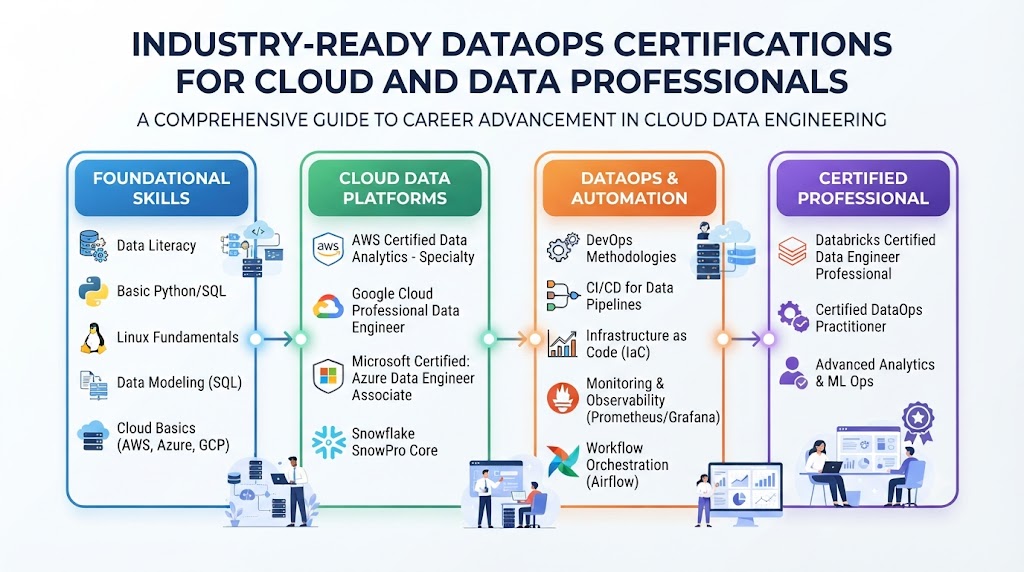
The certification structure includes foundational, professional, and advanced levels to accommodate various stages of a technical career. Specialization tracks allow practitioners to focus on specific domains such as orchestration, data quality, security, and cloud infrastructure management. Foundation levels establish core competencies in data pipeline monitoring, version control, and basic agile data practices. Professional levels dive deep into advanced CI/CD for data, automated testing frameworks, and scalable infrastructure provisioning. Advanced tracks prepare senior leaders to architect enterprise-wide data operations strategies and manage cross-functional data reliability engineering teams.
Complete CDOM – Certified DataOps Manager Certification Table
| Track | Level | Who it’s for | Prerequisites | Skills Covered | Recommended Order |
| DataOps Foundation | Foundation | Beginners, Data Analysts | Basic SQL and Python | Pipeline basics, Git, monitoring | 1 |
| DataOps Engineering | Professional | Data Engineers, Developers | Foundation level or 1 year experience | CI/CD, orchestration, testing | 2 |
| DataOps Management | Advanced | Managers, Architects | Professional level or 3 years experience | Governance, strategy, leadership | 3 |
CDOM – Certified DataOps Manager – Foundation Level
What it is
This entry-level credential validates foundational knowledge of data pipeline concepts, basic version control, and operational monitoring principles. It ensures candidates understand how to apply agile methodologies to data workflows and collaborate effectively across teams.
Who should take it
Suitable for junior data engineers, software developers transitioning into data roles, and analysts seeking operational fluency. Ideal for candidates with basic programming experience looking to build a strong operational foundation.
Skills you’ll gain
- Basic understanding of data lifecycle management
- Introduction to Git and version control for data
- Pipeline monitoring and alerting fundamentals
- Agile methodologies for data teams
Real-world projects you should be able to do
- Set up basic version control repositories for data scripts
- Configure simple pipeline execution monitors and alerts
- Implement basic data quality checks using open-source tools
- Document data pipeline workflows and dependencies
Preparation plan
- 7–14 days: Review core documentation, basic concepts, and introductory pipeline tutorials.
- 30 days: Complete hands-on labs, practice exercises, and sample assessment questions.
- 60 days: Ideal for working professionals needing a relaxed pace to absorb foundational concepts.
Common mistakes
- Focusing solely on theory without practicing basic pipeline configuration.
- Ignoring version control best practices for data assets.
- Skipping hands-on labs and relying only on video lectures.
Best next certification after this
- Same-track option: CDOM Professional Level
- Cross-track option: DevOps Foundation Certification
- Leadership option: Agile Data Leadership Credential
CDOM – Certified DataOps Manager – Professional Level
What it is
This professional credential validates advanced capability in designing, automating, and maintaining production-grade data pipelines. It focuses heavily on automated testing, CI/CD integration, and robust infrastructure orchestration.
Who should take it
Designed for mid-level data engineers, DevOps practitioners, and platform engineers with hands-on pipeline management experience. Ideal for professionals looking to prove their technical competence in enterprise environments.
Skills you’ll gain
- Advanced CI/CD pipeline automation for data workflows
- Comprehensive data quality and testing frameworks
- Infrastructure as Code for data environments
- Performance tuning and cost optimization
Real-world projects you should be able to do
- Build fully automated CI/CD pipelines for data ingestion and transformation
- Implement automated data quality validation gates prior to production deployment
- Configure containerized data processing environments using Docker and Kubernetes
- Establish comprehensive logging and observability for distributed data systems
Preparation plan
- 7–14 days: Intensive review for experienced engineers with strong background in CI/CD.
- 30 days: Standard preparation involving structured labs and practical implementation tasks.
- 60 days: Extended study track for candidates balancing heavy workload and complex projects.
Common mistakes
- Underestimating the complexity of automated data testing frameworks.
- Neglecting infrastructure security and credential management in pipelines.
- Failing to test pipeline rollback and disaster recovery scenarios.
Best next certification after this
- Same-track option: CDOM Advanced Management Level
- Cross-track option: SRE Professional Certification
- Leadership option: Enterprise Data Engineering Leadership
CDOM – Certified DataOps Manager – Advanced Level
What it is
This advanced credential validates expert-level mastery in architecting enterprise-wide data operations strategies, governance frameworks, and leadership practices. It emphasizes organizational scalability, risk management, and team orchestration.
Who should take it
Targeted at senior architects, engineering managers, and technical directors leading enterprise data initiatives. Suitable for leaders responsible for defining organizational data reliability and operational standards.
Skills you’ll gain
- Enterprise data architecture and governance strategy
- Cross-functional team leadership and operational scaling
- Advanced risk management and compliance frameworks
- Cost-benefit analysis for data platform investments
Real-world projects you should be able to do
- Design a comprehensive enterprise DataOps framework for multi-cloud environments
- Implement organization-wide data governance and compliance automation
- Lead cross-functional migration projects with zero downtime for data consumers
- Establish operational metrics and SLAs for enterprise data platforms
Preparation plan
- 7–14 days: High-level review of enterprise architecture patterns and governance models.
- 30 days: Deep dive into case studies, leadership strategies, and advanced technical design.
- 60 days: Comprehensive preparation incorporating real-world architectural design projects.
Common mistakes
- Focusing too much on technical tools rather than organizational and cultural strategy.
- Ignoring compliance and security governance requirements.
- Failing to define measurable business outcomes for data platforms.
Best next certification after this
- Same-track option: Principal DataOps Architect
- Cross-track option: Enterprise FinOps Master
- Leadership option: VP of Engineering / CTO Advisory Track
Choose Your Learning Path
DevOps Path
The DevOps path focuses on bridging software development and IT operations through continuous integration, continuous delivery, and infrastructure automation. Practitioners learn to treat infrastructure as code and streamline deployment lifecycles across cloud environments. This journey equips engineers to manage containerized workloads, configure orchestration platforms, and ensure high system availability. It serves as an essential foundation for anyone looking to build robust and scalable enterprise delivery pipelines.
DevSecOps Path
The DevSecOps path integrates security practices directly into every phase of the software and data development lifecycle. Professionals learn to automate vulnerability scanning, manage compliance policies, and implement robust identity and access controls. This track emphasizes shifting security left to catch vulnerabilities early before code reaches production environments. Graduates are well-prepared to protect critical enterprise assets while maintaining high deployment velocity.
SRE Path
The Site Reliability Engineering path applies software engineering principles to infrastructure and operational problem-solving. Engineers learn to design scalable systems, establish service level objectives, and automate incident response workflows. This track focuses heavily on observability, capacity planning, and reducing toil through intelligent automation. It empowers professionals to maintain exceptional system reliability under high-load enterprise conditions.
AIOps / MLOps Path
The AIOps and MLOps path addresses the unique operational challenges of deploying and monitoring machine learning models in production. Practitioners learn to manage feature stores, automate model training pipelines, and track model drift over time. This track bridges data science and production engineering to ensure AI applications run reliably at scale. It is crucial for organizations looking to operationalize artificial intelligence investments effectively.
DataOps Path
The DataOps path focuses on applying agile and lean manufacturing principles to data engineering and analytics workflows. Professionals learn to automate data testing, streamline pipeline delivery, and enhance collaboration across data teams. This track minimizes data latency and errors while maximizing the business value delivered by analytics platforms. It prepares engineers to build resilient, trustworthy data ecosystems for modern enterprises.
FinOps Path
The FinOps path brings financial accountability to the variable spend model of cloud computing, enabling organizations to maximize business value. Practitioners learn to monitor cloud expenditure, allocate costs accurately, and implement optimization strategies. This track fosters a culture of cost consciousness among engineering and finance teams alike. It empowers leaders to drive cloud efficiency without compromising performance or innovation speed.
Role → Recommended CDOM – Certified DataOps Manager Certifications
| Role | Recommended Certifications |
| DevOps Engineer | CDOM Professional Level |
| SRE | CDOM Professional Level, SRE Certifications |
| Platform Engineer | CDOM Professional Level, Advanced Level |
| Cloud Engineer | CDOM Foundation and Professional |
| Security Engineer | CDOM Professional Level, DevSecOps Track |
| Data Engineer | CDOM Foundation, Professional Level |
| FinOps Practitioner | CDOM Foundation, FinOps Integration |
| Engineering Manager | CDOM Advanced Management Level |
Next Certifications to Take After CDOM – Certified DataOps Manager
Same Track Progression
Advancing within the same track involves pursuing specialized masterclasses or expert-level credentials in data reliability engineering. This allows professionals to deepen their technical expertise in areas such as real-time stream processing operations and advanced pipeline automation. Deep specialization makes engineers indispensable for complex, enterprise-scale data architecture challenges. It also positions candidates for senior individual contributor roles such as Principal DataOps Architect.
Cross-Track Expansion
Broadening skill sets through cross-track expansion involves exploring complementary domains like Site Reliability Engineering, FinOps, or Cloud Security. By combining data operations expertise with cloud financial management or security orchestration, professionals become versatile technical leaders. This multidisciplinary approach enables engineers to solve complex architectural problems that span across departmental boundaries. Cross-track expansion significantly enhances career resilience and mobility in competitive job markets.
Leadership & Management Track
Transitioning to leadership involves moving from hands-on engineering execution to strategic oversight, team mentorship, and organizational governance. Professionals focus on developing leadership acumen, managing multi-disciplinary engineering budgets, and aligning technology roadmaps with business goals. This pathway prepares senior practitioners for roles such as Director of Engineering, Vice President of Technology, or Chief Technology Officer. Leadership certifications provide the formal validation needed to guide enterprise-scale digital transformations.
Training & Certification Support Providers for CDOM – Certified DataOps Manager
DevOpsSchool is a globally recognized training provider offering comprehensive certification preparation programs, expert-led bootcamps, and real-world project experience for modern engineering professionals seeking career advancement across diverse technical domains.
Cotocus delivers specialized corporate training and consulting services designed to bridge skill gaps in enterprise environments through hands-on workshops, tailored curriculum development, and experienced industry mentorship.
Scmgalaxy serves as a prominent knowledge-sharing hub and training provider focusing on software configuration management, DevOps tooling, and continuous delivery best practices for global engineering teams.
BestDevOps provides curated learning paths, practical tutorials, and certification training programs aimed at helping engineers master cloud-native technologies and modern infrastructure automation practices effectively.
devsecopsschool.com specializes in security-first training tracks that integrate vulnerability management, compliance automation, and secure coding practices into standard software delivery lifecycles.
sreschool.com offers targeted education on site reliability engineering principles, focusing on observability, incident management, automation, and maintaining high system availability under production stress.
aiopsschool.com focuses on operationalizing artificial intelligence and machine learning workflows, helping engineers master model deployment, monitoring, and automated infrastructure management for AI applications.
dataopsschool.com provides authoritative training and certification programs specifically designed to streamline data pipelines, enhance data quality, and foster collaboration across enterprise data engineering teams.
finopsschool.com delivers specialized education on cloud financial management, cost optimization strategies, and establishing accountability across engineering and finance departments in cloud-native organizations.
Frequently Asked Questions
1. What is the overall difficulty level of the CDOM certification?
The difficulty level varies by track, ranging from accessible foundation exams to rigorous professional and advanced assessments that require hands-on production experience.
2. How long does it typically take to prepare for the certification exam?
Preparation generally takes between two to four weeks of dedicated study for experienced professionals, while beginners may require up to six weeks of structured learning.
3. Are there any mandatory prerequisites for taking the certification?
Foundation levels have no strict prerequisites, while professional and advanced levels recommend relevant industry experience or completion of prior foundational credentials.
4. What is the expected return on investment after earning this credential?
Certified professionals often experience accelerated career growth, enhanced job security, and increased earning potential due to high enterprise demand for pipeline reliability.
5. Can I attempt the certification exam without attending a formal training course?
Yes, candidates can choose a self-study path and register directly for the examination, though structured training significantly improves practical readiness and pass rates.
6. How are the certification exams structured and delivered?
Exams combine multiple-choice theoretical questions with practical scenario-based evaluations delivered through secure online proctoring platforms.
7. How often should certified professionals renew their credentials?
Certifications typically require renewal every two to three years through continuing education, advanced exams, or active contributions to the engineering community.
8. What kind of hands-on environment is needed for exam preparation?
Candidates benefit from access to a cloud sandbox environment or local containerized setups to practice pipeline automation, CI/CD configuration, and monitoring.
9. Is this certification recognized globally by enterprise employers?
Yes, the certification holds strong recognition across global technology markets in North America, Europe, and Asia-Pacific regions for validating practical operational skills.
10. How does this credential compare to traditional cloud vendor certifications?
While cloud vendor certifications focus on specific platform tools, this credential emphasizes vendor-neutral operational practices, automation, and cross-functional collaboration.
11. What support is available if I fail the certification exam on my first attempt?
Candidates typically receive a detailed performance breakdown and are eligible to retake the examination after a brief mandatory cooling-off and review period.
12. How do I choose the right specialization track for my career goals?
Evaluate your current daily responsibilities, long-term career aspirations, and organizational needs to select a track that bridges your current skill gaps most effectively.
FAQs on CDOM – Certified DataOps Manager
1. What specific pipeline orchestration tools are covered in the curriculum?
The curriculum covers vendor-neutral concepts alongside popular orchestration frameworks like Airflow, Prefect, and modern CI/CD runners to ensure broad applicability.
2. How does the certification address automated data quality testing?
It emphasizes implementing automated testing gates for schema validation, data freshness, null checks, and anomaly detection prior to production deployment.
3. Is coding experience mandatory for clearing the professional level?
Basic proficiency in scripting languages such as Python or SQL is highly recommended for configuring pipelines and writing automated test assertions.
4. How does the program help engineering managers evaluate team performance?
It equips managers with standard metrics, SLA frameworks, and operational governance models to measure data pipeline reliability and team throughput objectively.
5. Does the curriculum include multi-cloud data operations strategies?
Yes, advanced modules cover architectures and operational patterns designed for multi-cloud and hybrid enterprise data environments.
6. How are data security and compliance integrated into data workflows?
Candidates learn to implement secure credential management, role-based access control, and automated compliance auditing within their deployment pipelines.
7. Can software engineers with no prior data background transition smoothly?
Software engineers find the transition very manageable because the curriculum leverages familiar DevOps, CI/CD, and infrastructure automation principles.
8. What resources are provided upon enrolling in the official program?
Enrolled candidates receive comprehensive study guides, hands-on lab environments, practice assessments, and access to an active community of engineering peers.
Final Thoughts: Is CDOM – Certified DataOps Manager Worth It?
Investing time and effort into the CDOM – Certified DataOps Manager is a pragmatic decision for any engineer or leader aiming to master modern data pipeline reliability. In an industry flooded with superficial training programs, this credential stands out by focusing on rigorous, production-grade operational practices that solve real enterprise problems. It equips you with the technical depth and strategic mindset needed to eliminate data silos and accelerate delivery velocity. If your goal is to build resilient data platforms and lead high-performing teams, this certification provides an invaluable roadmap for your career journey.
