Introduction
The intersection of machine learning and production infrastructure is where the most significant technical challenges—and rewards—reside today. If you are building models that never leave a laptop, you aren’t doing MLOps; you are doing research. To truly excel, you need to master the art of deploying, monitoring, and scaling AI in real-world systems. The Certified MLOps Engineer program is built for practitioners who want to move past the theory and become architects of reliable AI. This guide acts as your professional compass, helping you navigate the requirements, career paths, and technical frameworks that matter most in aiopsschool.
What is the Certified MLOps Engineer?
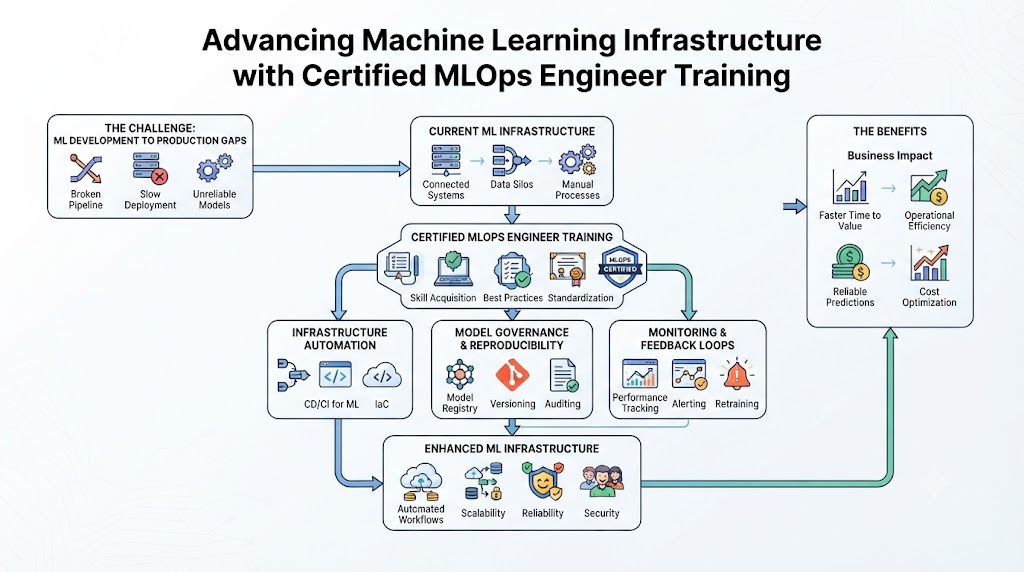
This certification is a deep dive into the operational lifecycle of machine learning. It exists because “it works on my machine” is not an acceptable standard for enterprise AI. The program covers the end-to-end process of taking an ML experiment and transforming it into a production-grade service that is reproducible, scalable, and resilient. It aligns closely with the principles of DevOps and SRE, teaching you how to treat models as code artifacts and data as a critical, managed dependency. It is built for engineers who value practical production outcomes over abstract mathematical models.
Who Should Pursue Certified MLOps Engineer?
If you are a software engineer, DevOps specialist, or a data scientist who is tired of the “black box” deployment phase, this is for you. Site Reliability Engineers (SREs) who need to extend their monitoring frameworks to cover model performance will find this extremely relevant. Engineering managers who are currently struggling with technical debt in their AI projects will also gain the necessary insights to guide their teams toward better practices. Whether you are working in a startup or managing global infrastructure in India, the skills mapped out here are universal and highly sought after by modern tech organizations.
Why Certified MLOps Engineer
The tech landscape is shifting rapidly, but the need for reliable systems remains constant. By becoming certified, you prove that you can handle the non-deterministic nature of machine learning within a deterministic infrastructure environment. This certification keeps you relevant because it focuses on the “how” of engineering, not just the current “what” of popular tools. You are essentially buying back your future time by learning how to automate, version, and monitor systems that would otherwise require constant manual intervention. It is a high-yield investment that differentiates you from peers who only understand how to train models.
Certified MLOps Engineer Certification Overview
This program is offered through. The certification process is designed to be rigorous, focusing on real-world engineering capability rather than rote memorization. It includes various levels that cater to different expertise tiers, ensuring that everyone from a junior engineer to a seasoned architect has a clear path forward. The assessment is designed to verify that you can handle the pressure of real production scenarios where data pipelines meet software delivery.
Certified MLOps Engineer Certification Tracks & Levels
The certification path is tiered to reflect the depth of your operational expertise. Foundation levels cover the basic tenets of automation and versioning, which are the building blocks of any MLOps practice. Professional levels introduce the complexities of model serving and CI/CD for data. Advanced levels challenge you to design scalable, secure, and cost-effective AI platforms that serve enterprise needs. Choosing a track allows you to align your certification with your daily work, whether that leans more toward infrastructure automation, data engineering, or reliability engineering.
Complete Certified MLOps Engineer Certification Table
| Track | Level | Who it’s for | Prerequisites | Skills Covered | Recommended Order |
|---|---|---|---|---|---|
| Core MLOps | Foundation | Aspiring Engineers | Basic Cloud Knowledge | CI/CD, Versioning | 1 |
| Production MLOps | Professional | MLOps Practitioners | Core Certification | Monitoring, Serving | 2 |
| AI Architecture | Advanced | Lead Engineers | Professional Certification | Scaling, Strategy | 3 |
Detailed Guide for Each Certified MLOps Engineer Certification
Certified MLOps Engineer – Foundation Level
What it is This entry-level credential tests your grasp of the fundamental MLOps lifecycle, verifying that you understand how to bridge the gap between model code and production deployment.
Who should take it Engineers starting their journey into the AI infrastructure space or developers moving from traditional apps to data-intensive services.
Skills you’ll gain
- Automated model versioning workflows.
- Basics of CI/CD for ML.
- Setting up reproducible development environments.
Real-world projects you should be able to do
- Setting up a basic versioning system for data and models.
- Automating the training trigger based on code changes.
- Creating simple unit tests for input data validation.
Preparation plan
- 7–14 days: Master the core theory and basic pipeline patterns.
- 30 days: Implement three small, automated workflows from scratch.
- 60 days: Review advanced toolchain integration and complete practice simulations.
Common mistakes
- Neglecting data quality checks.
- Overcomplicating the initial architecture.
Best next certification after this
- Same-track option: Certified MLOps Engineer – Professional Level
- Cross-track option: Certified DevOps Specialist
- Leadership option: Certified AIOps Strategist
Choose Your Learning Path
DevOps Path This track is about building the foundation of your AI systems. You will learn to use familiar DevOps tools to manage model lifecycles, focusing on infrastructure as code, automated testing, and the orchestration of training and deployment environments.
DevSecOps Path This track brings security to the forefront of AI. You will learn how to identify potential attack vectors in machine learning, such as adversarial inputs or data poisoning, and implement automated security controls within your deployment pipelines.
SRE Path In this track, the focus is purely on the reliability of AI services. You will learn how to define and measure service-level indicators for model performance and create robust, self-healing systems that can survive data drift and infrastructure failures.
AIOps Path This track focuses on the application of intelligence to infrastructure itself. You will learn to build systems that analyze logs, metrics, and traces using machine learning to proactively identify bottlenecks and automate remediation tasks.
MLOps Path This is the central track for engineers who want to specialize in the end-to-end model pipeline. You will master data ingestion, feature store management, model training orchestration, and the critical monitoring of models after they are live.
DataOps Path Focusing on the data side, this path teaches you how to manage large-scale data flows reliably. You will learn how to perform data validation, lineage tracking, and transformation in ways that support the continuous training requirements of modern ML.
FinOps Path This track addresses the economic side of AI. You will learn to manage the significant costs associated with GPU compute and model inference, implementing strategies to optimize cloud spend without compromising on system performance.
Role → Recommended Certified MLOps Engineer Certifications
| Role | Recommended Certifications |
|---|---|
| DevOps Engineer | MLOps Core, MLOps Production |
| SRE | MLOps Production, MLOps Architecture |
| Platform Engineer | MLOps Architecture |
| Cloud Engineer | MLOps Core |
| Security Engineer | MLOps Production |
| Data Engineer | MLOps Core, DataOps Practitioner |
| FinOps Practitioner | FinOps for ML |
| Engineering Manager | MLOps Architecture |
Next Certifications to Take After Certified MLOps Engineer
Same Track Progression Once the core concepts are solid, you should aim for architectural depth. This means moving into specialized fields like high-availability model inference or multi-region deployment architectures that ensure global scale.
Cross-Track Expansion The most versatile engineers understand how MLOps intersects with data quality and cloud economics. Adding DataOps or FinOps certifications to your portfolio makes you a Swiss Army knife capable of solving complex, multi-layered enterprise problems.
Leadership & Management Track For those aiming to lead, the focus must shift to governance and strategic adoption. Certifications in AI management help you articulate the business value of your technical work and foster a culture of operational excellence within your organization.
Training & Certification Support Providers for Certified MLOps Engineer
DevOpsSchool is a top-tier provider that specializes in the technical nuances of the software delivery lifecycle, offering hands-on training that perfectly aligns with the requirements of this certification.
Cotocus provides an ecosystem for learning that emphasizes real-world application, ensuring that candidates are not just learning definitions but are building the capability to execute.
Scmgalaxy offers deep technical insights into the world of configuration and release management, providing the essential building blocks for any serious MLOps engineer.
BestDevOps provides a comprehensive learning experience that helps bridge the gap between standard development practices and the unique requirements of modern machine learning workflows.
devsecopsschool ensures that you learn to build AI systems that are not only high-performing but also inherently secure, covering the critical aspects of model and pipeline integrity.
sreschool focuses on the “always-on” aspect of AI, teaching you how to build the observability and reliability frameworks that are essential for mission-critical ML deployments.
aiopsschool is your primary resource for this journey, offering a curriculum that is updated to reflect the latest industry advancements and operational strategies for AI systems.
dataopsschool provides the specialized knowledge needed to build and manage robust data pipelines, which are the backbone of any reliable and high-performing machine learning system.
finopsschool gives you the tools to manage your AI infrastructure costs effectively, teaching you how to align your engineering decisions with the business’s financial objectives.
Frequently Asked Questions
- How hard is the certification compared to traditional IT exams? It is more applied than traditional exams. Expect to be tested on how you would solve specific pipeline problems rather than just identifying definitions from a textbook.
- How long should I realistically prepare? If you have a background in cloud and DevOps, a month of focused, hands-on study should suffice. If you are newer to the field, give yourself two to three months.
- What are the prerequisites for these certifications? A solid foundation in Linux, containers, and basic coding is necessary. The certification builds on these skills, so having that base will make your learning much faster.
- Will this certification help me get a salary raise? Most professionals find that these certifications open doors to more senior, specialized roles, which naturally come with better compensation and growth prospects.
- Is this certification for researchers or engineers? It is almost exclusively for engineers. If your interest is in building better algorithms, this might be too operational for you; if your interest is in scaling and maintaining AI, this is perfect.
- Can I pass this exam without professional experience? Yes, but you will need to put in extra effort to build and break your own pipelines in a lab environment to gain the necessary practical experience.
- How often does the material change? The field of MLOps is moving fast. The curriculum is updated regularly to ensure you are learning modern patterns rather than outdated, legacy techniques.
- Is the exam globally recognized? Yes, the certification holds weight internationally because it validates standardized skills that are in demand by companies operating at scale worldwide.
- What is the fail policy? Providers generally offer a grace period for retakes, allowing you to focus your study on the specific areas identified in your initial attempt.
- Do I need to renew the certification? Yes, because technology advances, periodic renewal is a best practice to ensure your skills remain relevant and respected in the industry.
- Where should a beginner start? Begin with the fundamentals of cloud infrastructure and containers, then layer on the MLOps-specific modules to build a logical and durable career path.
- Are there any management-focused tracks? Yes, we offer tracks specifically for those looking to bridge the gap between technical operations and business value, helping you manage AI teams and strategy.
FAQs on Certified MLOps Engineer
- Does this cover model drift? Yes, monitoring and mitigating model drift is a central part of the professional and advanced certification levels.
- Is it purely about AWS or Azure? It is cloud-agnostic. The principles taught apply to any environment, as the focus is on the architecture and flow rather than specific vendor GUIs.
- Does it include labs? Yes, the certification path is designed around hands-on practice, ensuring you can apply what you learn directly to production environments.
- Will this help me manage Data Scientists? Definitely. It gives you the operational language to communicate with your data team and understand their technical bottlenecks.
- What is the focus of the pipeline modules? The modules focus on reproducibility, ensuring that your training and inference pipelines are consistent, traceable, and automated.
- Can I apply this to edge AI? The core principles of MLOps are highly applicable to edge deployment, and the advanced levels touch on these specific scaling and monitoring challenges.
- How does this differ from DevOps? DevOps focuses on software; MLOps adds the complexity of data versioning and model monitoring, which are unique to machine learning systems.
- Is this a high-demand skill? It is one of the fastest-growing niches in the industry, as companies struggle to get their ML investments into a reliable, production-ready state.
Final Thoughts: Is Certified MLOps Engineer Worth It?
If you are looking for an honest assessment, this certification is a gateway to a higher level of professional maturity. It doesn’t promise shortcuts; it promises a structured way to master the technical rigor required for production AI. In a field cluttered with hype, having a verifiable, skill-based certification proves you are one of the few who can actually build and maintain these systems. If you want to stop guessing and start engineering, this path is the most effective way to elevate your career and deliver tangible value to your organization.
