Introduction
In today’s fast-paced digital landscape, IT operations teams face an unprecedented challenge: managing hyper-scale, cloud-native environments that generate millions of data points every second. Imagine an enterprise infrastructure spanning hundreds of microservices, Kubernetes clusters, and distributed cloud databases. When a system failure occurs, the traditional manual approach to debugging—sifting through endless logs and fragmented alerts—is no longer feasible. This “noise” leads to alert fatigue, where critical issues are buried under thousands of false positives, ultimately leading to extended downtime.
The solution to this complexity lies in the shift toward intelligent operations. Organizations are increasingly turning to AIOps—the application of Artificial Intelligence and Machine Learning to IT operations data—to bring order to chaos. As businesses prioritize reliability and speed, the demand for professionals who can bridge the gap between traditional operations and intelligent automation is skyrocketing. For those looking to gain specialized knowledge, AIOpsSchool provides the structured curriculum and industry-focused guidance necessary to master these high-demand skills.
Featured Snippet
What Is AIOps?
AIOps (Artificial Intelligence for IT Operations) integrates machine learning, big data analytics, and automation to streamline IT processes. It enables teams to automatically identify patterns, correlate alerts across disparate systems, predict potential failures, and automate root cause analysis, effectively transforming reactive troubleshooting into proactive, intelligent system management.
Understanding AIOps
What Is Artificial Intelligence for IT Operations?
AIOps is a methodology that applies AI to IT operations data. It collects vast amounts of logs, metrics, traces, and events, processing them to extract actionable insights. It serves as the “brain” of your infrastructure monitoring stack.
Why Traditional IT Operations Are No Longer Enough
Traditional monitoring relies on static, rule-based alerts. If a CPU threshold hits 80%, an alert is fired. In a modern environment, this leads to “alert storms.” Human operators cannot scale to match the velocity of modern deployment cycles.
How AI and Machine Learning Improve Operations
ML algorithms excel at finding patterns that humans cannot see. They learn the “normal” behavior of an application and detect anomalies immediately, reducing the mean time to detect (MTTD) and mean time to resolve (MTTR).
Evolution from Monitoring to Intelligent Operations
| Traditional Operations | AIOps-Driven Operations |
| Manual Rule Creation | Pattern Recognition & Anomaly Detection |
| Reactive Troubleshooting | Proactive Incident Prevention |
| Fragmented Data Silos | Unified Observability & Correlation |
| High Alert Fatigue | Context-Aware Intelligent Alerting |
Why AIOps Skills Are Becoming Essential
The migration toward microservices and ephemeral infrastructure means IT teams can no longer manage systems manually. AIOps skills are essential because they provide the framework to automate the management of these complex environments, ensuring high availability and system reliability.
AIOps Certification Explained
What Is an AIOps Certification?
A professional validation that demonstrates a candidate’s proficiency in applying AI/ML techniques to IT infrastructure, observability, and incident management.
Benefits of Professional Certification
- Credibility: Proves your technical expertise to employers.
- Career Growth: Positions you for specialized roles like AIOps Architect.
- Standardization: Ensures you follow industry best practices for automation.
AIOps Engineer Career Roadmap
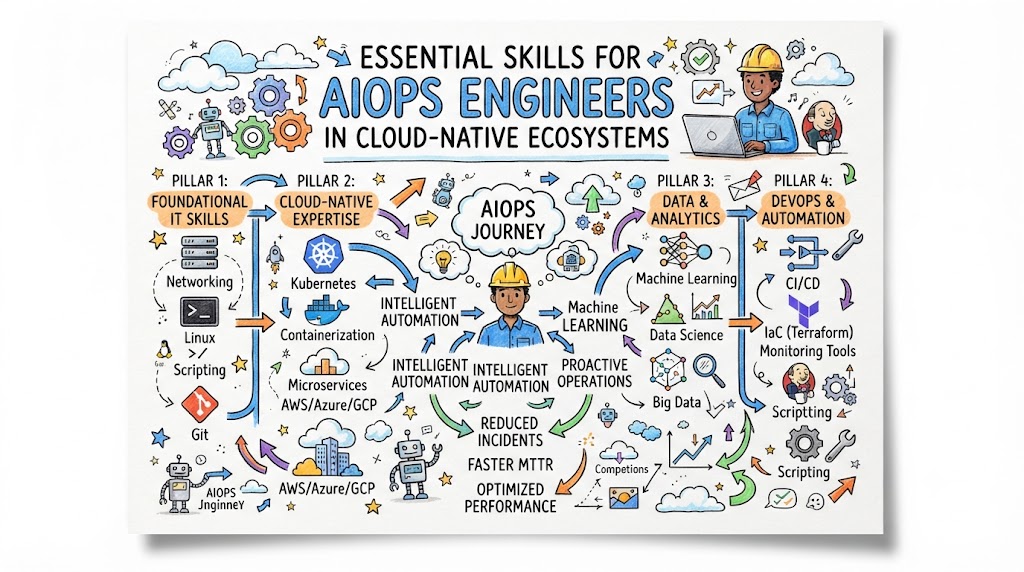
Required Technical Skills
- Observability: Understanding OpenTelemetry and distributed tracing.
- Automation: Scripting (Python) and infrastructure-as-code.
- Data Analysis: Ability to interpret data trends and anomalies.
- Cloud Architecture: Deep knowledge of AWS, Azure, or GCP.
AI Observability Training
What Is AI Observability?
It is the practice of gaining deep visibility into your system’s internal state by analyzing the data it produces (logs, metrics, and traces) through the lens of AI.
| Monitoring | Observability |
| Tells you if the system is down | Tells you why the system is down |
| Tracks predefined metrics | Provides exploratory visibility into state |
AIOps for SRE and DevOps Engineers
For SREs, AIOps acts as a force multiplier. Instead of manually correlating an incident across logs, the AIOps platform clusters related alerts into a single incident, allowing the SRE to focus on fixing the root cause rather than investigating noise.
Real-World Enterprise Use Cases
- Banking: Using anomaly detection to identify fraudulent transaction patterns or sudden service outages that impact customer access.
- SaaS Companies: Automating capacity planning to ensure resources scale during unexpected traffic spikes, preventing downtime.
Common Mistakes Professionals Make
- Tool Obsession: Focusing on the platform rather than the operational strategy.
- Ignoring Fundamentals: Skipping basic observability concepts like logging practices.
- Data Quality Neglect: Relying on poor data feeds, which results in inaccurate AI insights.
Why Learn with AIOpsSchool
Learning at AIOpsSchool offers a specialized environment tailored for professionals. You gain access to industry-grade curricula that focus on real-world implementation, ensuring that you don’t just learn the theory but understand how to deploy AIOps within complex enterprise infrastructures.
FAQ SECTION
1. What is AIOps Certification? An AIOps Certification is a professional credential that validates a candidate’s expertise in applying Artificial Intelligence and Machine Learning techniques to optimize IT operations. It confirms that the individual can effectively implement event correlation, anomaly detection, and predictive analytics to enhance system reliability.
2. Who should learn AIOps? AIOps is essential for professionals managing complex digital environments, including DevOps Engineers, Site Reliability Engineers (SREs), Cloud Architects, IT Operations Managers, and Monitoring Specialists who want to transition from manual troubleshooting to automated, intelligent infrastructure management.
3. What skills are required for AIOps Engineers? Successful AIOps engineers require a blend of technical skills, including proficiency in Python, Linux, and Cloud platforms (AWS, Azure, GCP). They must also possess strong knowledge of Kubernetes orchestration, observability frameworks like OpenTelemetry, data analysis methodologies, and automation scripting.
4. How does AIOps help DevOps teams? AIOps significantly benefits DevOps teams by filtering out noise from massive volumes of monitoring data. By automatically correlating alerts and identifying root causes, it allows DevOps engineers to focus on continuous delivery and feature development rather than spending hours on manual incident investigation.
5. What is AI Observability? AI Observability is the practice of using AI/ML to gain deep, actionable insights into the internal state of a system based on its external outputs—logs, metrics, and traces. Unlike basic monitoring, it uses intelligence to understand the “why” behind performance issues in distributed systems.
6. What is OpenTelemetry? OpenTelemetry is a vendor-neutral, open-source framework designed for the collection and export of telemetry data (logs, metrics, and traces). It acts as the industry-standard foundation for AIOps, ensuring that operations teams have a unified way to collect data across diverse infrastructure.
7. How long does it take to learn AIOps? While the timeline depends on an individual’s background, a structured professional certification path generally requires 3 to 6 months of dedicated learning. This includes mastering the theoretical foundations of AI/ML in operations and gaining practical experience with modern observability tooling.
8. What are AIOps Implementation Services? These are specialized consulting services provided by experts to help organizations integrate AIOps platforms into their existing stack. They cover the entire lifecycle, including maturity assessments, tool selection, data integration, automation strategy development, and continuous operational improvement.
9. Is AIOps a good career choice? Yes, AIOps is one of the most promising career paths in IT. As enterprises shift toward autonomous operations, the demand for specialists who can manage AI-driven infrastructure is growing faster than the supply of qualified talent, leading to competitive salaries and leadership opportunities.
10. What is the future of AIOps? The future of AIOps is moving toward “Autonomous Operations.” This involves self-healing infrastructure that can automatically detect, diagnose, and repair issues without human intervention, as well as predictive reliability engineering that prevents incidents before they ever impact the end user.
FINAL SUMMARY
AIOps is fundamentally changing the way enterprises manage their digital backbone. By moving from manual, reactive processes to intelligent, proactive operations, organizations can drastically reduce downtime and improve user experience. For professionals, obtaining the right training and certification is the most effective way to stay relevant in a market that demands reliability at scale. Whether you are an SRE, a DevOps engineer, or a technical manager, now is the time to develop these critical competencies. Explore the specialized programs at AIOpsSchool today to start your journey toward becoming an expert in AI-driven IT operations.
