Introduction
The DevSecOps Certified Professional (DSOCP) represents a significant milestone for any engineer aiming to bridge the gap between development, operations, and security. In an era where cyber threats evolve rapidly, this guide helps professionals navigate the complexities of integrating security protocols into the modern software development lifecycle. Organizations now prioritize candidates who possess the technical depth to automate security audits and compliance checks within their delivery pipelines. By reading this guide, engineers can determine if this certification aligns with their specific career objectives in platform engineering or cloud architecture. Furthermore, it clarifies how professionals can make better decisions regarding their long-term learning path in a competitive market.
What is the DevSecOps Certified Professional (DSOCP)?
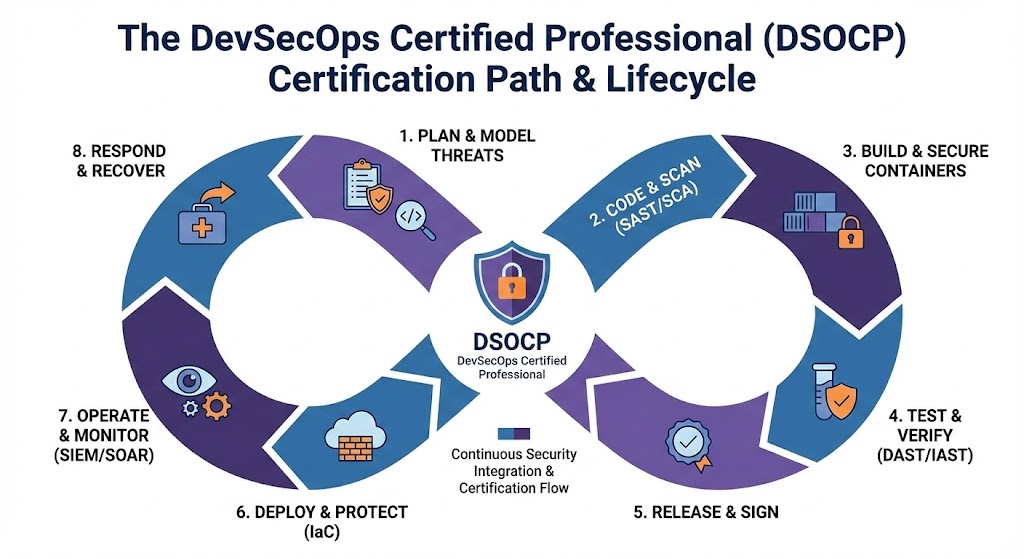
The DevSecOps Certified Professional (DSOCP) serves as a validation of an engineer’s ability to implement security at every stage of the DevOps lifecycle. Unlike theoretical certifications, this program emphasizes hands-on mastery of tools and techniques required for production environments. It addresses the growing need for “shift-left” practices, ensuring that security is not an afterthought but a foundational component of the build process. Consequently, this certification aligns with global enterprise standards for building resilient and secure cloud-native applications. Professionals who earn this credential demonstrate that they can manage infrastructure-as-code while simultaneously ensuring continuous compliance.
Who Should Pursue DevSecOps Certified Professional (DSOCP)?
Software engineers and system administrators who want to transition into security-focused roles find immense value in this certification. SREs and platform engineers who manage large-scale infrastructure also benefit by learning how to automate compliance. Furthermore, security professionals who want to understand the speed of modern DevOps gain the necessary technical skills to keep up with rapid release cycles. Managers and technical leaders should pursue this to better understand how to foster a culture of shared responsibility within their teams. Whether you are a beginner in the cloud space or an experienced lead, this certification provides the practical edge needed for the global market.
Why DevSecOps Certified Professional (DSOCP) is Valuable
Enterprises across the globe rapidly adopt DevSecOps to mitigate risks associated with frequent code deployments. Since automation is the backbone of modern engineering, professionals with DSOCP skills remain highly relevant even as individual tools change over time. This certification offers a significant return on investment because it positions individuals for high-demand roles in cybersecurity and cloud operations. Moreover, it provides a structured framework for mastering complex security architectures that are essential for long-term career growth. By completing this program, engineers ensure they stay ahead of the curve in an industry that increasingly treats security as code.
DevSecOps Certified Professional (DSOCP) Certification Overview
The program delivers training via the official course URL and is hosted on DevOpsSchool. This certification utilizes a rigorous assessment approach that prioritizes practical application over simple rote memorization. Candidates undergo comprehensive training that covers various security domains, ensuring they can handle real-world scenarios effectively. Ownership of the curriculum remains with industry experts who update the content to reflect the latest trends in the engineering landscape. Additionally, the structure of the program allows learners to master vulnerability management, container security, and cloud protection within a single, cohesive framework.
DevSecOps Certified Professional (DSOCP) Certification Tracks & Levels
The certification framework includes foundation, professional, and advanced levels to cater to diverse career stages. Beginners typically start at the foundation level to understand the core principles of security integration and CI/CD pipelines. The professional level targets mid-career engineers who need to master specialized tools like Vault, SonarQube, and Jenkins for automated security testing. Advanced levels focus on architectural design and leadership, preparing seniors to lead DevSecOps transformations across large organizations. Each level ensures a steady career progression, allowing professionals to broaden their skills in DevOps, SRE, or FinOps as they grow.
Complete DevSecOps Certified Professional (DSOCP) Certification Table
| Track | Level | Who it’s for | Prerequisites | Skills Covered | Recommended Order |
| Core DevSecOps | Foundation | Aspiring Engineers | Basic Linux/Git | Security Mindset, CI/CD | 1 |
| Engineering | Professional | DevOps/SREs | Container Basics | SAST/DAST, Vault, K8s | 2 |
| Strategy | Advanced | Leads/Architects | 3+ Years DevOps | Compliance as Code, Governance | 3 |
| Compliance | Specialist | Audit/Security | Security Basics | Regulatory Automation, Auditing | 4 |
Detailed Guide for Each DevSecOps Certified Professional (DSOCP) Certification
DevSecOps Certified Professional (DSOCP) – Foundation
What it is This certification validates the fundamental understanding of DevSecOps culture and the “shift-left” philosophy. It confirms that the candidate understands how to integrate security early in the development cycle.
Who should take it Junior developers, fresh graduates, and system administrators should take this to build a strong foundation. It also suits project managers who need to understand security workflows.
Skills you’ll gain
- Understanding the DevSecOps lifecycle.
- Basic knowledge of automated security testing.
- Familiarity with Git-based workflows and security branches.
- Awareness of common vulnerabilities (OWASP Top 10).
Real-world projects you should be able to do
- Setting up a basic secure code repository.
- Running simple automated linting and security scans on local code.
- Identifying common security bottlenecks in a standard CI pipeline.
Preparation plan
- 7–14 days: Review the core DevSecOps manifesto and basic terminology.
- 30 days: Familiarize yourself with basic Linux commands and Git security features.
- 60 days: Complete a foundational lab setting up a secure Jenkins pipeline.
Common mistakes
- Ignoring the cultural aspect of DevSecOps and focusing only on tools.
- Underestimating the importance of Linux and shell scripting basics.
Best next certification after this
- Same-track option: DSOCP Professional
- Cross-track option: SRE Foundation
- Leadership option: Certified DevOps Leader
DevSecOps Certified Professional (DSOCP) – Professional
What it is The Professional level validates the technical ability to implement complex security tools within production-grade pipelines. It proves that an engineer can automate secrets management and container scanning at scale.
Who should take it Active DevOps Engineers, Cloud Engineers, and SREs should pursue this level. It serves individuals who handle day-to-day infrastructure and application security.
Skills you’ll gain
- Advanced CI/CD security integration.
- Secrets management using HashiCorp Vault.
- Container security and image hardening (Docker/Trivy).
- Static and Dynamic Analysis (SAST/DAST).
Real-world projects you should be able to do
- Building a full CI/CD pipeline that fails on security policy violations.
- Implementing zero-trust architecture for microservices communication.
- Automating the patching process for containerized applications.
Preparation plan
- 7–14 days: Study specific tool integrations like SonarQube and OWASP ZAP.
- 30 days: Focus on Kubernetes security and network policies.
- 60 days: Build and document an end-to-end secure delivery workflow.
Common mistakes
- Failing to test the security tools against actual “dirty” code.
- Neglecting the performance impact of security scans on the build time.
Best next certification after this
- Same-track option: DSOCP Expert/Advanced
- Cross-track option: Cloud Security Specialist
- Leadership option: DevSecOps Manager
Choose Your Learning Path
DevOps Path
Engineers following the DevOps path prioritize speed and reliability alongside security. They focus on how security tools can be integrated into the CI/CD pipeline without slowing down the development team. Consequently, these professionals master automation scripts that trigger security checks during every code commit. This path ensures that security becomes an invisible yet robust part of the delivery process.
DevSecOps Path
The dedicated DevSecOps path deepens the focus on security as the primary driver of infrastructure design. These professionals specialize in vulnerability management, penetration testing automation, and compliance as code. They work closely with security teams to translate complex regulatory requirements into executable automated tests. Therefore, this path is ideal for those who want to be the ultimate authority on secure cloud-native deployments.
SRE Path
Site Reliability Engineers use the DSOCP knowledge to ensure that security measures do not compromise system uptime. They focus on the intersection of security and reliability, such as protecting against DDoS attacks or securing service meshes. Furthermore, SREs implement monitoring and alerting systems that detect security incidents in real-time. This path creates a professional who can defend production environments while maintaining high availability.
AIOps / MLOps Path
Professionals in AIOps or MLOps apply DevSecOps principles to the data science and machine learning pipelines. They ensure that training data remains secure and that model deployment follows strict security protocols. Additionally, they use AI-driven tools to identify security patterns and anomalies within large-scale logs. This path is essential for organizations dealing with sensitive data and complex algorithmic deployments.
DataOps Path
The DataOps path emphasizes the security and integrity of data pipelines from ingestion to visualization. Data engineers learn how to mask sensitive information and manage access controls throughout the data lifecycle. Moreover, they implement automated checks to ensure data privacy regulations like GDPR or CCPA are met. This specialized path bridges the gap between traditional data management and modern secure operations.
FinOps Path
FinOps practitioners integrate security with cloud cost management to prevent unauthorized resource provisioning. They learn how security breaches can lead to massive financial losses through “crypto-jacking” or resource abuse. By following this path, professionals ensure that the infrastructure is both secure and cost-efficient. Consequently, they provide a dual value of protection and fiscal responsibility to the organization.
Role → Recommended (Topic name) Certifications
| Role | Recommended Certifications |
| DevOps Engineer | DSOCP Professional, Docker Specialist |
| SRE | DSOCP Professional, Kubernetes Expert |
| Platform Engineer | DSOCP Advanced, Terraform Associate |
| Cloud Engineer | DSOCP Professional, AWS/Azure Security |
| Security Engineer | DSOCP Advanced, Pentest+ |
| Data Engineer | DSOCP Foundation, DataOps Specialist |
| FinOps Practitioner | DSOCP Foundation, FinOps Certified |
| Engineering Manager | DSOCP Foundation, DevOps Leader |
Next Certifications to Take After DevSecOps Certified Professional (DSOCP)
Same Track Progression
Once you master the professional level, you should aim for advanced architectural certifications. These credentials focus on enterprise-wide security governance and the design of global-scale security frameworks. Furthermore, they prepare you to handle complex multi-cloud security challenges. Staying within this track allows you to become a subject matter expert in the DevSecOps domain.
Cross-Track Expansion
Broadening your skills into SRE or Platform Engineering adds immense value to your profile. By understanding how security affects system reliability, you become a more versatile engineer. You might consider certifications in Kubernetes orchestration or Cloud-Native architecture to complement your security expertise. This expansion helps you understand the broader context of the applications you are securing.
Leadership & Management Track
If you aspire to move into leadership, you should pursue certifications focused on project management and team culture. These programs teach you how to manage the human element of DevSecOps transformations. You will learn how to align technical security goals with business objectives and budgets. Transitioning into management requires a balance of technical depth and strategic thinking.
Training & Certification Support Providers for DevSecOps Certified Professional (DSOCP)
DevOpsSchool This provider offers extensive hands-on labs and expert-led sessions for DSOCP candidates. They focus on real-world scenarios that prepare engineers for actual production challenges. Their curriculum covers a wide range of tools, ensuring a comprehensive learning experience.
Cotocus Cotocus specializes in providing immersive technical training with a focus on automation and cloud-native technologies. They provide tailored roadmaps for professionals looking to transition into DevSecOps roles. Their training methodology emphasizes practical skill acquisition over theoretical knowledge.
Scmgalaxy As a community-driven platform, Scmgalaxy provides a wealth of resources, including tutorials and certification guides. They offer detailed insights into CI/CD integration and configuration management. This provider is an excellent resource for staying updated on the latest DevSecOps trends.
BestDevOps BestDevOps delivers high-quality training focused on the practical implementation of DevOps and security practices. They provide a structured approach to learning, making complex topics accessible to engineers at all levels. Their certification support ensures that candidates are well-prepared for their assessments.
devsecopsschool.com This dedicated portal focuses exclusively on security within the DevOps ecosystem. They provide specialized courses that dive deep into vulnerability management and automated auditing. Professionals seeking a security-first approach to their training find this provider highly effective.
sreschool.com Sreschool.com bridges the gap between reliability engineering and secure operations. They offer training that helps SREs integrate security monitoring into their reliability frameworks. This provider is ideal for those who manage large-scale, high-availability systems.
aiopsschool.com This provider focuses on the intersection of artificial intelligence and operations security. They teach professionals how to use machine learning to enhance threat detection and incident response. Their courses are essential for engineers working with advanced automated systems.
dataopsschool.com Dataopsschool.com provides training on securing data pipelines and ensuring data privacy at scale. They cover topics like data masking, encryption, and secure data governance. This provider helps data professionals integrate DevSecOps principles into their daily workflows.
finopsschool.com Finopsschool.com offers courses that combine cloud financial management with infrastructure security. They teach engineers how to prevent costly security incidents that impact the bottom line. This training is vital for those who want to manage both risk and cost in the cloud.
Frequently Asked Questions
- How difficult is the DSOCP certification for a beginner? The difficulty level is moderate but manageable if you have basic knowledge of Linux and Git. The program starts with foundational concepts before moving into complex automation. Consequently, a dedicated beginner can succeed by following the structured learning path provided by the training. Consistent practice in the lab environments is essential for mastering the technical requirements.
- How much time should I dedicate to prepare for the professional level? Preparing for the professional level typically requires 30 to 60 days of consistent study. You should spend at least 10 hours per week practicing tool integrations and pipeline configurations. Since the exam is hands-on, the time spent in labs is more valuable than reading theory. Therefore, a balanced approach between study and practice ensures the best results.
- What are the main prerequisites for taking the DSOCP exam? Candidates should possess a basic understanding of software development cycles and command-line interfaces. Familiarity with at least one cloud platform like AWS or Azure is highly beneficial. Moreover, understanding how Jenkins or similar CI/CD tools function will give you a significant advantage. The program is designed to build these skills if you lack them initially.
- What is the return on investment for this certification? The ROI is high because security is currently the top priority for most tech organizations. Certified professionals often see significant salary increases and access to more senior roles. Furthermore, the skills you gain are transferable across different industries and cloud providers. Investing in this certification secures your career against the fluctuations of the job market.
- In what sequence should I take the certifications? You should start with the Foundation level to grasp the core philosophy of DevSecOps. After gaining some hands-on experience, you can progress to the Professional level for technical mastery. Finally, move to the Advanced or Specialist levels based on your career interests. This logical progression ensures that you build a solid knowledge base before tackling complex topics.
- Is the DSOCP certification recognized globally? Yes, the certification is recognized by major enterprises and tech companies around the world. It follows industry-standard frameworks that are applicable in any geographic region. Organizations in India, the US, and Europe actively seek professionals with these credentials to secure their digital transformations. Consequently, holding this certification improves your global mobility as an engineer.
- How does this certification help in a cloud-native environment? The program focuses heavily on tools like Kubernetes, Docker, and Terraform which are essential for cloud-native setups. You learn how to secure containers and manage infrastructure-as-code securely. This knowledge is critical for maintaining the integrity of microservices architectures. Therefore, the certification makes you an expert in modern cloud security practices.
- Can I take the exam online? Yes, the certification provider offers online proctored exams for the convenience of global candidates. You can schedule the assessment at a time that fits your schedule from any location. This flexibility allows working professionals to balance their career development with their daily responsibilities. Ensure you have a stable internet connection and a compatible computer for the exam.
- Does the certification expire? Most professional certifications require renewal or continuing education every few years to stay current. The DSOCP program encourages professionals to keep their skills sharp as new security threats emerge. You can maintain your status by participating in advanced workshops or taking higher-level assessments. This ensures that your expertise remains relevant in a fast-changing industry.
- What kind of support is available during training? Training providers like DevOpsSchool offer 24/7 support through forums, chat, and live sessions. You gain access to a community of peers and experts who can help resolve technical hurdles. Furthermore, the detailed documentation and lab guides provide a self-paced learning experience. This support system is crucial for successfully completing the rigorous technical requirements.
- How does DSOCP differ from a standard security certification? Standard security certifications often focus on manual auditing and network security. In contrast, DSOCP emphasizes automation and the integration of security into the development pipeline. It teaches you how to write code that secures other code. Consequently, it is more aligned with the needs of modern, high-speed engineering teams.
- Are there any hands-on labs included in the training? Yes, the training is predominantly lab-based to ensure you gain practical experience. You will work on real-world projects like setting up secure Jenkins pipelines and managing secrets with Vault. These labs simulate production environments, allowing you to make mistakes and learn in a safe setting. This hands-on approach is what makes the certification valuable to employers.
FAQs on DevSecOps Certified Professional (DSOCP)
- Which specific security tools does the DSOCP curriculum cover? The curriculum covers essential tools like SonarQube for static analysis, OWASP ZAP for dynamic testing, and Trivy for container scanning. You also learn secrets management with HashiCorp Vault. These tools provide a comprehensive toolkit for securing every stage of the CI/CD pipeline and managing cloud-native infrastructure effectively.
- Does the certification include training on Kubernetes security? Yes, Kubernetes security is a core component of the professional and advanced tracks. You will learn about network policies, role-based access control (RBAC), and pod security standards. These skills are vital for ensuring that containerized applications remain secure while running in large-scale production environments.
- How does DSOCP address compliance-as-code? The program teaches you how to translate legal and regulatory requirements into automated scripts. You learn to use tools that scan infrastructure for compliance violations automatically. This approach ensures that your environments stay compliant with standards like SOC2 or HIPAA without requiring manual audits for every change.
- Can this certification help me move into a Lead DevSecOps role? The advanced levels of the certification focus on strategy, governance, and leadership. You learn how to build security cultures and design enterprise-wide frameworks. These skills are exactly what organizations look for when hiring leads to oversee their DevSecOps transformation projects and manage technical security teams.
- What is the format of the DSOCP assessment? The assessment typically involves a combination of multiple-choice questions and practical lab challenges. You must demonstrate that you can solve real-world problems by configuring tools and fixing security vulnerabilities. This dual approach ensures that you possess both the theoretical knowledge and the technical skills required for the job.
- Are there any group discounts for enterprise training? Most training providers offer customized packages for corporate teams looking to upskill their employees. These programs often include tailored labs and dedicated support sessions for the entire group. This is an excellent way for companies to standardize security practices across their development and operations departments simultaneously.
- How does DSOCP handle secrets management? The certification places a heavy emphasis on removing hardcoded passwords from code and configurations. You learn to use centralized secrets management systems to inject credentials at runtime. This practice significantly reduces the risk of credential leakage and is a foundational requirement for any secure modern infrastructure.
- Is the course content updated for the latest threats? Yes, the curriculum is regularly reviewed by industry experts to include new vulnerabilities and mitigation techniques. As the threat landscape changes, the training evolves to cover new security tools and best practices. This commitment to current information ensures that you are prepared for the latest challenges in the field.
Final Thoughts: Is DevSecOps Certified Professional (DSOCP) Worth It?
If you want to remain competitive in the modern engineering landscape, the answer is a definitive yes. Security is no longer an optional skill; it is a fundamental requirement for every professional working in the cloud. This certification provides a clear, practical, and structured path to mastering the tools that the industry uses every day. While the journey requires dedication and a significant amount of hands-on practice, the career rewards are substantial. You will gain the confidence to lead security initiatives and the technical ability to build truly resilient systems. Ultimately, the DSOCP credential marks you as a forward-thinking professional who understands the critical intersection of speed, reliability, and security.
