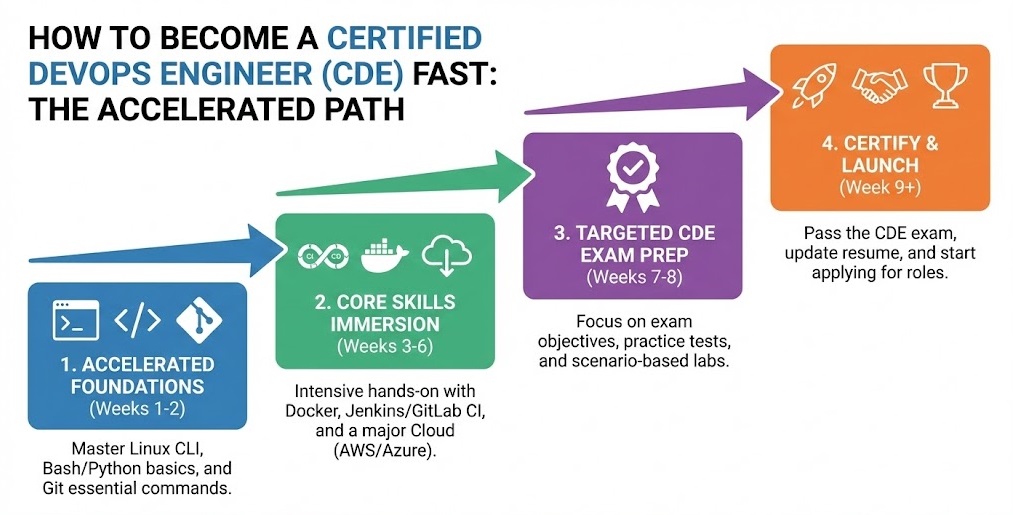
Introduction
Software delivery has changed forever. Today, organizations no longer settle for slow deployment cycles or manual infrastructure management. They demand speed, reliability, and precision. This guide introduces you to the Certified DevOps Engineer (CDE) designation, a professional benchmark that transforms how engineers build and ship software. Whether you currently write code, manage servers, or lead technical teams, this comprehensive guide clarifies the path toward mastering the intersection of development and operations.
The modern tech landscape moves quickly, often leaving professionals overwhelmed by tool sprawl and shifting methodologies. We designed this guide to cut through that noise. It explains how the CDE helps you make better career decisions by focusing on the core principles of platform engineering and cloud-native growth. By following this roadmap, you will understand how to transition from a traditional technical role into a high-impact DevOps career that commands respect and competitive compensation.
What is the Certified DevOps Engineer (CDE)?
The Certified DevOps Engineer (CDE) serves as a rigorous professional validation for individuals who manage the lifecycle of modern applications. It represents more than just a certificate; it signifies a practitioner’s ability to orchestrate complex continuous integration and continuous delivery (CI/CD) pipelines. Organizations rely on CDE holders to bridge the gap between software creation and system stability. This program prioritizes real-world competency over abstract theory, ensuring that every certified professional can handle production-level challenges.
Modern engineering workflows require a deep understanding of automation, and the CDE addresses this directly. It aligns with enterprise practices like infrastructure as code (IaC), container management, and automated monitoring. When you pursue the CDE, you demonstrate a commitment to operational excellence. The program exists to ensure that engineers do not just use tools, but rather design resilient systems that support the rapid, secure delivery of value to end-users.
Who Should Pursue Certified DevOps Engineer (CDE)?
Software engineers who want to influence the entire delivery lifecycle find the CDE indispensable. It moves them beyond the confines of a local development environment and gives them the power to manage production systems. System administrators, cloud architects, and site reliability engineers (SREs) also benefit significantly. They use this certification to modernize their skill sets and transition into automation-centric roles that define the future of IT operations.
The CDE carries immense weight for professionals in global markets, including India’s booming tech hubs. Beginners use it as a structured entry point into the world of DevOps, while experienced engineers use it to formalize their expertise and advance to senior leadership. Technical managers also pursue the CDE to better understand the technical hurdles their teams face. If you aim to lead digital transformations or manage large-scale cloud platforms, this certification provides the technical foundation you need.
Why Certified DevOps Engineer (CDE) is Valuable Now and Beyond
The shift toward cloud-native architecture has created a massive demand for engineers who understand automation. The CDE remains valuable because it focuses on fundamental principles like observability and automated delivery that outlast individual tools. While the industry may adopt new configuration languages, the core logic of the DevOps methodology remains constant. Earning this credential ensures your skills remain relevant regardless of how the technical landscape evolves in the coming years.
Enterprises actively look for CDE-certified professionals to help them reduce deployment lead times and improve system uptime. This expertise directly impacts an organization’s bottom line by lowering operational costs and increasing the frequency of successful releases. For the individual, the CDE offers a high return on investment through accelerated career growth and access to high-paying senior roles. It acts as a long-term insurance policy for your career, positioning you as an expert in the most critical area of modern technology.
Certified DevOps Engineer (CDE) Certification Overview
DevOpsSchool hosts the Certified DevOps Engineer (CDE) program to provide engineers with a clear, practical learning path. This program focuses on competency-based assessments that require students to solve real-world engineering problems in live environments. It moves away from the traditional model of simple multiple-choice questions and instead prioritizes the actual application of technical skills.
Industry veterans maintain and update the CDE curriculum to reflect the latest shifts in enterprise engineering. The program utilizes a tiered structure—Foundation, Professional, and Advanced—to accommodate professionals at different stages of their career journey. By utilizing self-paced learning combined with hands-on labs, the program ensures that every graduate possesses a deep, strategic understanding of DevOps culture and its associated toolchains.
Certified DevOps Engineer (CDE) Certification Tracks & Levels
The CDE program organizes its curriculum into three distinct levels to ensure a logical progression of expertise. You begin with the Foundation level, where you master the core concepts of CI/CD, version control, and team collaboration. This stage provides the necessary technical vocabulary and cultural understanding required to work within a modern DevOps team. It serves as the bedrock for all future learning and specialization within the program.
After mastering the basics, you advance to the Professional and Advanced levels. The Professional level dives deep into production-grade tools like Docker, Kubernetes, and Terraform, teaching you how to build and scale delivery pipelines. The Advanced level focuses on high-level architecture, SRE practices, and cost optimization strategies. These levels allow you to specialize in high-demand tracks like DevSecOps or MLOps, ensuring that your certification aligns perfectly with your professional aspirations and the needs of your employer.
Complete Certified DevOps Engineer (CDE) Certification Table
| Track | Level | Who it’s for | Prerequisites | Skills Covered | Recommended Order | Official Link |
| Core DevOps | Foundation | Beginners, Managers | Basic IT awareness | Git, CI/CD Basics, Culture | 1 | CDE Official |
| Core DevOps | Professional | Engineers (1-3 yrs) | Foundation Level | Docker, K8s, Terraform | 2 | CDE Official |
| Architecture | Advanced | Senior Engineers, SREs | Professional Level | Scaling, Observability, SRE | 3 | CDE Official |
| Specialized | Expert | Principal Engineers | Advanced Level | Multi-cloud, FinOps | 4 | CDE Official |
Detailed Guide for Each Certified DevOps Engineer (CDE) Certification
Certified DevOps Engineer (CDE) – Foundation
What it is The Foundation level validates your understanding of the essential DevOps philosophy and the core components of a modern delivery pipeline. It confirms that you speak the technical language used by high-performing engineering teams globally.
Who should take it Junior developers, IT operations staff, and project managers should pursue this level. It provides the necessary context for anyone who needs to understand how DevOps impacts the speed and quality of software development.
Skills you’ll gain
- Mastery of the CALMS framework (Culture, Automation, Lean, Measurement, Sharing).
- Core proficiency in version control strategies using Git.
- Fundamental understanding of Continuous Integration and Continuous Deployment (CI/CD).
- Familiarity with the automated software development lifecycle (SDLC).
Real-world projects you should be able to do
- Setup and manage a basic version control workflow for a small team.
- Identify manual steps in a deployment process and propose automation fixes.
- Contribute effectively to Scrum or Kanban-based DevOps workflows.
Preparation plan
- 7-14 Days: Focus on reading core DevOps whitepapers and learning key terminology.
- 30 Days: Complete introductory hands-on labs for Git and basic CI tools.
- 60 Days: Use this period to deepen your understanding of team collaboration culture.
Common mistakes Candidates often focus too much on specific tools and neglect the underlying cultural shift. They also frequently skip learning the nuances of Git branching, which causes issues later.
Best next certification after this
- Same-track option: CDE Professional.
- Cross-track option: Certified DevSecOps Professional.
- Leadership option: Certified DevOps Manager.
Certified DevOps Engineer (CDE) – Professional
What it is The Professional level serves as the benchmark for hands-on DevOps expertise. It proves your ability to build, manage, and scale production-grade toolchains in real-world, high-pressure environments.
Who should take it Engineers with 1 to 3 years of experience who handle build servers, containers, and infrastructure automation should take this exam. It targets those who want to establish themselves as reliable technical practitioners.
Skills you’ll gain
- Advanced containerization with Docker and orchestration with Kubernetes.
- Pipeline construction using tools like Jenkins, GitLab CI, or GitHub Actions.
- Infrastructure as Code (IaC) implementation with Terraform or Ansible.
- Configuration of monitoring and logging for distributed systems.
Real-world projects you should be able to do
- Containerize a multi-tier application and deploy it to a production cluster.
- Automate infrastructure provisioning using Terraform scripts and modules.
- Build a self-healing pipeline that automatically rolls back failed deployments.
Preparation plan
- 7-14 Days: Review configuration language syntax like YAML and HCL.
- 30 Days: Focus on daily hands-on labs that integrate multiple tools together.
- 60 Days: Practice troubleshooting complex failures in a safe sandbox environment.
Common mistakes Many candidates fail because they memorize commands without understanding the underlying logic. Others ignore the security aspect of the pipeline, such as managing secrets properly.
Best next certification after this
- Same-track option: CDE Advanced.
- Cross-track option: Certified SRE Professional.
- Leadership option: DevOps Technical Lead certification.
Certified DevOps Engineer (CDE) – Advanced
What it is The Advanced level validates your capacity to architect resilient systems and lead large-scale organizational change. it focuses on the strategic application of DevOps to solve complex enterprise problems.
Who should take it Senior Engineers, Architects, and SREs with over 5 years of experience should pursue this level. It serves those who design the platforms and standards that other teams follow.
Skills you’ll gain
- Design of high-availability, multi-region cloud architectures.
- Implementation of Service Mesh (Istio) and GitOps (ArgoCD) workflows.
- Advanced observability, distributed tracing, and incident response strategies.
- Mastery of FinOps principles to optimize and manage large cloud budgets.
Real-world projects you should be able to do
- Design a disaster recovery plan for a global, mission-critical application.
- Implement a centralized observability platform for hundreds of microservices.
- Lead a large-scale migration from legacy systems to a modern GitOps model.
Preparation plan
- 7-14 Days: Analyze complex failure patterns and architectural case studies.
- 30 Days: Build and break advanced hybrid-cloud environments in a lab.
- 60 Days: Focus on engineering productivity metrics like DORA and SLOs.
Common mistakes Candidates often over-engineer simple solutions or focus on technical perfection at the expense of business value. They may also neglect the financial impact of their designs.
Best next certification after this
- Same-track option: CDE Expert Specialist.
- Cross-track option: Certified MLOps Engineer.
- Leadership option: CTO or Head of Platform Engineering path.
Choose Your Learning Path
DevOps Path
The traditional DevOps path focuses on the fundamental lifecycle of software, from planning to monitoring. You learn to synchronize development and operations teams through automated workflows and shared responsibility. This track is perfect for engineers who want to specialize in CI/CD, general automation, and infrastructure management. It provides a broad foundation that allows you to move into various specialized roles as you progress.
DevSecOps Path
The DevSecOps path emphasizes “shifting security left” by integrating protection into every stage of the delivery pipeline. You learn to automate security scanning, manage vulnerabilities in real-time, and ensure compliance without slowing down the release speed. This is a critical path for regulated industries like finance and healthcare. Professionals here act as the ultimate guardians of the production environment’s integrity and safety.
SRE Path
Site Reliability Engineering applies software engineering principles to operations problems to ensure system stability and performance. This path focuses on service level objectives (SLOs), error budgets, and how to automate away manual “toil.” This is a highly analytical track for those who enjoy solving deep technical problems and optimizing system internals. SREs ensure that systems remain available and performant even under massive user load.
AIOps / MLOps Path
This futuristic path combines traditional DevOps with machine learning and artificial intelligence to manage complex systems. MLOps focuses on automating the lifecycle of AI models, while AIOps uses machine learning to enhance and predict IT operations. You learn to handle data versioning, model retraining pipelines, and predictive monitoring. This is the ideal track for engineers who want to lead the next wave of intelligent infrastructure.
DataOps Path
DataOps focuses on the agile management of data flows between producers and consumers within an organization. You learn to build automated, resilient data pipelines that ensure high-quality information reaches the business quickly and accurately. This track bridges the gap between big data engineering and DevOps. It is essential for any company that relies on real-time data to drive its products and decision-making processes.
FinOps Path
The FinOps path teaches you how to manage the financial health of your cloud infrastructure. You learn to balance technical performance with cost-efficiency by making data-driven spending decisions based on real-time metrics. This track involves mastering cloud billing, automated rightsizing, and budget forecasting. It is a highly valued skill set for senior engineers who must justify infrastructure costs to executive leadership.
Role → Recommended Certified DevOps Engineer (CDE) Certifications
| Role | Recommended Certifications |
| DevOps Engineer | CDE Foundation, Professional, Advanced |
| SRE | CDE Professional, Certified SRE Professional |
| Platform Engineer | CDE Advanced, Certified Kubernetes Specialist |
| Cloud Engineer | CDE Professional, Cloud-Specific Architect Certs |
| Security Engineer | CDE Foundation, Certified DevSecOps Professional |
| Data Engineer | CDE Professional, Certified DataOps Professional |
| FinOps Practitioner | CDE Foundation, Certified FinOps Specialist |
| Engineering Manager | CDE Foundation, Certified DevOps Manager |
Next Certifications to Take After Certified DevOps Engineer (CDE)
Same Track Progression
Once you master the core CDE levels, you should aim for expert-level specializations in specific tools or platforms. This might involve earning deep-dive certifications in advanced Kubernetes security or specialized service mesh configurations. Staying on this track solidifies your status as a Subject Matter Expert (SME). Organizations rely on these specialists to lead their most critical projects and mentor the next generation of engineers.
Cross-Track Expansion
Broadening your skill set through cross-track certifications makes you an incredibly versatile engineer. A CDE-certified professional who adds DevSecOps or MLOps expertise becomes a “force multiplier” for their team. This “T-shaped” knowledge base allows you to handle a wider variety of challenges and communicate effectively across different departments. It is the best strategy for long-term career resilience and high-demand roles in a competitive market.
Leadership & Management Track
If you wish to move away from daily coding and into strategic leadership, focus on certifications that emphasize people and process. These programs teach you how to lead organizational change, manage large budgets, and build high-performing DevOps cultures. This path prepares you for roles like VP of Infrastructure or CTO. It shifts your focus from individual technical tasks to solving organizational bottlenecks and aligning technology with business goals.
Training & Certification Support Providers for Certified DevOps Engineer (CDE)
DevOpsSchool
DevOpsSchool provides a robust ecosystem for CDE candidates, featuring comprehensive hands-on labs and expert-led mentorship. They offer a curriculum that directly mirrors real-world production challenges, ensuring that students gain practical experience. Their global community support helps professionals stay connected and updated with the latest industry trends.
Cotocus
Cotocus specializes in delivering enterprise-grade DevOps training that focuses on technical depth and project-based implementation. They follow a project-driven approach, allowing students to build and manage full toolchains during their certification journey. This focus on “doing” makes them a preferred choice for working professionals.
Scmgalaxy
Scmgalaxy offers a wealth of resources for those pursuing DevOps and Software Configuration Management (SCM) certifications. They maintain a vast library of tutorials, community forums, and training programs that cover the entire delivery pipeline. Their long-standing presence in the community makes them a reliable source of technical knowledge.
BestDevOps
BestDevOps focuses on accelerating the career growth of engineers through targeted, high-impact training modules. They strip away unnecessary fluff and focus on the most in-demand tools and practices required to pass the CDE. Their training is designed for quick skill acquisition and immediate application in a job setting.
devsecopsschool.com
This provider focuses exclusively on the intersection of security and DevOps. They offer specialized training for the DevSecOps track, covering topics like automated security testing, compliance as code, and secure cloud architecture. They are a vital resource for CDE holders who want to move into the security domain.
sreschool.com
Sreschool.com provides deep-dive training into the world of Site Reliability Engineering. Their curriculum focuses on the metrics and automation strategies required to maintain massive, high-availability systems. They are the go-to provider for CDE professionals transitioning into senior SRE roles.
aiopsschool.com
Aiopsschool.com leads the way in training engineers for the future of AI-driven operations. They offer specialized modules on integrating machine learning into the DevOps lifecycle and using AI for predictive system maintenance. This provider is ideal for those who want to innovate in the AIOps space.
dataopsschool.com
Dataopsschool.com addresses the unique challenges of automating data environments at scale. They help engineers apply DevOps principles to data science and analytics workflows, ensuring that high-quality data reaches the business quickly. Their training covers everything from ETL automation to data lake management.
finopsschool.com
Finopsschool.com focuses on the financial management aspect of the modern cloud. They provide the training necessary for engineers to master cloud cost optimization and financial accountability. This is a critical resource for those following the FinOps track after completing their initial CDE certifications.
Frequently Asked Questions (General)
- How difficult is the CDE certification compared to other IT exams? The CDE certification presents a higher challenge than standard multiple-choice IT exams because it requires practical application. You must demonstrate that you can configure tools and build pipelines in a live environment. While basic cloud certifications test your awareness of services, the CDE tests your ability to integrate those services into a functioning system. This practical focus ensures that the certification holds significant weight with hiring managers who need engineers ready for production tasks on day one.
- What is the typical timeframe to prepare for the CDE Professional level? Most professionals spend between two and three months preparing for the CDE Professional level if they study consistently for ten hours a week. Your previous experience with Linux and coding will significantly influence this timeline. If you are starting from zero, you should plan for at least six months to build the foundational knowledge required. The goal is to develop “muscle memory” with the tools, which only comes through repeated practice in sandbox environments.
- Are there specific technical prerequisites for the CDE Foundation level? The Foundation level does not have strict technical prerequisites, making it accessible to a wide range of IT professionals. However, a basic understanding of the software development lifecycle and familiarity with a command-line terminal will give you a head start. If you understand what a server is and how developers write code, you possess enough background to begin. This level focuses more on the “big picture” of DevOps, preparing you for the technical deep dives later.
- Does the CDE certification focus on a single cloud provider like AWS? The CDE remains cloud-agnostic, meaning it focuses on the tools and philosophies that work across any cloud provider. While you may use AWS or Azure in your practice labs, the skills you learn—such as Kubernetes, Terraform, and Jenkins—are transferable to any environment. This approach prevents vendor lock-in and makes you a more valuable asset to companies using multi-cloud or hybrid strategies. it ensures your expertise remains relevant regardless of which cloud provider a company chooses.
- Is the CDE certification recognized by major companies globally? Major technology firms and enterprises worldwide recognize the CDE as a valid mark of DevOps expertise. Because the curriculum aligns with standard toolchains used by leaders like Netflix, Google, and Amazon, the certification serves as a global technical passport. Recruiters in the US, Europe, and India actively look for CDE-certified candidates to fill their platform and SRE roles. It provides an objective baseline of your skills that transcends local market differences and hiring preferences.
- How long does the CDE certification remain valid before expiration? The CDE certification remains valid for three years from the date you pass the exam. To maintain your status, you must either pass a higher-level exam or complete continuing education modules that reflect the latest industry changes. This renewal process ensures that your skills do not become stagnant in a field that evolves every few months. It protects the value of the certification for both the individual and the employer by ensuring the holder stays current.
- Can I expect a salary increase after obtaining the CDE? Professionals who earn the CDE often see a salary increase of 20% to 40%, depending on their region and experience level. DevOps engineers are among the highest-paid professionals in IT because they possess a unique mix of development and operations skills. The certification provides the concrete proof needed to negotiate for higher pay during performance reviews or when applying for new roles. it signals that you can handle high-responsibility production tasks, justifying a higher compensation package.
- Is the CDE exam conducted in a proctored online format? Yes, you can take the CDE exam from anywhere in the world through a proctored online platform. This format requires a stable internet connection, a webcam, and a quiet space. The online exam includes the same hands-on lab challenges as a physical testing center, maintaining the high standards of the certification. This flexibility allows busy professionals to schedule their exams at a time that suits them without needing to travel to a specific testing location.
- Which tools should I focus on most for the Professional exam? For the Professional exam, you should focus your efforts on Git, Docker, Kubernetes, Jenkins, and Terraform. These five tools form the core of most modern DevOps toolchains. You need to understand how they interact: for example, how a code push in Git triggers a Jenkins build that creates a Docker image and deploys it to a cluster via Terraform. Mastery of these integrations is the key to passing the lab-based portions of the exam successfully.
- Does the CDE community provide networking opportunities? The CDE community is highly active and provides numerous networking opportunities through official forums, Slack groups, and alumni events. Training providers like DevOpsSchool host exclusive groups where you can share job leads, seek technical advice, and collaborate on projects. Networking within this community often leads to mentorship opportunities and career advancements that are not available through traditional job boards. It is a valuable ecosystem for lifelong learning and professional growth.
- How much coding knowledge do I really need for the CDE? You do not need to be a professional software developer, but you must be comfortable with “scripting” and managing configuration files. You should understand the basic logic of languages like Python or Bash and be proficient in reading and writing YAML and JSON files. DevOps is fundamentally “software-defined,” so you must be able to interact with APIs and automate tasks through code. If you can write a script to automate a repetitive task, you possess enough knowledge.
- What is the ROI of the CDE certification for an employer? Employers see a massive return on investment when their engineers earn the CDE. Certified engineers deliver software faster, experience fewer production outages, and recover from failures more quickly. This leads to higher customer satisfaction and lower operational costs. By training their staff in the CDE framework, companies build a more resilient and agile engineering organization. The certification ensures the entire team follows industry best practices, reducing the technical debt that often accumulates in non-standardized environments.
FAQs on Certified DevOps Engineer (CDE)
- Why does the CDE emphasize “Day 2” operations so heavily? The CDE focuses on Day 2 operations because that is where the real work of DevOps begins. While anyone can deploy an app once, maintaining that app through thousands of updates and scaling it for millions of users is the real challenge. The certification teaches you to handle these long-term operational tasks, such as automated scaling, persistent storage management, and complex monitoring. This focus ensures you are prepared for the sustained pressure of managing live, high-traffic production systems in any enterprise setting.
- How does the CDE certification help with career transitions? The CDE provides a structured roadmap for professionals moving from traditional IT roles into the modern cloud ecosystem. It breaks down complex topics into manageable levels, allowing you to build your skills progressively. For a sysadmin, it provides the coding and automation skills they lack; for a developer, it provides the infrastructure and networking knowledge they need. This balanced approach makes the transition smoother and ensures that you have a well-rounded skill set that is in high demand globally.
- Does the CDE curriculum include soft skills training? Yes, the CDE recognizes that DevOps is as much about culture as it is about tools. The curriculum includes modules on collaboration, blameless post-mortems, and how to drive organizational change. You learn how to communicate technical risks to non-technical stakeholders and how to build trust between development and operations teams. These “soft skills” are often what separate a good engineer from a great one. The certification ensures you have the leadership qualities needed to implement DevOps successfully.
- How does CDE compare to cloud-provider specific certifications? Cloud-provider certifications focus on proprietary tools like AWS CodePipeline or Azure DevOps. In contrast, the CDE focuses on industry-standard open-source tools like Jenkins and Terraform that work on any cloud. While cloud-specific certs are excellent for those committed to one ecosystem, the CDE provides broader flexibility. Many engineers pursue the CDE first to build their foundational automation skills and then take a cloud-specific cert as a specialized add-on later to diversify their professional profile.
- Can I skip the Foundation level if I have experience? If you have been working in a DevOps role for several years, you can usually jump straight to the Professional level. However, we still recommend reviewing the Foundation syllabus to ensure you do not have any conceptual gaps, particularly around the strategic aspects of DevOps culture. Many experienced engineers find that the Foundation level provides a useful “reset” that ensures they are following global industry standards rather than just the specific practices of their current employer.
- What kind of lab environment do I need for CDE preparation? You do not need an expensive home lab; most students use a combination of local virtual machines and free-tier accounts from major cloud providers. The CDE preparation is designed to be accessible, so you can perform most tasks on a standard laptop with at least 16GB of RAM. The focus remains on learning how to manage resources effectively, not on how much hardware you own. Many training providers also offer cloud-based lab environments to ensure you have everything you need.
- How does the CDE address the growing importance of Kubernetes? Kubernetes is a central pillar of the CDE Professional and Advanced levels. The certification recognizes that Kubernetes has become the “operating system” of the cloud. You learn how to deploy applications, manage networking, handle persistent data, and secure the cluster effectively. The Advanced level goes even further, teaching you how to architect multi-cluster environments and implement advanced GitOps workflows. This deep focus on Kubernetes ensures that CDE holders remain among the most skilled orchestration experts available.
- Will the CDE prepare me for a role in Platform Engineering? Platform Engineering is the next evolution of DevOps, and the CDE provides the perfect technical foundation for it. Platform engineers build the “Internal Developer Platforms” (IDP) that other teams use to ship code. The CDE teaches you the core components of these platforms: automated infrastructure, self-service CI/CD, and centralized observability. By mastering the CDE Advanced level, you gain the architectural perspective required to build these complex, developer-friendly platforms that are becoming the standard for large-scale engineering organizations today.
Final Thoughts: Is Certified DevOps Engineer (CDE) Worth It?
From the perspective of a mentor who has watched the industry evolve from physical racks to serverless functions, the CDE is a top-tier investment. It transforms you from a “tool user” into a “systems thinker” who can lead technical teams through complex challenges. As a mentor, I see many engineers get stuck in a cycle of learning the “tool of the month” without ever mastering the underlying principles. The CDE breaks that cycle by providing a rigorous, principle-based framework that applies to any technology stack.
The real value lies in the confidence you gain. When you can build a self-healing, automated pipeline from scratch and explain exactly how it impacts the business’s bottom line, you become indispensable. The CDE is not just a piece of paper; it is a grueling training program that prepares you for the realities of modern production environments. If you are willing to put in the work and do the labs, the career rewards in terms of salary, responsibility, and professional satisfaction will follow.
