Introduction
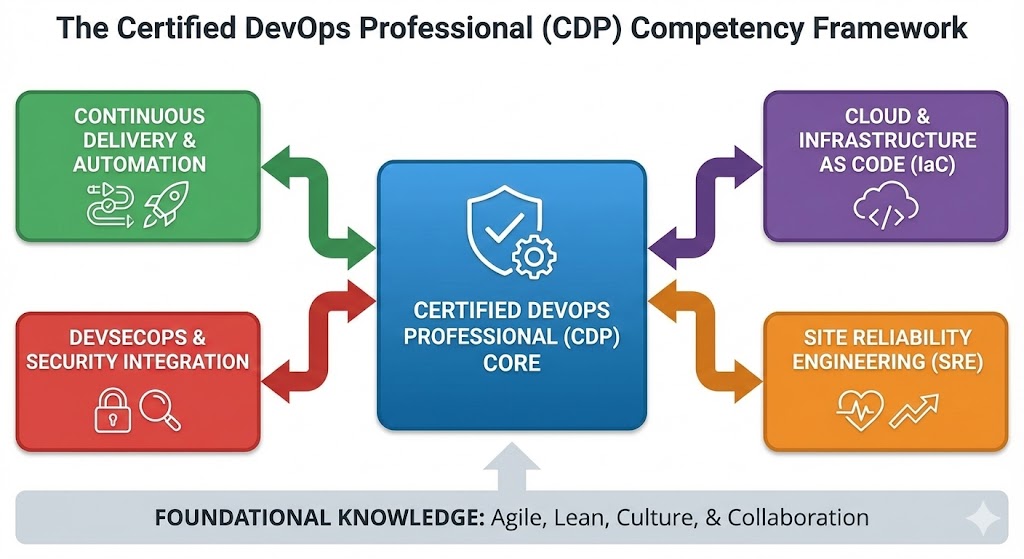
Modern software engineering requires a profound shift in how teams build, test, and deploy applications. The Certified DevOps Professional (CDP) serves as a specialized credential designed to validate an engineer’s ability to bridge the gap between development and operations. Consequently, this guide offers a clear roadmap for professionals who seek to master the nuances of continuous delivery and infrastructure automation. It addresses the needs of software engineers, system administrators, and technical leads who operate within cloud-native environments. Furthermore, this guide clarifies the specific competencies required to excel in platform engineering and site reliability roles.
Choosing the right career path often involves navigating a sea of various technical certifications and specialized tools. Therefore, this guide helps professionals make better career decisions by mapping the Certified DevOps Professional (CDP) to actual industry demands. It explains the inherent value of the program while highlighting how it integrates with modern platform engineering frameworks. Readers will discover how this certification empowers them to lead digital transformation initiatives within their organizations. Ultimately, pursuing this credential ensures that your skills remain aligned with the rapidly evolving standards of the global technology landscape.
What is the Certified DevOps Professional (CDP)?
The Certified DevOps Professional (CDP) represents a rigorous validation of an individual’s proficiency in automating the entire software delivery lifecycle. It exists to provide a standardized framework for measuring the practical skills required to manage production environments effectively. Instead of focusing solely on theoretical knowledge, the program emphasizes hands-on mastery of orchestration, configuration, and monitoring. This ensures that every certified professional can handle the complexities of high-velocity deployment cycles. Specifically, the program bridges the gap between traditional IT practices and the agile requirements of modern enterprises.
Furthermore, the Certified DevOps Professional (CDP) aligns perfectly with enterprise practices by prioritizing scalability, security, and resilience. Organizations adopt this framework to ensure their engineering teams possess a shared vocabulary and a unified set of best practices. Consequently, the certification represents more than just a title; it signifies a commitment to cultural transformation and technical excellence. It prepares engineers to design robust pipelines that reduce lead times and improve overall system stability. By focusing on real-world outcomes, the CDP transforms theoretical practitioners into reliable production-focused experts.
Who Should Pursue Certified DevOps Professional (CDP)?
Software engineers and systems administrators who aim to specialize in automation find immense value in the Certified DevOps Professional (CDP). Moreover, Site Reliability Engineers (SREs) and cloud professionals utilize this certification to deepen their understanding of infrastructure as code and container orchestration. Security and data professionals also pursue this path to integrate their specific domains into the broader delivery pipeline. Therefore, the certification serves a wide spectrum of roles, from individual contributors to technical managers overseeing cross-functional teams. It provides a common foundation for anyone involved in the digital product lifecycle.
The relevance of the Certified DevOps Professional (CDP) extends across the global market, with significant demand in major tech hubs like India and the United States. Beginners use the certification to establish credibility and break into the competitive DevOps field with a recognized credential. Experienced engineers pursue the advanced levels to formalize their years of field experience and move into leadership or architectural roles. Additionally, managers find the program helpful for understanding the technical constraints and possibilities of their engineering teams. This global appeal ensures that certified professionals remain highly sought after by top-tier multinational corporations.
Why Certified DevOps Professional (CDP) is Valuable in 2026 and Beyond
The demand for streamlined operations and rapid software delivery shows no signs of slowing down as enterprises continue their digital journeys. Consequently, the Certified DevOps Professional (CDP) offers longevity because it focuses on core principles that remain constant despite frequent tool changes. Professionals who understand the underlying logic of automation and culture can easily adapt to new platforms and languages. This adaptability makes the certification a vital asset for long-term career stability in an unpredictable industry. Therefore, investing in this credential protects your career against the obsolescence of specific technologies.
Enterprises increasingly prioritize candidates who demonstrate a holistic understanding of the software lifecycle rather than just niche tool knowledge. The Certified DevOps Professional (CDP) validates this comprehensive perspective, making certified individuals prime candidates for senior engineering positions. Furthermore, the return on time and career investment is significant, as organizations often offer higher compensation for verified expertise. This certification enables you to influence architectural decisions and lead high-impact projects that drive business value. Ultimately, staying relevant requires a commitment to continuous learning, and the CDP provides the most structured path to achieving that goal.
Certified DevOps Professional (CDP) Certification Overview
The program delivers a comprehensive learning experience via the Certified DevOps Professional (CDP) and remains hosted on DevOpsSchool. Candidates navigate through multiple certification levels that test both foundational concepts and advanced implementation strategies. The assessment approach combines rigorous theoretical examinations with practical lab-based evaluations to ensure real-world readiness. Consequently, the program ownership ensures that the curriculum stays updated with the latest industry standards and tool versions. This structure provides a transparent and measurable way for engineers to track their professional growth over time.
Practitioners appreciate the logical flow of the program, which starts with core automation concepts before moving into specialized tracks. Specifically, the assessment validates your ability to troubleshoot production issues and optimize deployment pipelines under realistic constraints. Therefore, the certification acts as a reliable filter for employers who seek engineers capable of immediate contribution. The program structure also encourages a deep dive into specific domains like security, reliability, and financial management. By maintaining high standards for passing, the hosting site ensures that the credential carries weight across the global engineering community.
Certified DevOps Professional (CDP) Certification Tracks & Levels
The certification framework divides into three primary levels: Foundation, Professional, and Advanced. Each level builds upon the previous one, ensuring that professionals develop a well-rounded skill set over time. The Foundation level introduces the core philosophy of DevOps, while the Professional level focuses on the intricate details of tool chains and orchestration. Finally, the Advanced level prepares engineers for architectural leadership and complex system design. Consequently, this hierarchy allows you to align your certification journey with your current job responsibilities and future aspirations.
Furthermore, specialized tracks allow professionals to tailor their learning toward specific domains like SRE, FinOps, or DevSecOps. These tracks provide a focused approach to mastering the unique challenges associated with different engineering disciplines. For example, the SRE track emphasizes system reliability and performance, whereas the FinOps track focuses on cloud cost optimization. This variety ensures that every professional can find a niche that matches their career goals. Therefore, the levels and tracks work together to create a personalized development path for every ambitious engineer.
Complete Certified DevOps Professional (CDP) Certification Table
| Track | Level | Who it’s for | Prerequisites | Skills Covered | Recommended Order | Official Link |
| Core DevOps | Foundation | Aspiring Engineers | Basic IT Knowledge | Git, CI/CD, Linux | 1 | CDP |
| Core DevOps | Professional | DevOps Engineers | Foundation Level | Docker, Kubernetes | 2 | CDP |
| Core DevOps | Advanced | Senior Architects | Professional Level | IaC, Monitoring | 3 | CDP |
| Security | Specialist | Security Analysts | Foundation Level | Vault, Scan Tools | 4 | CDP |
| Reliability | Specialist | SRE Professionals | Professional Level | Prometheus, ELK | 5 | CDP |
Detailed Guide for Each Certified DevOps Professional (CDP) Certification
Certified DevOps Professional (CDP) – Foundation Level
What it is
The Foundation Level validates your understanding of the core DevOps philosophy and the basic tools required for modern software delivery. It proves that you comprehend the cultural shifts and technical pillars necessary for a successful DevOps environment.
Who should take it
Fresh graduates, traditional system administrators, and software developers looking to pivot into DevOps should take this certification. It serves as the ideal entry point for those with limited experience in automated pipelines.
Skills you’ll gain
- Proficiency in Version Control using Git and GitHub.
- Understanding of Continuous Integration and Continuous Deployment (CI/CD) workflows.
- Fundamental knowledge of Linux server administration and shell scripting.
- Basic understanding of containerization and the role of Docker.
Real-world projects you should be able to do
- Configure a basic Jenkins pipeline to automate application builds.
- Manage source code repositories and implement branching strategies for teams.
- Deploy a simple web application using basic automation scripts.
Preparation plan
- 7 Days: Focus on the DevOps Manifesto and basic Git commands.
- 30 Days: Practice setting up local CI/CD pipelines and learning Linux basics.
- 60 Days: Complete mock exams and build a portfolio project showing end-to-end automation.
Common mistakes
Candidates often ignore the cultural aspects of DevOps and focus exclusively on learning specific tools. Additionally, many underestimate the importance of mastering basic Linux commands before moving to advanced automation.
Best next certification after this
- Same-track option: Certified DevOps Professional (Professional Level).
- Cross-track option: Certified DevSecOps Specialist.
- Leadership option: DevOps Foundation for Managers.
Certified DevOps Professional (CDP) – Professional Level
What it is
The Professional Level validates your ability to implement and manage complex orchestration and configuration management tools in a production setting. It demonstrates that you can build scalable, resilient systems that meet enterprise requirements.
Who should take it
Working DevOps engineers and cloud administrators with one to two years of experience should pursue this level. It targets professionals who are responsible for maintaining the uptime and performance of live applications.
Skills you’ll gain
- Advanced orchestration of containerized applications using Kubernetes.
- Mastery of configuration management tools like Ansible or Chef.
- Implementation of Infrastructure as Code (IaC) using Terraform.
- Advanced monitoring and alerting setup for distributed systems.
Real-world projects you should be able to do
- Set up a production-ready Kubernetes cluster with high availability.
- Automate the provisioning of cloud infrastructure across multiple environments.
- Implement a centralized logging and monitoring solution for microservices.
Preparation plan
- 7 Days: Deep dive into Kubernetes architecture and networking.
- 30 Days: Practice writing complex Terraform modules and Ansible playbooks.
- 60 Days: Conduct performance tuning exercises and take advanced practice tests.
Common mistakes
Many candidates fail to practice troubleshooting in high-pressure scenarios, focusing only on successful deployments. Furthermore, some overlook the importance of secret management and security within their automation scripts.
Best next certification after this
- Same-track option: Certified DevOps Professional (Advanced Level).
- Cross-track option: Certified SRE Professional.
- Leadership option: Certified Platform Engineering Lead.
Certified DevOps Professional (CDP) – Advanced Level
What it is
The Advanced Level validates your expertise in designing large-scale, multi-cloud architectures and leading complex engineering teams. It proves you have the strategic vision to optimize the entire engineering ecosystem for maximum efficiency.
Who should take it
Senior DevOps engineers, architects, and technical leads with over five years of experience should take this. It is intended for those who make critical decisions about technology stacks and organizational workflows.
Skills you’ll gain
- Design of multi-region and multi-cloud infrastructure patterns.
- Leadership in implementing Site Reliability Engineering (SRE) practices at scale.
- Advanced optimization of the software delivery lifecycle for large organizations.
- Mastery of disaster recovery and business continuity planning in the cloud.
Real-world projects you should be able to do
- Architect a global application deployment strategy with automated failover.
- Lead the migration of a legacy monolithic system to a microservices architecture.
- Establish organization-wide standards for security, compliance, and observability.
Preparation plan
- 7 Days: Review enterprise architecture patterns and case studies.
- 30 Days: Focus on complex migration scenarios and cost optimization strategies.
- 60 Days: Document a comprehensive architectural plan and defend it in a peer review.
Common mistakes
Candidates at this level sometimes lose touch with hands-on technical details while focusing on high-level strategy. Additionally, failing to account for organizational politics and change management can hinder successful implementation.
Best next certification after this
- Same-track option: Continued professional development in specific cloud platforms.
- Cross-track option: Certified FinOps Practitioner.
- Leadership option: CTO or VP of Engineering tracks.
Choose Your Learning Path
DevOps Path
The traditional DevOps path focuses on the core integration of development and operations teams to improve delivery speed. Professionals on this path master the art of building robust CI/CD pipelines and managing server configurations. You will learn to eliminate silos and foster a culture of shared responsibility across the entire lifecycle. Consequently, this path remains the most versatile option for engineers seeking roles in almost any tech company. Therefore, starting with this path provides the strongest foundation for all other specializations.
DevSecOps Path
The DevSecOps path emphasizes the integration of security practices directly into the automated delivery pipeline. You will learn how to implement automated security scanning, vulnerability management, and compliance as code. This path ensures that security is never an afterthought, reducing the risk of breaches in production environments. Professionals here work closely with both developers and security analysts to create a “shift-left” security culture. Furthermore, this specialization is in high demand as organizations face increasing cyber threats.
SRE Path
Site Reliability Engineering (SRE) treats operations as a software engineering problem, focusing heavily on system uptime and performance. You will learn to define Service Level Objectives (SLOs) and manage error budgets to balance innovation with stability. This path is ideal for engineers who enjoy deep-dive troubleshooting and performance optimization of distributed systems. It requires a strong background in coding and a passion for building self-healing infrastructure. Therefore, the SRE path leads to high-impact roles in massive-scale technology companies.
AIOps / MLOps Path
The AIOps and MLOps path applies DevOps principles to the unique challenges of artificial intelligence and machine learning. You will learn how to automate the training, deployment, and monitoring of machine learning models at scale. This path bridges the gap between data science and production engineering, ensuring that models are reliable and reproducible. As AI becomes a core part of business strategy, the demand for these specialized engineers continues to skyrocket. Consequently, this is an excellent path for those looking to work at the cutting edge of technology.
DataOps Path
DataOps focuses on the automated management of data pipelines to ensure high-quality information reaches the end users. You will learn how to apply agile practices to data engineering, reducing the time it takes to gain insights from raw data. This path is essential for organizations that rely on big data and real-time analytics for decision-making. Professionals here ensure that data flows seamlessly and securely across various platforms and storage systems. Therefore, the DataOps path offers a unique blend of data engineering and operational excellence.
FinOps Path
The FinOps path addresses the financial management of cloud resources, helping organizations optimize their cloud spend. You will learn how to bring financial accountability to the variable spend model of the cloud through transparency and data. This path requires a mix of technical knowledge and business acumen to bridge the gap between engineering and finance teams. Professionals here identify cost-saving opportunities and ensure that cloud investments align with business goals. Furthermore, this role is becoming critical as companies look to maximize the efficiency of their digital infrastructure.
Role → Recommended Certified DevOps Professional (CDP) Certifications
| Role | Recommended Certifications |
| DevOps Engineer | CDP Foundation, CDP Professional |
| SRE | CDP Professional, SRE Specialist Track |
| Platform Engineer | CDP Professional, CDP Advanced |
| Cloud Engineer | CDP Foundation, Cloud-Specific Track |
| Security Engineer | CDP Foundation, DevSecOps Specialist |
| Data Engineer | CDP Foundation, DataOps Specialist |
| FinOps Practitioner | CDP Foundation, FinOps Specialist |
| Engineering Manager | CDP Foundation, Leadership Track |
Next Certifications to Take After Certified DevOps Professional (CDP)
Same Track Progression
Advancing within the same track allows you to move from being a practitioner to a subject matter expert. Specifically, moving from the Professional to the Advanced level of the Certified DevOps Professional (CDP) demonstrates your readiness for architectural roles. This progression ensures that you stay ahead of the curve as the core DevOps field evolves. Therefore, deep specialization within your primary domain is the most effective way to secure senior positions. It builds a reputation for reliability and expertise that is hard to match.
Cross-Track Expansion
Broadening your skills by pursuing cross-track certifications makes you a highly versatile asset to any engineering team. For example, a DevOps engineer who earns a DevSecOps or SRE certification can handle a much wider range of responsibilities. This expansion allows you to understand the interdependencies between different domains and design more holistic systems. Consequently, you become the “go-to” person for complex, multi-disciplinary projects that require a broad perspective. Therefore, cross-track expansion is a strategic move for those aiming for principal engineer or architect roles.
Leadership & Management Track
Transitioning into leadership requires a shift in focus from technical execution to organizational strategy and team empowerment. Pursuing the leadership track after your technical certifications helps you understand how to scale DevOps cultures across entire departments. You will learn about key performance indicators, team dynamics, and how to align technical roadmaps with business objectives. This path prepares you for roles such as Engineering Manager, Director of DevOps, or even CTO. Ultimately, this progression is for those who want to influence the direction of the company at a higher level.
Training & Certification Support Providers for Certified DevOps Professional (CDP)
DevOpsSchool
DevOpsSchool offers extensive instructor-led training and comprehensive course materials specifically for the CDP program. They provide hands-on labs that simulate real-world production environments to ensure practical mastery. Furthermore, their experienced mentors offer personalized guidance to help students navigate complex topics. Consequently, they remain a top choice for both individual learners and corporate teams.
Cotocus
Cotocus provides specialized consulting and training services focused on modern cloud-native technologies. They emphasize the integration of open-source tools and best practices within the DevOps lifecycle. Their training programs are designed to be highly interactive and result-oriented for working professionals. Therefore, they are an excellent partner for those looking to implement what they learn immediately.
Scmgalaxy
Scmgalaxy serves as a massive community hub and resource center for configuration management and DevOps professionals. They offer a wealth of tutorials, blog posts, and forums that support the Certified DevOps Professional (CDP) journey. Their content is updated frequently to reflect the latest changes in the tool ecosystem. Specifically, they provide great support for troubleshooting and peer-to-peer learning.
BestDevOps
BestDevOps focuses on providing curated learning paths and high-quality study materials for engineering certifications. They simplify complex architectural concepts into digestible modules that are easy for busy professionals to follow. Their practice exams are known for being very close to the actual certification assessments. Consequently, they help candidates build the confidence needed to pass on their first attempt.
devsecopsschool.com
This provider specializes exclusively in the security aspects of the DevOps lifecycle. They offer deep-dive training on automated compliance, threat modeling, and secure pipeline design. Their programs are essential for engineers who want to specialize in the DevSecOps domain. Therefore, they provide the technical depth required to protect modern enterprise infrastructures.
sreschool.com
SRE School provides targeted training for professionals who want to master site reliability and system performance. Their curriculum focuses on the mathematical and engineering principles behind SLOs, error budgets, and toil reduction. They offer advanced labs that challenge students to optimize complex, distributed systems. Consequently, they are the premier destination for aspiring Site Reliability Engineers.
aiopsschool.com
AIOps School addresses the emerging field of applying artificial intelligence to IT operations. They provide training on how to use machine learning for anomaly detection, root cause analysis, and automated remediation. Their courses are designed for forward-thinking engineers who want to lead the next wave of automation. Furthermore, they bridge the gap between data science and operational engineering.
dataopsschool.com
DataOps School focuses on the specialized world of data pipeline automation and quality management. They teach engineers how to apply DevOps principles to big data environments and analytics workflows. Their training ensures that data-driven organizations can deliver accurate insights at high velocity. Therefore, they provide a critical service for the modern data engineering community.
finopsschool.com
FinOps School offers the leading curriculum for managing the financial health of cloud deployments. They provide the tools and frameworks needed to bring cost transparency to engineering teams. Their training helps organizations balance technical performance with budget constraints effectively. Consequently, they are essential for those looking to master the business side of the cloud.
Frequently Asked Questions (General)
- How long does it take to prepare for the Certified DevOps Professional (CDP) exam?The preparation time varies significantly based on your existing experience with automation tools and Linux environments. Generally, a professional with a solid background in IT can prepare for the Foundation level within 30 days of focused study. However, the Professional and Advanced levels often require 60 to 90 days to master the complex lab-based requirements. It is essential to spend at least half of your study time in hands-on labs rather than just reading theory. Consistency remains the key to retaining the vast amount of technical information required for success.
- Is the Certified DevOps Professional (CDP) recognized globally by major tech companies?Yes, the certification holds significant weight across the global technology industry, including major hubs in India, the US, and Europe. Top-tier multinational corporations often list such certifications as preferred qualifications for DevOps and SRE roles. It provides a standardized way for hiring managers to verify that a candidate possesses the necessary practical skills. Consequently, being certified can significantly improve your chances of getting noticed by recruiters at leading tech firms. Therefore, it serves as a powerful tool for career mobility and international job opportunities.
- What are the technical prerequisites for starting the Foundation level?The Foundation level is designed to be accessible, but it does require a basic understanding of the software development lifecycle. Specifically, you should have a working knowledge of at least one programming or scripting language, such as Python or Bash. Familiarity with basic Linux command-line operations is also highly recommended, as most tools run in Linux environments. If you are entirely new to IT, spending a few weeks learning the basics of networking and servers is a good idea. These prerequisites ensure that you can follow the technical labs without getting stuck on fundamental concepts.
- How does this certification compare to cloud-specific certifications like AWS or Azure?While cloud-specific certifications focus on the services provided by a single vendor, the CDP focuses on the underlying processes and tools. The Certified DevOps Professional (CDP) teaches you how to build pipelines and manage infrastructure using platform-agnostic tools like Jenkins, Docker, and Terraform. This knowledge is transferable across any cloud environment, providing you with more career flexibility. Therefore, many professionals choose to earn the CDP alongside a cloud-specific certification to become truly versatile. Specifically, the CDP covers the “how” of DevOps, while cloud certifications cover the “where.”
- Does the certification include hands-on lab exams or only multiple-choice questions?The Certified DevOps Professional (CDP) assessment approach is comprehensive and includes both theoretical and practical components. Higher levels, such as the Professional and Advanced tracks, place a heavy emphasis on lab-based evaluations where you must solve real-world problems. This ensures that you can actually implement the solutions you have learned about in the course material. Consequently, passing the exam is a genuine indicator of technical proficiency rather than just the ability to memorize facts. Therefore, you should prioritize building and troubleshooting actual environments during your preparation phase.
- What kind of salary increase can I expect after becoming a Certified DevOps Professional (CDP)?While salary depends on many factors like location and experience, certified professionals often see a significant bump in their earning potential. In the Indian market, for example, DevOps roles are among the highest-paid positions in the IT sector. Many professionals report salary increases of 20% to 50% after moving into certified DevOps positions. Furthermore, the certification opens doors to senior roles that come with even higher compensation and better benefits. Ultimately, the credential acts as a catalyst for faster career growth and improved financial stability.
- How often is the certification curriculum updated to reflect new tools?The curriculum undergoes regular reviews to ensure it remains aligned with current industry trends and the latest tool versions. Specifically, the hosting site updates the training materials whenever a major shift occurs in the DevOps ecosystem, such as the rise of new orchestration platforms. This commitment to relevance ensures that your certification does not become obsolete shortly after you earn it. Therefore, you can be confident that the skills you gain are immediately applicable to modern production environments. Staying updated is a core value of the program’s ownership team.
- Can I skip the Foundation level if I already have years of experience in DevOps?While the program is designed to be sequential, experienced professionals can sometimes challenge the higher-level exams directly if they meet the prerequisites. However, it is often recommended to review the Foundation material to ensure there are no gaps in your core knowledge. The Foundation level often covers cultural and philosophical aspects that even experienced engineers might have overlooked. Consequently, completing the full sequence provides a more complete and robust professional profile. Therefore, you should evaluate your current skill set against the syllabus of each level before deciding.
- What is the passing score for the Certified DevOps Professional (CDP) exams?The passing score is typically set at a level that ensures only those with a deep understanding of the material can succeed. Usually, this is around 70% to 75%, but it can vary depending on the specific level and the complexity of the lab components. The practical labs are often weighted heavily, meaning you cannot pass by only answering the theoretical questions correctly. This high bar maintains the integrity and value of the credential in the eyes of employers. Therefore, you should aim for a complete understanding of every topic rather than just trying to scrape by.
- Are there any renewal requirements to keep the certification active?Yes, like most professional technical credentials, the CDP requires periodic renewal to ensure your skills stay current. This usually happens every two to three years and may involve taking a recertification exam or demonstrating continuing education. Specifically, you might earn credits by attending workshops, contributing to open-source projects, or completing advanced training modules. This requirement encourages lifelong learning and ensures that the “Certified” status remains meaningful over time. Consequently, the certification represents an ongoing commitment to excellence in the DevOps field.
- Does the program provide job placement assistance after certification?Many of the training providers mentioned, such as DevOpsSchool, offer various levels of career support, including resume reviews and interview preparation. While they cannot guarantee a job, their strong industry connections often lead to placement opportunities for top-performing students. Furthermore, having the Certified DevOps Professional (CDP) on your LinkedIn profile significantly increases your visibility to technical recruiters. Consequently, the certification serves as a powerful door-opener in the competitive job market. Therefore, the program provides both the skills and the professional network needed to advance your career.
- Is it better to study independently or join an instructor-led training program?Both paths are viable, but instructor-led training often provides a faster and more structured route to success. Specifically, having access to an expert who can explain complex topics and troubleshoot lab issues can save you weeks of frustration. However, self-motivated learners can succeed using the extensive documentation and community resources available on sites like Scmgalaxy. If you are new to the field, the guidance of a mentor is highly recommended to avoid common pitfalls. Ultimately, the best choice depends on your learning style, budget, and how quickly you need to get certified.
FAQs on Certified DevOps Professional (CDP)
- What specific automation tools are covered in the Certified DevOps Professional (CDP) curriculum?The curriculum covers a wide array of industry-standard tools, focusing on those that are most prevalent in enterprise environments. Specifically, you will gain hands-on experience with Git for version control and Jenkins or GitLab CI for continuous integration. For containerization and orchestration, the program dives deep into Docker and Kubernetes. Configuration management is typically handled through Ansible, while Terraform is the primary tool for Infrastructure as Code. Furthermore, the program includes monitoring and logging tools like Prometheus and Grafana. This comprehensive toolset ensures that you are prepared for almost any modern tech stack.
- How does the Certified DevOps Professional (CDP) handle the “Culture” aspect of DevOps?Unlike many certifications that focus purely on tools, the CDP places a strong emphasis on the cultural transformation required for success. Specifically, it teaches the principles of the CAMS model—Culture, Automation, Measurement, and Sharing. You will learn how to break down silos between development and operations teams and foster an environment of shared accountability. The program provides strategies for managing change and overcoming resistance within large organizations. Consequently, you graduate with the ability to lead both the technical and human aspects of a DevOps initiative. Therefore, it prepares you for leadership roles.
- Can I complete the Certified DevOps Professional (CDP) labs on my personal laptop?Most of the foundational and professional labs can be performed on a modern laptop with sufficient RAM and a virtualization tool like VirtualBox or Docker Desktop. However, for some of the advanced orchestration and multi-cloud scenarios, you may need access to cloud resources like AWS or Azure. Many training providers provide cloud-based lab environments as part of their course packages. This allows you to practice in a realistic setting without incurring significant personal costs. Consequently, having a reliable internet connection is just as important as having a powerful computer for your studies.
- Is the Certified DevOps Professional (CDP) exam available online or at a testing center?The exam is primarily delivered online through a proctored environment, allowing you to take it from the comfort of your home or office. This flexibility is a significant advantage for working professionals with busy schedules. You will need a reliable computer with a webcam and a stable internet connection to complete the assessment. Specifically, the proctoring process ensures the integrity of the exam while providing a convenient experience for candidates globally. Therefore, you can schedule your exam at a time that works best for your preparation timeline and time zone.
- How does the Certified DevOps Professional (CDP) address security within the pipeline?Security is integrated throughout the curriculum rather than being treated as a separate, final step in the process. Specifically, you will learn about “Shift-Left” security, where vulnerability scanning and compliance checks are automated within the CI/CD pipeline. The program covers secrets management using tools like HashiCorp Vault to ensure that sensitive data is never exposed in code. Furthermore, you will learn how to implement identity and access management (IAM) best practices for your infrastructure. This approach ensures that you build systems that are not just fast, but also secure and compliant.
- What makes the Certified DevOps Professional (CDP) different from other DevOps certifications?The CDP distinguishes itself through its heavy emphasis on practical, production-grade engineering rather than just high-level theory. Specifically, the inclusion of lab-based assessments ensures that certified individuals can actually perform the tasks required in a job setting. The program is also unique in its structured progression through multiple levels, allowing for long-term career planning. Furthermore, the curriculum is vendor-neutral, meaning the skills you learn are applicable across any cloud or platform. Consequently, it provides a more holistic and versatile credential than many other options available in the market today.
- How many attempts do I get to pass the Certified DevOps Professional (CDP) exam?Most training programs include at least one retake as part of the initial certification fee, but this can vary by provider. If you fail on your first attempt, it is highly recommended to review your performance report to identify specific areas of weakness. Specifically, you should spend more time on the lab components where you struggled during the actual assessment. Most candidates who fail initially are able to pass on their second attempt after additional focused practice. Therefore, you should treat a failed attempt as a learning opportunity rather than a permanent setback.
- Is the Certified DevOps Professional (CDP) suitable for someone in a management role?Absolutely, the certification is highly beneficial for managers who need to oversee technical teams and make strategic decisions. Specifically, the Foundation level provides the necessary vocabulary and conceptual framework to understand the challenges your engineers face. It allows you to set realistic goals and measure the success of your DevOps initiatives using industry-standard metrics. Furthermore, understanding the technical constraints of automation helps you advocate for the necessary resources and cultural changes. Consequently, being a certified manager builds significant trust and credibility with your technical staff.
Final Thoughts: Is Certified DevOps Professional (CDP) Worth It?
Investing in the Certified DevOps Professional (CDP) is a strategic move for any engineer or manager who wants to thrive in a cloud-native world. Specifically, it provides a clear, structured path to mastering the most critical skills in modern software delivery. While the journey requires a significant commitment of time and effort, the professional rewards in terms of career growth and salary are substantial. The program moves beyond the hype of trending tools to teach the enduring principles of automation, reliability, and culture. Therefore, it serves as a solid foundation for long-term success in the ever-changing IT landscape.
Furthermore, the certification acts as a powerful signal to employers that you possess both the theoretical knowledge and the practical skills to handle production environments. In a competitive job market, having a verified credential from a respected provider like DevOpsSchool can be the deciding factor in landing a top-tier role. It empowers you to lead digital transformation projects and influence the architectural direction of your organization. Ultimately, the Certified DevOps Professional (CDP) is not just a badge; it is a comprehensive career development framework. If you are serious about your future in engineering, this path is undoubtedly worth the investment.
