Introduction
In modern cloud computing, managing infrastructure costs has become as critical as ensuring performance, uptime, and security. The Certified FinOps Engineer program, provided by FinOpsSchool, bridges the crucial gap between engineering teams and financial accountability. As organizations migrate heavily to public, multi-cloud, and hybrid environments, unmonitored cloud spending frequently erodes profit margins. This comprehensive guide is designed for software engineers, DevOps specialists, Site Reliability Engineers (SREs), platform architects, and engineering managers who aim to master cloud financial management. By mastering these principles, professionals can make informed, data-driven career decisions while driving financial predictability across complex engineering workflows.
What is the Certified FinOps Engineer?
The Certified FinOps Engineer credential validates an individual’s capability to bridge the gap between cloud architecture decisions and enterprise financial targets. Rather than viewing spend management as a reactive audit, this framework embeds continuous cost intelligence directly into developer workflows. It focuses on resolving complex billing challenges, including idle resource purging, instance right-sizing, anomaly tracking, taxonomy enforcement, and discount instrument management across public platforms. By training engineers to treat cost as a core performance metric, it ensures cloud adoption scales efficiently without budget overruns.
Who Should Pursue Certified FinOps Engineer?
This credential is engineered for technical practitioners and leaders responsible for cloud infrastructure governance. Cloud architects, DevOps leads, Site Reliability Engineers, and platform administrators directly benefit by understanding the financial implications of system design. Furthermore, engineering directors, cloud procurement officers, and technical program managers gain the vocabulary needed to bridge engineering outputs with finance requirements. Whether managing local infrastructure teams across India or overseeing global multi-cloud setups, acquiring this expertise provides a distinct professional advantage.
Why Certified FinOps Engineer
Enterprise cloud consumption accelerates annually, making financial governance a foundational operational discipline. With modern setups leaning heavily on microservices, serverless patterns, and resource-heavy workloads, tracking resource utilization grows increasingly intricate. Professionals capable of deciphering granular telemetry, setting up automated remediation workflows, and instituting chargeback models remain vital assets. The true value of this expertise lies in its durable, framework-first design that remains relevant regardless of specific cloud vendor evolution.
Certified FinOps Engineer Certification Overview
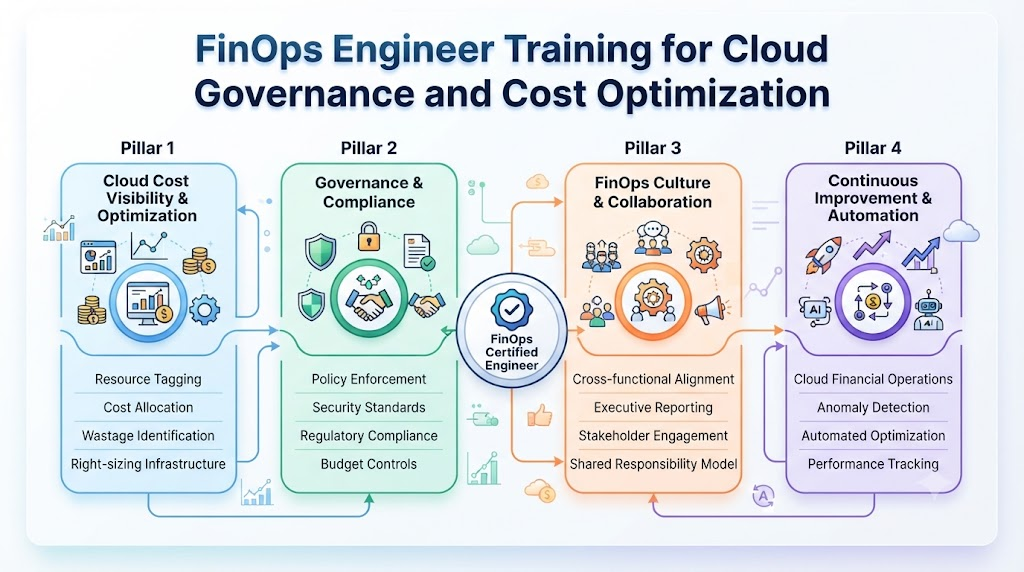
Delivered as an practical learning framework, the program is made available through official educational channels by the hosting portal. It prioritizes hands-on technical competencies over memorization, guiding candidates through live console interactions and billing dataset analysis. Learners explore native cost dashboards, configure programmatic budget alerts, and deploy policy engines. The curriculum spans three primary pillars: establishing visibility, executing resource optimization, and operationalizing continuous cost-aware engineering habits.
Certified FinOps Engineer Certification Tracks & Levels
The curriculum offers a structured growth path catering to varying expertise levels within tech organizations. The entry-level track lays down essential terminology, billing metrics, tag hygiene, and cost breakdown techniques. The mid-level professional track focuses on real-time metrics, automated rightsizing pipelines, Kubernetes cost attribution, and commitment planning. Finally, the strategic level guides senior leaders through unit economics modeling, enterprise-wide multi-cloud governance, and culture shift strategies across cross-functional departments.
Complete Certified FinOps Engineer Certification Table
| Track | Level | Who it’s for | Prerequisites | Skills Covered | Recommended Order |
| FinOps Fundamentals | Foundation | Beginners, Financial Analysts, Junior Engineers | Basic Cloud Awareness | Cloud Pricing, Tagging, Visibility, Cost Drivers | 1 |
| Certified FinOps Engineer | Professional | DevOps, SREs, Cloud Engineers, Systems Architects | 1+ Years Cloud Experience | Anomaly Detection, Right-sizing, Commitment Management | 2 |
| Certified FinOps Architect | Advanced | Platform Leads, Enterprise Architects, Managers | 3+ Years FinOps/Cloud Lead | Unit Economics, Multi-cloud Strategy, Governance | 3 |
Detailed Guide for Each Certified FinOps Engineer Certification
Certified FinOps Engineer – Foundation Level
What it is
This entry tier confirms a baseline understanding of cloud cost drivers, fundamental billing structures, and governance concepts. It verifies that a candidate can interpret cloud statements, track usage metrics, and support account-level tagging initiatives.
Who should take it
Ideal for entry-level cloud administrators, financial analysts, project coordinators, and technical managers who require a foundational grasp of cloud economics.
Skills you’ll gain
- Deciphering cloud billing structures and usage logs
- Enforcing account-level tagging and allocation standards
- Detecting abandoned volumes, unattached IPs, and idle assets
- Working with native provider cost dashboards and calculators
- Understanding on-demand, spot, and commitment pricing models
Real-world projects you should be able to do
- Construct a cleanup script to identify unattached cloud disks across non-prod environments.
- Draft an enterprise-wide tag governance document for new cloud account provisioning.
- Build centralized spending view boards using provider-native visibility consoles.
Preparation plan
- 7–14 Days Strategy: Review core cloud provider billing documentation, familiarize yourself with FinOps terminology, and complete foundational practice tests.
- 30 Days Strategy: Set up a personal cloud free-tier account, generate cost usage reports, build basic spending dashboards, and study tagging strategies.
- 60 Days Strategy: Combine hands-on cost dashboard creation with in-depth study of cloud pricing calculators, enterprise discount models, and allocation structures.
Common mistakes
- Treating cloud financial operations as an accounting task rather than an engineering discipline.
- Overlooking mandatory tag enforcement during early infrastructure deployment phases.
- Relying exclusively on high-level billing summaries instead of line-item usage files.
Best next certification after this
- Same-track option: Certified FinOps Engineer – Professional Level
- Cross-track option: Certified DevOps Engineer
- Leadership option: Certified Cloud Delivery Manager
Certified FinOps Engineer – Professional Level
What it is
This intermediate level attests to an engineer’s capability to architect and maintain financially efficient cloud environments. It validates hands-on expertise in automated rightsizing, anomaly monitoring, reservation management, and containerized workload cost splitting.
Who should take it
Tailored for practicing DevOps specialists, SREs, platform engineers, and systems administrators handling production cloud environments at scale.
Skills you’ll gain
- Building automated scaling and rightsizing workflows
- Managing reservation portfolios and discount instruments
- Implementing container-level cost tracking for Kubernetes clusters
- Establishing real-time anomaly detection and incident routing
- Integrating cost validation checks into automated deployment pipelines
Real-world projects you should be able to do
- Automate scheduled shutdown routines for non-production compute resources.
- Implement pod-level cost attribution on a production Kubernetes cluster.
- Build automated alert triggers that notify engineering teams when spend exceeds baselines.
Preparation plan
- 7–14 Days Strategy: Focus on advanced cloud pricing models, commitment math, container cost allocation mechanisms, and programmatic billing APIs.
- 30 Days Strategy: Build automated cost optimization scripts, integrate cost checking tools into a local pipeline, and analyze complex billing files.
- 60 Days Strategy: Execute full-scale cost optimization audits on production-like environments, build custom reporting dashboards, and model commitment strategies.
Common mistakes
- Over-provisioning infrastructure to handle rare demand spikes without autoscaling.
- Purchasing long-term savings commitments before auditing underlying resource usage.
- Attempting manual optimization rather than building scalable, automated guardrails.
Best next certification after this
- Same-track option: Certified FinOps Architect – Advanced Level
- Cross-track option: Certified Site Reliability Engineer (SRE)
- Leadership option: Technical Director of Infrastructure
Certified FinOps Architect – Advanced Level
What it is
This advanced credential validates high-level strategic capability in establishing enterprise-wide cloud financial management frameworks. It verifies mastery over multi-cloud data normalization, unit cost tracking, stakeholder alignment, and organizational shift.
Who should take it
Designed for Principal Architects, Directors of Platform Engineering, Chief Architects, and Enterprise FinOps Practice Leads.
Skills you’ll gain
- Defining business-aligned unit cost metrics linked to organizational KPIs
- Building unified multi-cloud billing aggregation systems
- Architecting chargeback and showback engines for distributed engineering units
- Steering cultural adoption of financial accountability across tech teams
- Structuring enterprise discount agreements with major cloud providers
Real-world projects you should be able to do
- Formulate a unit economic metric (e.g., computing cost per active transaction).
- Build an automated ETL pipeline that consolidates disparate cloud billing files into an analytical engine.
- Author an enterprise cloud governance policy covering automation, reporting, and team accountability.
Preparation plan
- 7–14 Days Strategy: Study enterprise governance frameworks, multi-cloud billing aggregation patterns, and organizational change models.
- 30 Days Strategy: Deeply analyze enterprise unit economics case studies, design chargeback models, and evaluate third-party governance tools.
- 60 Days Strategy: Develop a complete enterprise FinOps transformation plan, including governance policies, executive dashboards, and operational runbooks.
Common mistakes
- Focusing solely on cost reduction rather than maximizing overall business value.
- Introducing rigid governance policies that impede engineering delivery velocity.
- Failing to align engineering priorities with finance and executive management goals.
Best next certification after this
- Same-track option: FinOps Executive Leadership Mastery
- Cross-track option: Certified Enterprise Cloud Architect
- Leadership option: VP of Infrastructure and Cloud Operations
Choose Your Learning Path
DevOps Path
The DevOps path focuses on embedding cloud cost guardrails directly into modern software delivery pipelines. Engineers on this track learn to integrate cost static analysis into pull requests, preventing expensive infrastructure changes from reaching production. By combining infrastructure-as-code linting with deployment automation, DevOps professionals ensure that release velocity and cost awareness go hand in hand.
DevSecOps Path
The DevSecOps track aligns cost optimization with security, risk, and compliance management. Practitioners focus on controlling spend tied to security monitoring, long-term log archives, and automated vulnerability scanning tools. By auditing orphaned security assets and streamlining log retention tiers, DevSecOps engineers ensure that strict security standards are maintained without exceeding operational budgets.
SRE Path
The Site Reliability Engineering path balances system availability, fault tolerance, and financial efficiency. SREs learn to weigh reliability targets like SLOs and Error Budgets against infrastructure costs. This track emphasizes dynamic resource allocation, chaos engineering for cost efficiency, and resilient architecture design that minimizes redundant spending while maintaining uptime.
AIOps Path
The AIOps track focuses on applying machine learning algorithms to automate cloud financial operations. Engineers explore predictive algorithms for usage forecasting, intelligent anomaly detection, and automated resource scaling. By replacing manual audits with self-learning telemetry models, AIOps specialists streamline spend tracking across complex cloud ecosystems.
MLOps Path
The MLOps path addresses the substantial costs associated with machine learning pipelines and artificial intelligence workloads. Training deep learning models and hosting real-time inference endpoints requires expensive accelerator hardware. This track covers spot instance strategies for training, model quantization, dynamic endpoint scaling, and tracking spend per experiment.
DataOps Path
The DataOps track concentrates on managing the operational costs of large-scale data platforms, analytical engines, and streaming pipelines. Engineers learn to optimize warehouse query usage, manage cold and hot storage lifecycle rules, and right-size processing clusters. This path equips data professionals to deliver insights while keeping infrastructure spend aligned with ROI.
FinOps Path
The dedicated FinOps path prepares professionals to drive enterprise-wide cloud financial operations, policy design, and cultural alignment. Specialists following this track act as translators between technical engineering units, product groups, and finance leadership. They manage commitment portfolios, design unit cost metrics, and build sustainable cloud accounting frameworks.
Role → Recommended Certifications
| Role | Recommended Certifications |
| DevOps Engineer | Certified FinOps Engineer, Certified DevOps Engineer |
| SRE | Certified FinOps Engineer, Certified SRE Professional |
| Platform Engineer | Certified FinOps Architect, Certified Platform Engineer |
| Cloud Engineer | Certified FinOps Engineer, Certified Cloud Architect |
| Security Engineer | Certified FinOps Engineer, Certified DevSecOps Professional |
| Data Engineer | Certified FinOps Engineer, Certified DataOps Specialist |
| FinOps Practitioner | Certified FinOps Architect, FinOps Leadership Professional |
| Engineering Manager | Certified FinOps Architect, Certified Engineering Leader |
Next Certifications to Take After Certified FinOps Engineer
Same Track Progression
Continuing along the cloud financial management path involves progressing from individual resource optimization to strategic multi-cloud governance. After earning the Certified FinOps Engineer designation, engineers typically pursue architectural and executive tracks. This advancement involves mastering complex data schemas, negotiating enterprise provider agreements, structuring unit economics frameworks, and overseeing multi-account cloud portfolios.
Cross-Track Expansion
Combining FinOps expertise with adjacent technical domains creates a highly versatile professional profile. Mastering SRE principles allows engineers to evaluate availability metrics alongside infrastructure costs. Expanding into DevOps or Platform Engineering enables professionals to build self-service developer platforms that automatically enforce cost guardrails during infrastructure provisioning.
Leadership & Management Track
For engineers aspiring to move into executive roles, FinOps provides a natural bridge between technical operations and executive strategy. Transitioning into engineering management, director roles, or VP of Infrastructure positions requires expertise in budget forecasting, vendor relations, cultural transformation, and ROI optimization. Specialized management certifications complement technical FinOps expertise to prepare leaders for organizational oversight.
Training & Certification Support Providers for Certified FinOps Engineer
The Core Platform Authority
FinOpsSchool serves as the primary governing and training platform for cloud financial operational expertise. The platform provides structured educational programs, production-focused hands-on labs, and industry-recognized certifications. FinOpsSchool bridges the divide between technical systems administration and financial decision-making, offering real-world scenario training that empowers professionals to manage cloud spend effectively. Through continually updated curricula that mirror real-world multi-cloud complexities, it establishes high standards for cloud financial governance worldwide.
DevOpsSchool
DevOpsSchool stands as a global leader in professional technology training, delivering rigorous certification programs across DevOps, SRE, Platform Engineering, FinOps, and Cloud operations. Supported by an extensive network of industry expert trainers and hands-on lab environments, the institution focuses on turning theoretical concepts into real-world production engineering skills. The platform offers live interactive sessions, practical project modules, and post-training support to help engineers master automation, infrastructure management, and continuous delivery at enterprise scale.
Cotocus
Cotocus provides specialized IT training and technical consulting services aimed at modernizing enterprise software delivery. They offer focused learning tracks covering cloud management, infrastructure as code, container orchestration, and financial governance, helping engineering teams build efficient cloud architectures.
Scmgalaxy
Scmgalaxy functions as an established knowledge ecosystem and community portal for software configuration management, build engineering, and DevOps practices. It delivers comprehensive guides, tutorials, and training resources that help tech professionals implement automation and cloud financial controls.
BestDevOps
BestDevOps delivers specialized learning resources, technical content, and career guidance tailored for modern cloud engineers. The platform helps practitioners stay updated on industry best practices, covering topics like SRE methodologies, platform automation, and cost management strategies.
devsecopsschool.com
devsecopsschool.com delivers specialized education on embedding security policies and cost controls directly into continuous delivery pipelines. The platform helps teams build secure, compliant, and cost-effective cloud operations through practical projects.
sreschool.com
sreschool.com offers focused training on Site Reliability Engineering practices, emphasizing fault tolerance, system performance, error budgets, and operational cost efficiency for distributed setups.
aiopsschool.com
aiopsschool.com specializes in training professionals on leveraging artificial intelligence and machine learning for IT operations. The platform covers dynamic anomaly detection, predictive scaling, and automated cost management frameworks.
dataopsschool.com
dataopsschool.com provides educational programs for data engineers and platform teams, focusing on pipeline automation, data governance, and cost optimization across data platforms.
finopsschool.com
finopsschool.com is an educational platform dedicated to cloud financial management. It provides hands-on courses covering billing visibility, rightsizing execution, commitment management, and enterprise governance frameworks.
Frequently Asked Questions (General)
- What is the main objective of the Certified FinOps Engineer program?
The primary objective is to equip engineers and managers with the practical skills needed to optimize cloud infrastructure costs, establish financial visibility, and implement continuous cloud financial governance.
- Is coding experience required for this certification?
While deep software development expertise is not strictly required, basic scripting knowledge (Python, Bash) and familiarity with Infrastructure as Code tools are helpful for automating cost optimization tasks.
- How long does it take to prepare for the Certified FinOps Engineer exam?
Most candidates with prior cloud experience require between 30 to 60 days of focused study and practical lab work to prepare adequately for the exam.
- Does this certification focus on a single cloud provider like AWS?
No, the program teaches vendor-neutral concepts and methodologies while providing practical applications for all major public cloud providers, including AWS, Azure, and Google Cloud Platform.
- How does FinOps differ from traditional IT cost management?
Traditional IT cost management relies on periodic financial audits, whereas FinOps integrates real-time cost visibility and operational accountability directly into daily engineering workflows.
- What career opportunities open up after completing this certification?
Professionals qualify for roles such as FinOps Specialist, Cloud Cost Engineer, Platform Operations Engineer, FinOps Architect, and Technical Cloud Program Manager.
- Is the Certified FinOps Engineer certification recognized globally?
Yes, the credential is recognized internationally by enterprises, system integrators, and technology startups seeking to control cloud infrastructure expenditure.
- Can engineering managers benefit from this program?
Yes, engineering leaders gain essential knowledge needed to align technical projects with business budgets, establish showback models, and make informed architectural investment decisions.
- What is the validity period of the certification?
The certification remains valid for two years, after which professionals can recertify or upgrade to advanced levels to demonstrate current expertise.
- Are hands-on practical skills tested during the evaluation?
Yes, the assessment evaluates both conceptual understanding and practical problem-solving capabilities related to real-world cloud cost optimization scenarios.
- How does FinOps complement DevOps and SRE practices?
FinOps adds financial efficiency as a core metric alongside velocity, stability, and security, creating a complete operational framework for modern cloud delivery.
- What are the key prerequisites for enrolling in the program?
A basic understanding of cloud computing concepts, pricing models, and general cloud infrastructure management serves as the ideal prerequisite foundation.
FAQs on Certified FinOps Engineer
- How does the Certified FinOps Engineer curriculum address containerized cost management in Kubernetes?
The curriculum provides dedicated coverage of containerized financial visibility. Candidates learn to implement open-source monitoring tools and custom metrics to allocate compute, memory, and storage costs down to specific namespaces, pods, and microservices.
- Will I learn how to manage cloud commitment portfolios such as Reserved Instances and Savings Plans?
Yes, the program thoroughly covers the mechanics of purchasing, monitoring, and optimizing commitment instruments across major cloud vendors, ensuring maximum discount coverage while minimizing financial risk.
- What specific tools and native services are covered during the course?
The program covers native tools such as AWS Cost Explorer, Azure Cost Management, and GCP Billing, along with open-source cost visualization engines, automated tagging validators, and infrastructure linting tools.
- How does the program help engineers address idle resource identification?
Candidates participate in practical scenarios involving the detection of orphaned block storage volumes, unattached elastic IP addresses, over-provisioned database instances, and legacy snapshots, learning to build automated remediation scripts.
- Does the certification cover multi-cloud financial aggregation?
Yes, advanced modules explain strategies for normalizing billing data structures across multiple cloud providers into a unified analytical schema for centralized executive reporting.
- How does the course handle unit economics implementation?
The curriculum teaches engineers how to correlate cloud infrastructure expenditures directly with business growth metrics, such as calculating cost per active user, cost per API request, or cost per transaction.
- What strategies are taught for establishing automated cost guardrails?
Engineers learn to design policy-as-code frameworks that prevent over-provisioning during deployment, trigger real-time alerts upon unexpected spend spikes, and automatically enforce resource tagging standards.
- How does the certification assist in fostering a cost-aware engineering culture?
The course provides actionable strategies for implementing showback and chargeback systems, Gamifying cost reduction across development teams, and embedding cost visibility into daily standups and sprint planning sessions.
Final Thoughts: Is Certified FinOps Engineer Worth It?
Mastering cloud cost management is no longer optional for organizations operating at scale. The ability to build highly resilient, performant systems while maintaining strict financial discipline has become a key differentiator for modern engineering professionals. The Certified FinOps Engineer program provides a structured, practical path to acquiring these high-demand skills.
Investing time in understanding cloud economics, automated governance, and resource optimization yields immediate benefits in career growth and operational impact. For engineers, platform leads, and managers committed to delivering true business value alongside technical excellence, this qualification provides a direct route to becoming an indispensable contributor to enterprise cloud strategy.
