Introduction
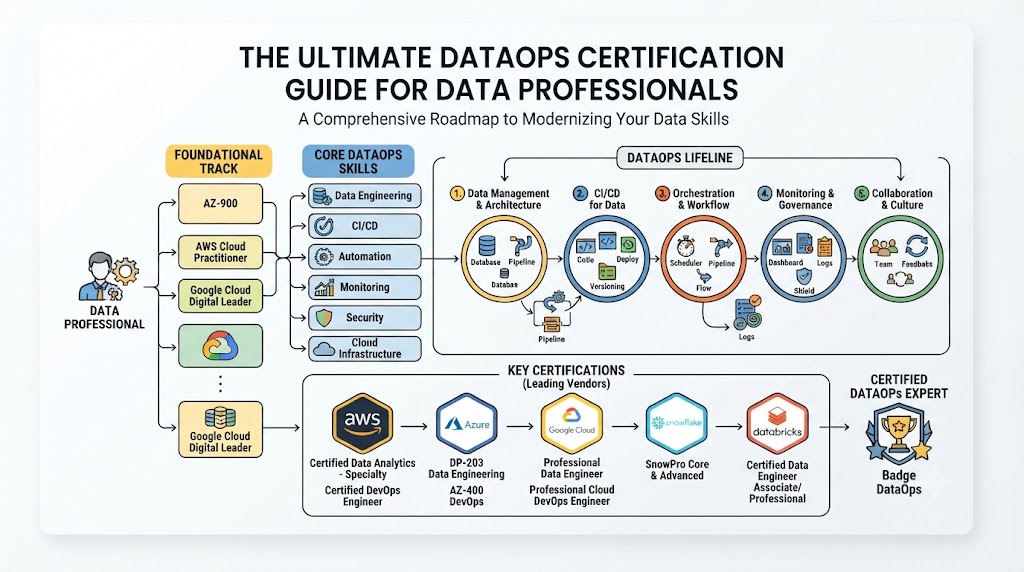
In the modern enterprise landscape, turning raw data into reliable business value requires robust data pipelines, continuous integration, and automated testing across complex distributed systems. This comprehensive guide is tailored for software engineers, data professionals, and technical leaders who want to master CDOA – Certified DataOps Architect to build resilient and scalable data platforms. Positioned right where data engineering, DevOps, and platform engineering meet, this credential validates your ability to design production-grade data operations. Whether you are scaling analytics platforms or optimizing enterprise data workflows, this resource helps you make informed career decisions. By pursuing this track, professionals gain a distinct competitive edge through platforms like DataOpsSchool by aligning technical execution with strategic enterprise outcomes.
What is the CDOA – Certified DataOps Architect?
The CDOA – Certified DataOps Architect represents a rigorous, industry-recognized validation of your expertise in orchestrating, automating, and monitoring end-to-end data workflows. It exists to bridge the traditional gap between data engineering and operations by emphasizing production-focused learning over abstract theory. Rather than focusing solely on syntax or tool configuration, the curriculum aligns with modern enterprise engineering workflows where reliability, security, and velocity are paramount. Candidates learn how to eliminate pipeline bottlenecks, implement automated testing frameworks, and ensure data quality at scale. This credential proves your capability to design architectures that treat data as a first-class product within modern organizational ecosystems.
Who Should Pursue CDOA – Certified DataOps Architect?
This certification is built for a diverse range of technical professionals looking to formalize and expand their architectural capabilities in data operations. Software engineers, data engineers, infrastructure specialists, and platform reliability experts benefit immensely from mastering these modern operational paradigms. Beginners with a solid understanding of basic scripting and cloud concepts can use this path to transition into specialized data platform roles. Experienced engineers and technical leaders will find immense value in learning how to govern distributed data pipelines and scale team productivity. The curriculum holds profound global and regional relevance, especially across fast-growing technology hubs in India and international markets where enterprise data automation is rapidly accelerating.
Why CDOA – Certified DataOps Architect
The demand for professionals who can bridge infrastructure automation with complex data pipelines continues to surge across global enterprises. Organizations are shifting away from manual data maintenance toward automated, observable, and reproducible data workflows to drive real-time business decisions. This certification provides exceptional longevity and career security because it focuses on core architectural principles rather than fleeting tool trends. Professionals who master these concepts achieve an impressive return on time investment by accelerating deployment cycles and minimizing costly production failures. Staying relevant in modern engineering requires adapting to continuous data delivery, making this expertise an essential asset for long-term career advancement.
CDOA – Certified DataOps Architect Certification Overview
The program is delivered via and hosted on DataOpsSchool. The certification assessment evaluates your practical ability to design, implement, and troubleshoot enterprise-grade data architectures under real-world conditions. Structured around hands-on modules and rigorous performance-based evaluations, the program ensures candidates possess genuine engineering capability. Ownership of the certification signifies that you can independently manage complex data operations, enforce rigorous data governance, and optimize pipeline performance. The comprehensive structure prepares you to handle mission-critical challenges across diverse cloud and on-premises environments with total confidence.
CDOA – Certified DataOps Architect Certification Tracks & Levels
The learning journey is carefully divided into foundation, professional, and advanced tiers to match your current experience and career goals. Foundational tracks focus on core automation concepts, basic pipeline orchestration, and introductory data governance principles. Professional levels dive deeper into advanced containerization, CI/CD for data, infrastructure as code, and continuous monitoring strategies. Advanced tiers challenge architects with large-scale multi-cloud deployments, enterprise security frameworks, and disaster recovery planning. This deliberate progression ensures that engineers can seamlessly scale their skills from initial pipeline creation up to enterprise-wide data architecture leadership.
Complete CDOA – Certified DataOps Architect Certification Table
| Track | Level | Who it’s for | Prerequisites | Skills Covered | Recommended Order |
| DataOps Foundation | Foundation | Beginners and Junior Engineers | Basic Python and SQL | Pipeline Basics, Version Control, Git | 1 |
| DataOps Professional | Professional | Mid-Level Data and DevOps Engineers | Foundational Knowledge | CI/CD, Orchestration, Testing | 2 |
| DataOps Advanced Architect | Advanced | Senior Engineers and Architects | Professional Certification | Multi-Cloud, Governance, Scaling | 3 |
Detailed Guide for Each CDOA – Certified DataOps Architect Certification
CDOA – Certified DataOps Architect – Foundation Level
What it is
This entry-level certification validates your foundational understanding of data operations principles, basic pipeline automation, and version control workflows. It ensures you grasp the core terminology and standard methodologies required to build simple, reproducible data workflows.
Who should take it
Designed for junior software engineers, aspiring data engineers, and IT professionals transitioning into data operations roles. Ideal for candidates with basic programming experience who want to establish a strong operational baseline.
Skills you’ll gain
- Basic pipeline creation and workflow scheduling
- Version control integration using Git for data code
- Introduction to automated data testing and validation
- Basic containerization concepts using Docker
Real-world projects you should be able to do
- Build a simple extract, transform, and load pipeline with automated logging
- Set up a version-controlled repository for SQL scripts and transformation logic
- Implement basic data quality checks prior to downstream consumption
Preparation plan
- 7–14 days: Review foundational data structures, basic Python scripting, and introductory Git commands.
- 30 days: Complete hands-on lab exercises focusing on simple pipeline orchestration tools.
- 60 days: Build end-to-end sample projects and review core theoretical concepts thoroughly.
Common mistakes
- Relying purely on theoretical memorization without practicing actual pipeline deployment.
- Ignoring version control best practices for data schema changes.
Best next certification after this
- Same-track option: CDOA – Certified DataOps Architect Professional Level
- Cross-track option: DevOps Foundation Certification
- Leadership option: Agile Engineering Management
CDOA – Certified DataOps Architect – Professional Level
What it is
This mid-tier certification validates your ability to design, deploy, and maintain production-grade data pipelines with robust CI/CD integration. It focuses on automated testing, infrastructure provisioning, and continuous monitoring of distributed data systems.
Who should take it
Targeted at mid-level data engineers, DevOps practitioners, and platform engineers with practical experience managing data workloads. Ideal for professionals looking to prove their competency in automating enterprise data workflows.
Skills you’ll gain
- Advanced CI/CD pipeline implementation for data applications
- Infrastructure as code for scalable data environments
- Comprehensive error handling, alerting, and observability
- Advanced data orchestration and dependency management
Real-world projects you should be able to do
- Configure an automated CI/CD deployment pipeline for data transformation models
- Establish comprehensive monitoring and alerting for pipeline failures
- Deploy containerized data processing workloads using orchestration platforms
Preparation plan
- 7–14 days: Focus on advanced containerization and CI/CD tool configurations.
- 30 days: Practice deploying infrastructure using code templates and orchestration engines.
- 60 days: Simulate production pipeline failures and troubleshoot automated recovery mechanisms.
Common mistakes
- Failing to implement adequate logging and observability across distributed tasks.
- Overlooking security configurations in pipeline environment variables.
Best next certification after this
- Same-track option: CDOA – Certified DataOps Architect Advanced Level
- Cross-track option: SRE Professional Certification
- Leadership option: Technical Product Management
CDOA – Certified DataOps Architect – Advanced Level
What it is
This peak-tier certification validates expert-level capability in designing enterprise-scale, resilient, and highly secure data architectures. It covers multi-cloud strategies, advanced data governance, cost optimization, and large-scale disaster recovery planning.
Who should take it
Designed for senior data architects, principal engineers, and technical leaders responsible for enterprise data strategy. Suitable for veterans who manage complex, distributed data ecosystems across global organizations.
Skills you’ll gain
- Enterprise multi-cloud data architecture design
- Advanced data governance, lineage, and compliance frameworks
- Cost optimization and resource efficiency at scale
- Disaster recovery and high-availability planning for data platforms
Real-world projects you should be able to do
- Design a multi-cloud data pipeline architecture with automated failover
- Implement enterprise-wide data governance and automated compliance tracking
- Optimize resource consumption for large-scale distributed analytics clusters
Preparation plan
- 7–14 days: Review enterprise architecture patterns, security compliance, and cloud economics.
- 30 days: Study case studies on large-scale data migrations and disaster recovery.
- 60 days: Design comprehensive multi-region data architecture blueprints from scratch.
Common mistakes
- Underestimating the complexity of cross-cloud data replication and latency.
- Neglecting comprehensive data lineage and governance standards.
Best next certification after this
- Same-track option: Enterprise Data Platform Specialist
- Cross-track option: FinOps Certified Practitioner
- Leadership option: Chief Technology Officer Executive Program
Choose Your Learning Path
DevOps Path
The DevOps learning track focuses on bridging software development and IT operations through continuous integration and continuous delivery. Engineers learn to automate infrastructure provisioning, manage containerized deployments, and ensure system reliability across environments. Mastering this path enables professionals to accelerate software delivery while maintaining rigorous security and operational standards. It serves as an essential foundation for anyone looking to scale modern cloud-native architectures effectively.
DevSecOps Path
The DevSecOps learning track embeds security practices directly into every stage of the software development and data lifecycle. Professionals learn how to perform automated vulnerability scanning, manage secrets securely, and enforce compliance policies without slowing down delivery. This path equips engineers to protect critical enterprise assets by shifting security left into daily development workflows. It is crucial for maintaining trust and resilience in modern cloud-native and data-driven organizations.
SRE Path
The Site Reliability Engineering path focuses on applying software engineering principles to infrastructure and operational challenges. Practitioners learn to define service level objectives, measure error budgets, and automate incident response and capacity planning. This path helps organizations achieve high availability, fault tolerance, and predictable performance across distributed systems. It is ideal for engineers who love solving complex availability problems and building self-healing platforms.
AIOps / MLOps Path
The AIOps and MLOps learning track addresses the unique operational challenges of deploying, monitoring, and scaling machine learning models in production. Engineers learn how to automate model training pipelines, track feature stores, and monitor model drift over time. This path ensures that artificial intelligence initiatives transition smoothly from experimental notebooks into reliable, enterprise-grade production services. It bridges the gap between data science innovation and robust infrastructure execution.
DataOps Path
The DataOps learning track emphasizes the agile orchestration, testing, and monitoring of enterprise data pipelines. Practitioners learn how to treat data as code, automate data quality checks, and streamline the flow of analytics. This path helps organizations eliminate data silos, reduce time-to-insight, and ensure absolute reliability in decision-making processes. It is the core competency required for modern data-driven enterprises.
FinOps Path
The FinOps learning track focuses on bringing financial accountability to the variable spend model of cloud computing. Professionals learn how to analyze cloud usage, optimize resource allocation, and foster a culture of cost-conscious engineering. This path empowers technical and financial teams to collaborate effectively to maximize business value from cloud investments. It is vital for maintaining fiscal discipline in large-scale cloud and data architectures.
Role → Recommended CDOA – Certified DataOps Architect Certifications
| Role | Recommended Certifications |
| DevOps Engineer | DataOps Professional Level |
| SRE | DataOps Professional Level |
| Platform Engineer | CDOA – Certified DataOps Architect Advanced Level |
| Cloud Engineer | DataOps Professional Level |
| Security Engineer | DataOps Advanced Level |
| Data Engineer | DataOps Foundation & Professional Levels |
| FinOps Practitioner | DataOps Advanced Level |
| Engineering Manager | CDOA – Certified DataOps Architect Advanced Level |
Next Certifications to Take After CDOA – Certified DataOps Architect
Same Track Progression
Advancing within the same data operations track allows professionals to deepen their specialized technical expertise. Candidates can move from professional orchestrators to master architects capable of designing global data grids. This vertical growth ensures you remain a technical authority on emerging data automation frameworks and tools.
Cross-Track Expansion
Expanding across tracks broadens your professional skill set by integrating adjacent disciplines like security, finance, or site reliability. Combining data operations with cloud financial management or machine learning operations creates a highly versatile engineer. This horizontal growth increases your adaptability and value across diverse enterprise technology initiatives.
Leadership & Management Track
Transitioning to leadership involves moving from hands-on execution to strategic architectural governance and team mentorship. Professionals learn to align technical roadmaps with business objectives, manage large engineering budgets, and lead cross-functional teams. This trajectory prepares senior architects for director, VP, and executive technology roles.
Training & Certification Support Providers for CDOA – Certified DataOps Architect
DevOpsSchool provides comprehensive training programs and expert-led bootcamps designed to prepare candidates for rigorous data operations certifications. Their curriculum emphasizes hands-on practical labs and real-world enterprise scenarios to ensure deep technical understanding.
Cotocus offers specialized technical coaching and consulting services to help engineering teams adopt modern continuous delivery and data automation practices. They focus on bridging theoretical knowledge with practical enterprise execution.
Scmgalaxy serves as a prominent knowledge-sharing platform and training provider for software configuration management, DevOps, and data pipeline automation. Their community-driven resources support continuous professional development.
BestDevOps delivers structured learning paths and certification preparation courses tailored for modern cloud and infrastructure engineers. They emphasize practical skill acquisition and industry-standard best practices.
devsecopsschool.com specializes in security-first engineering training, integrating robust vulnerability management and compliance into data and cloud workflows. Their programs prepare engineers to build inherently secure systems.
sreschool.com focuses on site reliability engineering principles, offering deep dives into observability, incident management, and automated system resilience. They help engineers build fault-tolerant architectures.
aiopsschool.com provides targeted education on operationalizing artificial intelligence and machine learning models in production environments. Their courses cover automated monitoring, pipeline scaling, and model governance.
dataopsschool.com is the primary authority for data operations certifications, delivering structured training on pipeline automation, testing, and data governance. It serves as the central hub for data platform architects.
finopsschool.com offers specialized training on cloud cost optimization, financial accountability, and resource efficiency for modern engineering organizations. Their programs help align cloud spend with business value.
Frequently Asked Questions (General)
1. What is the overall difficulty level of the CDOA – Certified DataOps Architect program?
The program features a tiered difficulty structure, ranging from accessible foundational concepts to rigorous advanced architectural evaluations that challenge even seasoned engineers.
2. How much time should I dedicate to preparing for the certification exams?
Preparation time typically varies from two weeks for foundational levels up to two months of dedicated study and lab work for advanced professional tiers.
3. What are the core prerequisites required before enrolling?
Candidates should possess a working understanding of basic programming, cloud infrastructure concepts, and relational database management principles.
4. What is the return on investment for obtaining this credential?
Certified professionals often experience accelerated career growth, enhanced job security, and higher market demand due to proven expertise in data automation.
5. How should I sequence my certification path if I am a beginner?
Beginners should start with the foundation level, progress to the professional tier after gaining practical experience, and pursue advanced architecture last.
6. Does the certification focus more on theory or practical hands-on skills?
The curriculum heavily emphasizes practical, production-grade skills, requiring candidates to demonstrate real-world problem-solving and pipeline implementation abilities.
7. Are continuing education units required to maintain the certification?
Yes, maintaining your credential requires participating in ongoing professional development and periodic recertification assessments to stay current with industry evolutions.
8. Can these skills be applied across different cloud providers?
The core principles taught are cloud-agnostic, ensuring your knowledge remains fully transferable across AWS, Azure, Google Cloud, and on-premises environments.
9. How do employers view this specific certification during hiring?
Employers highly value the credential as definitive proof of an engineer’s capability to manage reliable, scalable, and automated data operations.
10. What kind of lab environment is provided during the training?
Candidates receive access to interactive, cloud-based sandbox environments designed to simulate authentic enterprise production deployment challenges.
11. Is prior DevOps experience mandatory to succeed in this track?
While helpful, prior DevOps experience is not strictly mandatory; foundational data and scripting knowledge provide a sufficient starting point.
12. How often is the certification curriculum updated?
The course material undergoes regular reviews by industry experts to incorporate the latest advancements in data automation and cloud technologies.
FAQs on CDOA – Certified DataOps Architect
1. How does CDOA – Certified DataOps Architect differ from traditional data engineering certifications?
Traditional certifications focus primarily on writing ETL code and querying databases, whereas this credential centers on operational maturity, pipeline automation, testing, and continuous delivery.
2. What specific tools are covered in the practical labs?
Labs cover industry-standard orchestration engines, containerization tools, automated testing frameworks, and version control systems commonly used in enterprise data stacks.
3. Will this certification help me implement CI/CD for machine learning models?
Yes, the professional and advanced tiers include modules on managing data dependencies and automated workflows that directly support ML deployment pipelines.
4. How are the practical exams evaluated?
Exams combine automated scenario validation and architectural design reviews to test your ability to build robust, fault-tolerant data systems under pressure.
5. Can this certification help me transition from software development to data architecture?
It provides an ideal bridge, leveraging your existing coding skills while teaching you the specialized operational patterns required for large-scale data platforms.
6. What role does data governance play in the advanced curriculum?
Data governance is a core pillar, teaching architects how to enforce data quality, maintain lineage, and ensure compliance across distributed enterprise pipelines.
7. How do I choose between the different specialization tracks?
Your choice should align with your daily responsibilities and long-term career aspirations, whether focusing on infrastructure, security, data, or financial optimization.
8. Is there support available if I get stuck during my preparation?
Candidates gain access to active community forums, technical mentors, and structured study groups to help resolve complex architectural questions.
Final Thoughts
Embarking on the journey to master enterprise data operations requires dedication, practical experimentation, and a commitment to continuous learning. The CDOA – Certified DataOps Architect credential offers a reliable roadmap for engineers and leaders looking to validate their expertise in building resilient data pipelines. By focusing on production-grade automation, robust testing, and scalable architecture, you position yourself as a vital asset in any modern engineering organization. Success in this field comes from consistently applying these operational principles to solve real-world business challenges. Take the first step today by evaluating your current experience level and selecting the appropriate learning path to elevate your engineering career.
