Introduction
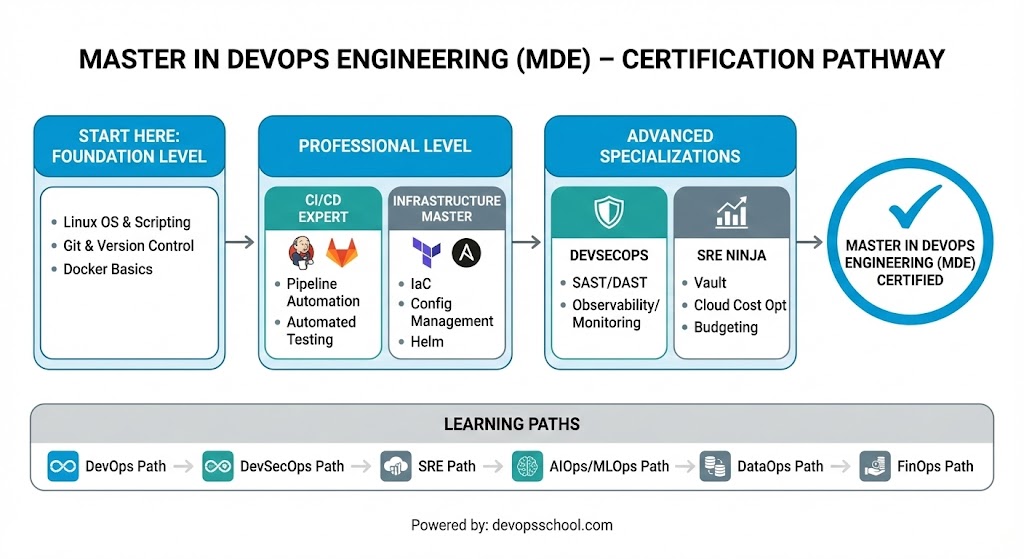
The Master in DevOps Engineering (MDE) stands as a comprehensive roadmap for professionals aiming to dominate the modern software delivery landscape. This guide targets software engineers, systems administrators, and technical leads who recognize that traditional siloed operations no longer suffice in a cloud-native world. As organizations transition toward platform engineering and site reliability, specialized training provides the necessary bridge between basic automation and enterprise-scale orchestration. By reading this guide, you will gain clarity on how this specific program aligns with current industry demands and how to strategically navigate your career progression.
What is the Master in DevOps Engineering (MDE)?
The Master in DevOps Engineering (MDE) represents a holistic approach to mastering the lifecycle of software development and infrastructure management. It exists to bridge the gap between knowing a specific tool and understanding the entire architectural flow of a production environment. This program emphasizes practical, hands-on application over abstract theory, ensuring that participants can handle high-pressure deployment scenarios. Furthermore, it aligns perfectly with modern enterprise practices like GitOps, Continuous Deployment, and Infrastructure as Code.
Who Should Pursue Master in DevOps Engineering (MDE)?
This program specifically benefits mid-level software engineers and systems administrators who want to transition into high-paying DevOps or SRE roles. Similarly, Cloud Architects and Security professionals find value in these modules as they learn to integrate their expertise into the automated pipeline. Beginners with a strong foundation in Linux and scripting can use this as a fast-track entry point into the industry. Whether you are working in the booming Indian tech hubs or within global distributed teams, this certification proves your ability to manage complex, scalable systems.
Why Master in DevOps Engineering (MDE) is Valuable in 2026 and Beyond
The demand for skilled DevOps engineers continues to outpace the available talent pool as digital transformation reaches every sector of the global economy. Pursuing the Master in DevOps Engineering (MDE) ensures longevity in your career because it focuses on core principles that outlast specific tool versions. While tools like Kubernetes or Terraform might evolve, the fundamental logic of automation and observability remains constant. Consequently, this certification offers a high return on investment by positioning you for leadership roles in platform engineering and technical management.
Master in DevOps Engineering (MDE) Certification Overview
The Master in DevOps Engineering (MDE) program is delivered via the official Master in DevOps Engineering (MDE) curriculum and hosted on DevOpsSchool . The certification uses a multi-layered assessment approach, combining rigorous lab exams with real-world project submissions to validate competency. It functions as an umbrella program that encompasses various technical domains, ensuring a well-rounded expertise. The ownership and structure of the course focus on providing industry-recognized credentials that hold weight during technical interviews and internal promotions.
Master in DevOps Engineering (MDE) Certification Tracks & Levels
The program splits into Foundation, Professional, and Advanced levels to accommodate different career stages and learning speeds. The Foundation level focuses on Linux, networking, and basic scripting, while the Professional level dives deep into CI/CD, containerization, and configuration management. Advanced tracks allow for specialization in areas like DevSecOps, SRE, or FinOps, depending on your career goals. This tiered structure ensures that you build a solid base before tackling complex orchestration and security challenges.
Complete Master in DevOps Engineering (MDE) Certification Table
| Track | Level | Who it’s for | Prerequisites | Skills Covered | Recommended Order |
| Core DevOps | Foundation | Aspiring Engineers | Linux Basics | Git, Docker, Linux | 1st |
| CI/CD Expert | Professional | DevOps Engineers | Foundation Level | Jenkins, GitLab, Maven | 2nd |
| Infrastructure | Professional | Cloud Engineers | Scripting Knowledge | Terraform, Ansible | 3rd |
| Orchestration | Advanced | SRE / Platform Eng | Container Exp | Kubernetes, Helm | 4th |
| Security | Advanced | DevSecOps Eng | Core DevOps | Vault, SonarQube | 5th |
Detailed Guide for Each Master in DevOps Engineering (MDE) Certification
Master in DevOps Engineering (MDE) – Foundation Level
What it is
This level validates your understanding of the essential building blocks required for any automation role. It ensures you can navigate the command line and manage source code efficiently.
Who should take it
New graduates or traditional IT administrators should start here to unlearn legacy habits and adopt the DevOps mindset.
Skills you’ll gain
- Proficient Linux administration and shell scripting.
- Version control management using Git and GitHub.
- Basic containerization concepts with Docker.
Real-world projects you should be able to do
- Set up a secure, multi-user Linux environment for development.
- Manage a collaborative code repository with branching strategies.
- Containerize a simple web application for consistent environments.
Preparation plan
- 7 Days: Focus on Linux commands and file system hierarchy.
- 30 Days: Master Git workflows and basic Dockerfile creation.
- 60 Days: Complete small automation scripts and join community forums for peer review.
Common mistakes
- Skipping Linux fundamentals to jump straight into complex tools.
- Ignoring the “cultural” aspect of DevOps in favor of just learning commands.
Best next certification after this
- Same-track: MDE Professional Level.
- Cross-track: Cloud Provider Certification (AWS/Azure).
- Leadership: Project Management Professional (PMP).
Master in DevOps Engineering (MDE) – Professional Level
What it is
This certification confirms your ability to build and maintain end-to-back delivery pipelines. It focuses on the “Continuous” aspect of the software lifecycle.
Who should take it
Active developers or junior DevOps engineers who need to prove they can handle enterprise-grade automation tools.
Skills you’ll gain
- Advanced CI/CD pipeline construction using Jenkins and GitLab CI.
- Configuration management at scale with Ansible.
- Infrastructure as Code (IaC) implementation using Terraform.
Real-world projects you should be able to do
- Build a fully automated pipeline that triggers on code commit and deploys to staging.
- Provision an entire VPC and server cluster using a single Terraform command.
- Automate the configuration of 50+ servers simultaneously using Ansible playbooks.
Preparation plan
- 7 Days: Deep dive into Jenkins plugins and pipeline syntax.
- 30 Days: Practice writing reusable Terraform modules and Ansible roles.
- 60 Days: Integrate security scanning and automated testing into your pipelines.
Common mistakes
- Hardcoding variables instead of using environment secrets.
- Failing to version control your infrastructure code.
Best next certification after this
- Same-track: MDE Advanced Level (Kubernetes).
- Cross-track: Certified Kubernetes Administrator (CKA).
- Leadership: Certified DevOps Leader (CDL).
Choose Your Learning Path
DevOps Path
The standard DevOps path focuses on the “Golden Path” of software delivery, emphasizing speed and reliability. You start with basic automation and gradually move toward complex environment management. This path is ideal for those who enjoy building bridges between development and operations teams. You will spend most of your time optimizing pipelines and reducing friction in the release process.
DevSecOps Path
Security-conscious engineers should follow this route to learn how to bake security into the pipeline rather than treating it as an afterthought. You will focus on static and dynamic analysis, container scanning, and secret management. This path is critical for professionals working in regulated industries like finance or healthcare. Ultimately, you become the guardian of the production environment without slowing down the developers.
SRE Path
The Site Reliability Engineering (SRE) path is for those who love solving complex operational problems with software engineering solutions. You will focus on observability, error budgets, and incident response automation. This route transitions you from “building” to “maintaining” high-availability systems. It requires a deep understanding of distributed systems and performance tuning.
AIOps / MLOps Path
This modern path caters to the intersection of artificial intelligence and operations. You will learn how to manage the lifecycle of machine learning models just like you manage code. This includes data versioning, model monitoring, and automated retraining loops. As AI becomes ubiquitous, this path offers significant career growth and specialized niche opportunities.
DataOps Path
DataOps focuses on the automated, policy-based management of data delivery. You will work on optimizing data pipelines, ensuring data quality, and managing large-scale databases in a DevOps fashion. This is the perfect route for data engineers who want to apply DevOps rigors to their data workflows. It ensures that data-driven organizations can rely on their insights without manual intervention.
FinOps Path
FinOps is an evolving cloud financial management discipline that brings accountability to cloud spend. Following this path allows you to help organizations optimize their cloud costs through technical and cultural changes. You will learn how to monitor usage, forecast spending, and implement automated cost-saving measures. This role is increasingly vital as enterprise cloud bills continue to rise.
Role → Recommended Master in DevOps Engineering (MDE) Certifications
| Role | Recommended Certifications |
| DevOps Engineer | MDE Foundation + MDE Professional |
| SRE | MDE Professional + Advanced Kubernetes Track |
| Platform Engineer | MDE Professional + IaC Specialization |
| Cloud Engineer | MDE Foundation + Multi-Cloud Certs |
| Security Engineer | MDE Professional + DevSecOps Specialization |
| Data Engineer | MDE Foundation + DataOps Module |
| FinOps Practitioner | MDE Foundation + FinOps Specialization |
| Engineering Manager | MDE Foundation + DevOps Leader Module |
Next Certifications to Take After Master in DevOps Engineering (MDE)
Same Track Progression
Once you complete the Master in DevOps Engineering (MDE), you should seek deep specialization in specific toolsets. Pursuing the Certified Kubernetes Administrator (CKA) or the HashiCorp Certified: Terraform Associate provides granular proof of your skills. These certifications complement your MDE status by showing you have mastered the specific “heavy machinery” of the industry. Continuous learning in this track keeps your technical edge sharp against evolving software versions.
Cross-Track Expansion
Broadening your skills into adjacent domains like Cloud Security or Big Data can make you an indispensable “T-shaped” professional. Consider certifications in AWS Certified Security – Specialty or Google Professional Data Engineer. Expanding cross-track allows you to see the “big picture” of the enterprise architecture beyond just the delivery pipeline. This versatility often leads to roles in high-level system design and architectural consultancy.
Leadership & Management Track
For those aiming for the C-suite or senior management, transitioning into leadership certifications is the logical next step. Look into the Certified DevOps Leader (CDL) or even an MBA with a focus on Information Technology. These programs teach you how to manage people, budgets, and organizational change, which are different from managing servers. You will learn how to align DevOps metrics with business value to drive digital transformation at the highest levels.
Training & Certification Support Providers for Master in DevOps Engineering (MDE)
DevOpsSchool
DevOpsSchool provides extensive, instructor-led training tailored specifically for the MDE curriculum. They offer a hands-on lab environment where students can practice real-world scenarios under expert guidance. Their focus on industry-relevant projects makes them a top choice for professionals.
Cotocus
Cotocus specializes in high-end consulting and training for DevOps and SRE practices. They bring real-world consulting experience into the classroom, offering students insights into how Fortune 500 companies implement automation. Their approach is highly practical and geared toward immediate job application.
Scmgalaxy
Scmgalaxy serves as a massive community hub and training provider for Software Configuration Management and DevOps. They offer a wealth of free resources alongside their structured certification support programs. This is a great starting point for those who value community interaction and peer support.
BestDevOps
BestDevOps focuses on delivering streamlined, efficient training modules for busy professionals. They prioritize the most impactful tools and techniques to ensure you get the maximum value in the shortest time. Their curriculum is updated frequently to reflect the latest industry shifts.
devsecopsschool.com
This provider focuses exclusively on the intersection of security and DevOps. They offer deep-dive modules on integrating security tools into the CI/CD pipeline. For those following the DevSecOps path, this is an essential resource for specialized knowledge.
sreschool.com
Sreschool.com provides dedicated training for Site Reliability Engineering roles. They cover advanced topics like chaos engineering, observability, and incident management. Their labs simulate high-traffic production failures to prepare you for real-world SRE challenges.
aiopsschool.com
Aiopsschool.com caters to the emerging field of AI-driven operations. They teach how to use machine learning to automate root cause analysis and predictive maintenance. This provider is ideal for engineers looking to stay ahead of the technology curve.
dataopsschool.com
Dataopsschool.com offers specialized training for managing data pipelines with DevOps rigor. They focus on data versioning, automated testing for data, and orchestrating complex data workflows. This is a key resource for modern data engineers and architects.
finopsschool.com
Finopsschool.com provides the necessary training to master cloud financial management. They teach the frameworks and tools required to bring cloud spend under control. As companies look to optimize their OpEx, this training becomes increasingly valuable.
Frequently Asked Questions (General)
- How difficult is the Master in DevOps Engineering (MDE) certification? The difficulty is moderate to high, depending on your prior experience with Linux and coding. It requires a solid grasp of architectural concepts and hands-on tool proficiency. However, the structured levels allow you to build confidence gradually. Success depends on your willingness to spend significant time in the lab environment practicing real scenarios.
- What is the typical time commitment required to complete the program? Most professionals complete the entire MDE track within 4 to 6 months of dedicated study. This assumes roughly 10-15 hours of study per week, including lab work. Some may move faster if they already work in a DevOps environment daily. It is a marathon, not a sprint, so consistency is more important than cramming.
- Are there any specific prerequisites before I start? A basic understanding of the Software Development Life Cycle (SDLC) and familiarity with the Linux command line are highly recommended. If you have never used a terminal before, you should take a “Linux Basics” course first. Knowledge of at least one scripting language like Bash or Python will also give you a significant advantage.
- What is the ROI of getting an MDE certification in the current market? The ROI is significant, often resulting in salary increases ranging from 20% to 50% for those moving into specialized DevOps roles. Beyond the salary, it provides job security as DevOps remains a “must-have” function in modern tech. It also opens doors to global remote work opportunities that require verified technical expertise.
- In what order should I take the different modules? You should always start with the Foundation level to master Linux and Git. Afterward, move to the Professional level for CI/CD and Configuration Management. Save the Advanced modules like Kubernetes or DevSecOps for the end, as they build upon the concepts learned in the earlier stages. Following this logical sequence prevents burnout and confusion.
- Does this certification help if I want to work abroad? Yes, the MDE certification is recognized globally as it covers industry-standard tools used by tech giants worldwide. Whether you are applying to companies in Europe, North America, or Southeast Asia, the skills validated here are in high demand. Having a structured certification helps recruiters verify your skills quickly in international hiring processes.
- How often is the curriculum updated? The curriculum is reviewed and updated at least twice a year to ensure it reflects the latest tool versions and industry trends. This prevents the training from becoming obsolete as the DevOps landscape changes. You can be confident that you are learning the techniques currently used in modern production environments.
- Is there a community or support group for students? Yes, students gain access to exclusive forums and Slack channels where they can interact with instructors and peers. This community support is vital for troubleshooting lab issues and sharing interview experiences. Networking with other students often leads to job referrals and collaborative project opportunities.
- Can I take the exams online, or do I need to visit a center? The exams are typically delivered online through a proctored environment, allowing you to take them from the comfort of your home. You will need a stable internet connection and a webcam for verification. This flexibility makes it easier for working professionals to fit the certification into their busy schedules.
- What happens if I fail an exam on the first attempt? Most tracks allow for a retake after a specific cooling-off period, which gives you time to study your weak areas. Instructors often provide feedback on which sections you struggled with the most. Use the failure as a learning opportunity to dive deeper into the documentation before your next attempt.
- Do I need a high-end computer to perform the labs? While a decent laptop helps, many of the labs are cloud-based, meaning you only need a browser and a terminal client. If you run labs locally, at least 16GB of RAM is recommended to run virtual machines or containers. Most tools used in the course are open-source and can run on Linux, macOS, or Windows.
- Is this certification valid for life? While the certificate does not expire, it is recommended to refresh your skills every 2-3 years due to the fast pace of technological change. Some advanced tracks might require periodic re-validation to ensure you are up to date with the latest security patches and features. Staying active in the community is the best way to maintain your “expert” status.
FAQs on Master in DevOps Engineering (MDE)
- How does MDE differ from other generic DevOps certifications? The MDE program offers a much deeper, multi-layered approach compared to generic, single-exam certifications that only test theoretical knowledge. It requires the completion of multiple tracks and real-world projects, ensuring that you have actual “keyboard time” with the tools. This holistic approach produces engineers who can design systems, not just run individual commands.
- Can a manager with no coding background benefit from MDE? Yes, managers find the Foundation and Leadership modules extremely valuable for understanding the technical constraints their teams face. While they may not need to write production code, knowing how the pipeline works allows them to make better resource and timeline decisions. It bridges the communication gap between business stakeholders and the engineering department.
- Does MDE cover specific cloud providers like AWS or Azure? The program is designed to be cloud-agnostic, focusing on tools that work across any environment, but it frequently uses major providers for its labs. This ensures that your skills are portable and not locked into a single vendor’s ecosystem. You will learn the principles of cloud integration that apply whether you are using AWS, Azure, or on-premise servers.
- Is there a heavy focus on Kubernetes in the MDE program? Yes, Kubernetes is a core component of the Advanced track because it is the industry standard for container orchestration. You will learn how to deploy, scale, and manage clusters, as well as how to integrate them into your CI/CD pipelines. This focus ensures you are prepared for the high-density container environments used by modern enterprises.
- How are the projects evaluated in the MDE program? Projects are evaluated based on their functionality, code quality, and adherence to DevOps best practices like security and scalability. You must submit your work via Git repositories, mimicking a real-world code review process. This provides you with a portfolio of work that you can show to potential employers during interviews.
- Does the program include training on “Soft Skills” like collaboration? While the focus is technical, the MDE curriculum emphasizes the cultural shifts required for successful DevOps, such as breaking down silos and improving communication. You will learn about “Blameless Post-mortems” and how to foster a culture of continuous improvement. These soft skills are what differentiate a good engineer from a great DevOps leader.
- Is Python or Go required for the Master in DevOps Engineering? While not strictly required for the foundation level, having a basic understanding of Python is highly beneficial as you move into the professional and advanced tracks. Python is widely used for advanced automation and custom tooling within the DevOps ecosystem. The course provides enough guidance to get you started with the scripts you need to succeed.
- What kind of career support does the program provide? The program often includes resume workshops, interview preparation sessions, and access to a network of hiring partners. Because the certification is well-regarded, many companies specifically look for MDE graduates to fill their open roles. You also receive guidance on how to present your technical projects to non-technical recruiters.
Final Thoughts: Is Master in DevOps Engineering (MDE) Worth It?
If you are looking for a shortcut or a “magic pill” to a high salary, no certification will provide that. However, if you are a dedicated professional willing to put in the hours to master the craft of modern software delivery, then the Master in DevOps Engineering (MDE) is an exceptional investment. It provides the structured path, the expert mentorship, and the technical rigor required to stand out in a crowded market. My advice as a mentor is to focus on the labs, embrace the failures during practice, and never stop being curious about how things work under the hood. The industry rewards those who can solve problems, and this program gives you the toolkit to do exactly that.
