Introduction
Success in the modern engineering world depends on your ability to automate at scale while maintaining absolute reliability. The DevOps Certified Professional (DCP) serves as a specialized credential that validates this capability for high-performing technical teams. This guide specifically caters to engineers and technical leads who need a structured approach to mastering the entire software delivery lifecycle.
Furthermore, the content within this roadmap positions the certification as a central pillar in the growth of cloud-native and platform engineering careers. It clarifies how this specific learning path helps you transition from basic administration into a more strategic, architect-level role. Ultimately, this guide provides the clarity you need to evaluate the technical landscape and make the best decisions for your professional advancement.
What is the DevOps Certified Professional (DCP)?
The DevOps Certified Professional (DCP) represents a comprehensive validation of an individual’s ability to design, implement, and optimize continuous delivery pipelines. It exists to bridge the gap between traditional software development and systems operations through a rigorous, standardized learning path. Specifically, the program emphasizes the practical application of automation tools within a cultural framework of shared responsibility and rapid feedback loops.
Rather than focusing purely on theoretical concepts, the DCP prioritizes production-focused learning that reflects the complexities of modern engineering environments. It aligns perfectly with enterprise practices by teaching you how to handle high-stakes deployments, security integrations, and infrastructure scalability. Consequently, this certification ensures that you possess the skills necessary to manage the entire lifecycle of an application in a professional setting.
Who Should Pursue DevOps Certified Professional (DCP)?
Software engineers, system administrators, and cloud professionals who want to formalize their automation skills will find this certification indispensable. It serves as an ideal path for those currently working in Site Reliability Engineering (SRE), Platform Engineering, or Security roles who need to broaden their technical reach. Additionally, data engineers and security specialists can use the DCP to better integrate their workflows into broader corporate delivery systems.
The program also offers significant value to engineering managers and technical leaders who need to understand the underlying mechanics of the teams they oversee. Whether you are a beginner looking to enter the field or an experienced professional in India or a global market, the DCP provides a clear benchmark for success. Specifically, it caters to anyone who believes that automation and reliability are the future of software infrastructure.
Why DevOps Certified Professional (DCP) is Valuable Now and Beyond
The global demand for skilled DevOps practitioners continues to rise as organizations accelerate their digital transformation initiatives. Mastering the principles behind the DCP ensures that your skills remain relevant even as specific tools and technologies evolve over time. Furthermore, the certification focuses on the durable architectural patterns that define long-term success in the cloud-native ecosystem.
Enterprises increasingly prioritize candidates who can demonstrate a return on investment through faster release cycles and reduced system downtime. Holding a DCP credential proves that you can contribute to these business-critical goals from day one. Additionally, the program fosters a mindset of continuous improvement, which is essential for staying competitive in an industry that never stops changing.
DevOps Certified Professional (DCP) Certification Overview
The certification program is delivered via the DevOps Certified Professional (DCP) curriculum and hosted on DevOpsSchool. This official platform provides the necessary infrastructure for both the learning modules and the final assessment process. The program uses a structured approach to verify that candidates can handle real-world scenarios across various automation domains.
Ownership of the program lies with the hosting site, which ensures that the content stays updated with the latest industry standards and tool versions. Practically speaking, the certification levels move from foundational knowledge to advanced architectural mastery, allowing for a natural career progression. This structure ensures that professionals at all levels can find a starting point that matches their current expertise.
DevOps Certified Professional (DCP) Certification Tracks & Levels
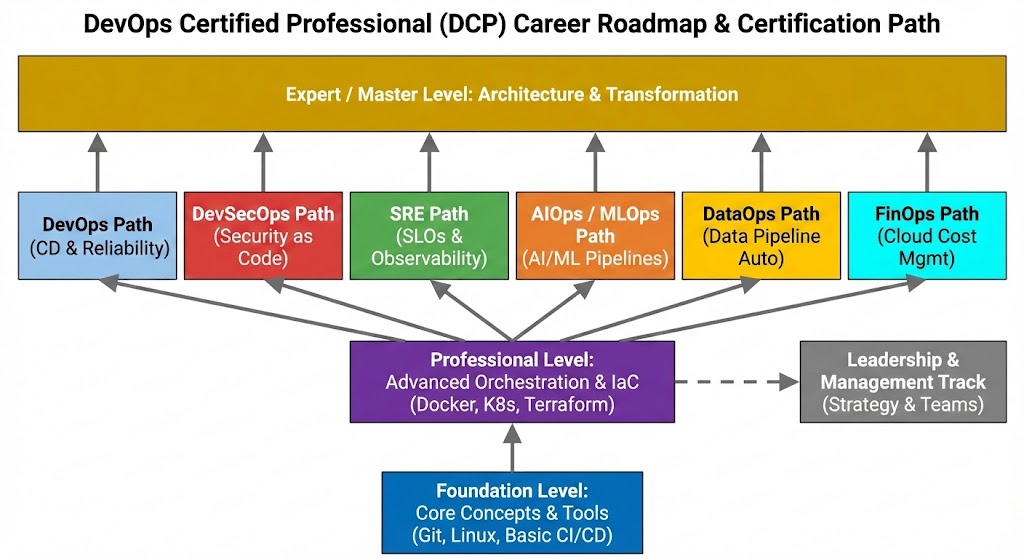
The DCP framework organizes its certifications into three distinct levels: Foundation, Professional, and Expert. The Foundation level focuses on core concepts like version control, basic CI/CD, and Linux fundamentals, making it perfect for those entering the field. Moving up, the Professional level dives into complex orchestration, infrastructure as code, and multi-stage delivery patterns.
Specialization tracks allow you to tailor your learning toward specific domains such as SRE, DevSecOps, or FinOps, depending on your career goals. These tracks ensure that you gain deep expertise in the areas that matter most to your current or future employer. As a result, the certification levels align perfectly with the natural progression from a junior engineer to a senior technical leader.
Complete DevOps Certified Professional (DCP) Certification Table
| Track | Level | Who it’s for | Prerequisites | Skills Covered | Recommended Order |
| Core DevOps | Foundation | Junior Devs / IT Admins | Basic IT Knowledge | Git, CI/CD, Linux | 1st |
| Core DevOps | Professional | DevOps Engineers | Foundation Level | Docker, K8s, Terraform | 2nd |
| SRE Track | Professional | SRE / Platform Team | Professional Level | SLOs, Monitoring, Toil | 3rd |
| Security | DevSecOps | Security Engineers | Core DevOps | Vault, Scanning, IaC | 4th |
| Management | Leadership | Managers / Leads | Professional Level | Culture, Strategy, ROI | 5th |
Detailed Guide for Each DevOps Certified Professional (DCP) Certification
DevOps Certified Professional (DCP) – Foundation Level
What it is
The Foundation Level validates your core understanding of the DevOps philosophy and the basic toolkit required to participate in an automated delivery pipeline. It serves as the baseline for all subsequent specializations in the DCP ecosystem.
Who should take it
This certification is ideal for junior software developers, system administrators, and manual QA engineers who want to transition into automation. It also suits project managers who need to understand the technical language used by their engineering teams.
Skills you’ll gain
- Version control management with Git.
- Fundamentals of continuous integration and build automation.
- Basic Linux administration and shell scripting.
- Understanding of the DevOps cultural shift and feedback loops.
Real-world projects you should be able to do
- Create and manage a multi-branch Git workflow for a development team.
- Automate a basic build and test cycle for a web application.
- Set up a simple virtualized environment for development testing.
Preparation plan
- 7–14 days: Review the core Git commands and Linux navigation.
- 30 days: Complete a full CI/CD lab exercise using Jenkins or GitLab.
- 60 days: Build a small personal project that includes automated testing and deployment.
Common mistakes
- Underestimating the importance of Linux command-line proficiency.
- Focusing too much on tools while ignoring the underlying principles of flow and feedback.
Best next certification after this
- Same-track option: DCP Professional Level.
- Cross-track option: DevSecOps Foundation.
- Leadership option: Certified Scrum Master or Lead Engineer.
DevOps Certified Professional (DCP) – Professional Level
What it is
The Professional Level confirms your ability to architect and maintain complex, production-ready infrastructures using modern orchestration and configuration tools. It demonstrates that you can manage the “as-code” lifecycle for an entire organization.
Who should take it
Experienced engineers who currently manage cloud workloads or on-premises servers should pursue this level. It is designed for those who want to prove they can handle the scale and security requirements of a modern enterprise.
Skills you’ll gain
- Advanced Kubernetes cluster administration and service discovery.
- Infrastructure as Code (IaC) implementation with Terraform.
- Advanced log aggregation and performance monitoring.
- Deployment strategies such as Blue-Green and Canary releases.
Real-world projects you should be able to do
- Provision a complete, multi-cloud environment using Terraform scripts.
- Deploy a microservices application into a high-availability Kubernetes cluster.
- Implement a centralized logging and alerting system for a global application.
Preparation plan
- 7–14 days: Master YAML syntax and basic Dockerfile optimization.
- 30 days: Practice deploying stateful applications in Kubernetes.
- 60 days: Design a disaster recovery plan for a production-grade infrastructure.
Common mistakes
- Ignoring cost optimization when provisioning cloud resources through code.
- Failing to implement proper secret management in the automation pipeline.
Best next certification after this
- Same-track option: DCP Master/Expert Level.
- Cross-track option: FinOps Certified Practitioner.
- Leadership option: Technical Program Manager (DevOps).
Choose Your Learning Path
DevOps Path
The traditional DevOps path focuses on creating a seamless flow from code commit to production deployment. You begin with the Foundation level to master Git and CI/CD basics before moving to the Professional level for orchestration mastery. Specifically, you will spend your time learning how to reduce cycle times and improve deployment frequency. This path is perfect for those who want to be the primary engineers responsible for software delivery reliability.
DevSecOps Path
In this path, you prioritize the integration of security at every stage of the automated pipeline. You start by learning standard DevOps practices and then add layers of vulnerability scanning, secret management, and compliance auditing. Consequently, you ensure that every release is not only fast but also secure by design. This route is ideal for security-minded engineers who want to automate protection in modern cloud environments.
SRE Path
Site Reliability Engineering applies a software engineering mindset to system operations to ensure maximum uptime. You will focus on defining Service Level Objectives (SLOs) and managing error budgets to balance innovation with stability. Furthermore, this path teaches you how to automate toil and manage incidents with data-driven precision. It is the best choice for engineers who enjoy solving complex availability challenges in distributed systems.
AIOps / MLOps Path
This specialized path addresses the unique lifecycle of machine learning models and data-driven applications. You will learn to build pipelines that manage data versioning, model training, and continuous deployment for AI workloads. Specifically, it bridges the gap between data science and traditional infrastructure management. This path serves the growing number of organizations that rely on artificial intelligence for their core business processes.
DataOps Path
DataOps focuses on the automated management of data to improve its quality and reduce the time it takes to gain insights. You will learn how to apply DevOps principles to data pipelines, ensuring that data flows accurately and securely across the organization. Consequently, you will master the tools required to manage databases and big data clusters as code. This path is essential for data engineers who want to bring predictability to their data infrastructure.
FinOps Path
The FinOps path centers on the financial management of cloud resources to maximize business value. You will learn how to track spending, optimize resource utilization, and foster a culture of cost accountability within engineering teams. By understanding the financial impact of technical decisions, you help the organization scale profitably in the cloud. This path is increasingly important for architects and managers who oversee large-scale public cloud budgets.
Role → Recommended DevOps Certified Professional (DCP) Certifications
| Role | Recommended Certifications |
| DevOps Engineer | DCP Foundation + DCP Professional |
| SRE | DCP Professional + SRE Specialist |
| Platform Engineer | DCP Professional + IaC Expert |
| Cloud Engineer | DCP Foundation + Professional Cloud Architect |
| Security Engineer | DCP Foundation + DevSecOps Practitioner |
| Data Engineer | DCP Foundation + DataOps Professional |
| FinOps Practitioner | DCP Foundation + FinOps Certified |
| Engineering Manager | DCP Foundation + DevOps Leadership |
Next Certifications to Take After DevOps Certified Professional (DCP)
Same Track Progression
Once you master the professional level, you should look toward the Master or Expert certifications within the DCP ecosystem. These advanced programs focus on organizational strategy, high-level architecture, and cross-team leadership. You will explore topics such as enterprise-scale service meshes and advanced disaster recovery patterns. Specifically, these certifications prepare you for Staff Engineer or Principal Architect roles where you set the technical direction for the entire company.
Cross-Track Expansion
Broadening your skills into areas like FinOps or DevSecOps makes you a much more versatile and valuable asset. Organizations highly prize engineers who can speak the languages of both security and finance while maintaining a high technical standard. Expanding your knowledge across tracks allows you to lead cross-functional initiatives and solve business problems from multiple angles. Furthermore, this diversity of skills helps protect your career against shifts in the technology market.
Leadership & Management Track
For those interested in moving into people management, leadership-focused certifications provide the necessary soft skills and strategic frameworks. You will learn how to build high-performing teams, manage technical debt, and align engineering goals with business outcomes. These certifications bridge the gap between technical excellence and organizational management. Consequently, you will be better prepared to lead large engineering departments through complex cultural and technical transformations.
Training & Certification Support Providers for DevOps Certified Professional (DCP)
DevOpsSchool
DevOpsSchool offers a comprehensive suite of training programs that focus on hands-on labs and real-world project scenarios. Their expert-led sessions help candidates bridge the gap between theoretical knowledge and professional application. Furthermore, they provide extensive resources and community support for those preparing for the DCP exam.
Cotocus
Cotocus provides specialized consulting and training services that focus on high-end infrastructure automation and cloud technologies. They help professionals master tools like Kubernetes and Terraform through practical, experience-driven learning modules. Consequently, they are an excellent choice for engineers looking for deep technical mastery.
Scmgalaxy
Scmgalaxy serves as a leading community hub for software configuration management and DevOps enthusiasts. They provide a wealth of tutorials, blog posts, and specialized training sessions that cover the entire automation spectrum. Specifically, their resources are ideal for those who want to stay updated on the latest trends in the SCM world.
BestDevOps
BestDevOps focuses on providing streamlined, efficient training paths for busy professionals who need to get certified quickly. Their curriculum prioritizes the most in-demand skills and tools currently used in the global tech industry. As a result, they offer a very high return on time investment for their students.
devsecopsschool.com
This provider specializes exclusively in the integration of security within the DevOps lifecycle. They offer training on automated security scanning, compliance as code, and secure infrastructure management. Their courses are essential for anyone aiming to become a certified DevSecOps professional.
sreschool.com
Sreschool focuses on the technical and cultural principles of Site Reliability Engineering. They provide deep-dive courses on observability, incident response, and performance tuning for large-scale distributed systems. Their training is perfect for engineers who want to move into high-availability operations roles.
aiopsschool.com
Aiopsschool addresses the emerging field of using artificial intelligence to optimize IT operations. They provide training on how to use machine learning to automate problem detection and resolution in complex environments. Specifically, this provider helps engineers stay ahead of the curve in intelligent automation.
dataopsschool.com
Dataopsschool focuses on the intersection of data engineering and DevOps principles. They teach students how to build automated, reliable data pipelines that can scale with the needs of the business. Their training is vital for data professionals who want to improve the speed and quality of their data delivery.
finopsschool.com
Finopsschool offers specialized training on the financial management and optimization of cloud infrastructure. They help professionals understand how to balance the trade-offs between speed, cost, and reliability in a cloud-first world. Their curriculum is essential for anyone managing significant cloud budgets.
Frequently Asked Questions (General)
- What is the difficulty level of the DCP exam? The DCP exam is designed to be rigorous and practically oriented to ensure that only competent professionals earn the credential. For the Foundation level, you will find it manageable if you have a good grasp of Linux and basic automation. However, the Professional and Expert levels require deep hands-on experience and the ability to solve complex scenarios under time pressure. You should expect questions that test your troubleshooting skills rather than just your ability to memorize tool features. Therefore, thorough preparation and practical lab work are essential for success at the higher levels.
- How much time should I dedicate to preparation? A typical candidate with some IT background should plan for about 4 to 6 weeks of study for the Foundation exam. If you are pursuing the Professional certification, you should realistically set aside 2 to 3 months of consistent effort. This time should be split between reading the theoretical material and performing hands-on labs in a sandbox environment. Your existing experience with tools like Docker or Jenkins will significantly influence the total time required. Ultimately, you should focus on achieving true proficiency rather than just rushing to pass the test.
- Are there any mandatory prerequisites for the DCP? For the entry-level Foundation certification, there are no strict mandatory prerequisites, although basic IT knowledge is highly recommended. To move on to the Professional level, you must typically have passed the Foundation exam or provide proof of significant industry experience. This ensures that all candidates in advanced sessions have a common baseline of knowledge. Specifically, you should be comfortable using the command line and understand basic networking concepts before starting. Always check the official website for the most current requirements before you begin your journey.
- What is the typical salary increase after getting DCP certified? While salaries vary by region and experience level, certified DevOps professionals consistently command higher pay than their non-certified peers. In major tech hubs like India or the US, holding a DCP can lead to a salary increase of 20% to 40% depending on the role. Organizations value the external validation of your skills, which reduces the risk for hiring managers. Furthermore, the certification often qualifies you for senior-level positions that were previously out of reach. Consequently, the investment in the certification usually pays for itself within the first year of a new role.
- Is the DCP certification recognized by major tech companies? Yes, the DCP is widely recognized by both multinational corporations and high-growth startups globally. Because the curriculum is based on industry-standard tools and practices, the skills you gain are directly applicable to most enterprise environments. Many companies use the DCP as a benchmark during their hiring process to filter for high-quality technical talent. Holding this certification shows that you have met a standardized level of excellence that is respected across the industry. Specifically, it serves as a powerful validation of your technical maturity and commitment to professional standards.
- Can I take the DCP training online? Most providers, including DevOpsSchool, offer fully online training options that include live instructor-led sessions and self-paced modules. These online programs are designed to be as interactive and hands-on as traditional classroom training. You will have access to cloud-based labs where you can practice your skills in a real-world environment. This flexibility allows you to balance your certification journey with your existing work and personal commitments. Furthermore, online training often gives you access to a global community of learners and experts.
- How does the DCP compare to other DevOps certifications? The DCP is unique because it offers a vendor-neutral approach that focuses on the best tools for the job rather than a single cloud provider. While certifications from AWS or Azure are valuable, they often lock you into a specific ecosystem. The DCP teaches you the underlying principles of DevOps that apply across all platforms and environments. This makes you a more flexible and adaptable engineer who can work in any technical stack. Ideally, you should use the DCP as your foundational automation credential and supplement it with platform-specific certifications later.
- Is the exam proctored? Yes, all levels of the DCP certification exam are proctored to maintain the integrity and value of the credential. You can usually take the exam online from your home or office using a secure browser and a webcam. The proctor will verify your identity and ensure that you follow all testing rules during the session. This high level of security ensures that when you show your DCP certificate to an employer, they know it was earned through hard work and honest effort. Always ensure you have a stable internet connection before starting your proctored session.
- What happens if I fail the DCP exam on my first try? If you do not pass the exam on your first attempt, do not be discouraged, as many successful professionals require more than one try. Most providers allow you to retake the exam after a mandatory waiting period, which gives you time to study your weak areas. You will receive a breakdown of your performance, which helps you focus your preparation for the next attempt. Use the retake period to go back to the labs and reinforce the concepts where you struggled. Ultimately, the goal is to master the material, and a second attempt is just another step in that process.
- Does the DCP focus on cultural aspects of DevOps? Absolutely, the DCP recognizes that DevOps is as much about culture and people as it is about tools and technology. The curriculum includes modules on communication, collaboration, and the psychological aspects of shifting to an automated workflow. You will learn how to break down silos between teams and foster an environment where failure is seen as a learning opportunity. This focus on culture is what sets the DCP apart from purely technical tool-training programs. Consequently, you will be prepared to lead cultural change within your organization as well as technical change.
- Do I need a computer science degree to get certified? While a computer science degree can provide a helpful background, it is not a requirement for the DCP certification. Many successful DevOps professionals come from diverse backgrounds, including systems administration, quality assurance, or even non-technical fields. The DCP program provides all the necessary technical training you need to succeed, provided you are willing to put in the effort. What matters most is your ability to think logically, solve problems, and master the practical application of tools. The certification path is designed to be accessible to anyone with a passion for technology and automation.
- How do I keep my certification active? To maintain the value of your DCP credential, you will need to recertify every few years or demonstrate continuous professional development. The tech industry moves quickly, and what was best practice two years ago may have changed today. Recertification ensures that your skills remain sharp and that you are up to date with the latest versions of the tools in the curriculum. You can usually recertify by taking an updated exam or by earning credits through advanced training courses. This commitment to ongoing learning is a hallmark of a true DevOps professional.
FAQs on DevOps Certified Professional (DCP)
- Which CI/CD tools are covered in the DCP? The DCP program covers a variety of the most popular CI/CD tools to ensure you are prepared for any enterprise environment. Specifically, you will gain hands-on experience with Jenkins, GitLab CI, and GitHub Actions. The course teaches you how to design pipelines that handle everything from code compilation to automated testing and deployment. You will also learn about newer, cloud-native CI/CD tools that are gaining popularity in the Kubernetes ecosystem. By learning multiple tools, you understand the common patterns that apply to all automation platforms.
- Is Kubernetes a major part of the Professional level? Yes, Kubernetes orchestration is a central pillar of the Professional level DCP certification. You will learn how to manage clusters, deploy microservices, and handle complex networking and storage requirements. The course goes beyond basic commands to cover advanced topics like Helm charts, service meshes, and cluster security. As Kubernetes has become the industry standard for container orchestration, this knowledge is essential for any modern DevOps engineer. You will finish the program with the confidence to manage production-grade Kubernetes environments at scale.
- How does the DCP handle cloud-native security? Security is woven into the fabric of the entire DCP curriculum rather than being treated as a separate topic. You will learn how to implement “Security as Code” by automating vulnerability scans and compliance checks within your pipelines. Specifically, the course covers secret management using tools like HashiCorp Vault to ensure that sensitive data is never exposed. You will also explore container security best practices and network policy management in Kubernetes. This comprehensive approach ensures that the systems you build are secure by default.
- Does the DCP cover Infrastructure as Code (IaC)? Infrastructure as Code is a core component of both the Professional and Expert levels of the DCP. You will learn how to use Terraform to provision resources across multiple cloud providers like AWS, Azure, and Google Cloud. The curriculum also covers configuration management tools like Ansible to automate the setup and maintenance of your servers. By mastering these tools, you can ensure that your infrastructure is versioned, repeatable, and easy to scale. Consequently, you will be able to manage thousands of servers as easily as you manage a single one.
- What kind of lab environments are used in the DCP? The DCP training uses sophisticated, cloud-based lab environments that simulate real-world production scenarios. You will have your own dedicated sandbox where you can experiment with tools and build pipelines without any risk. These labs are designed to be challenging and require you to solve real technical problems to move forward. Specifically, you will practice deploying multi-tier applications, troubleshooting network issues, and scaling clusters under load. This practical experience is the most valuable part of the training and directly prepares you for the exam.
- Can the DCP help me transition into a Platform Engineering role? Platform Engineering is a natural evolution of DevOps, and the DCP provides the perfect foundation for this transition. Platform engineers focus on creating “internal developer platforms” that allow other teams to deploy their code more easily. The DCP teaches you the orchestration and automation skills necessary to build these self-service systems. You will learn how to abstract away the complexity of the underlying infrastructure so that developers can focus on writing code. Consequently, the DCP is highly respected by organizations building out their platform engineering teams.
- How does the DCP address the “human” side of DevOps? The DCP places a strong emphasis on the soft skills and cultural changes required for a successful DevOps transformation. You will learn about the CAMS model (Culture, Automation, Measurement, Sharing) and how to apply it in your organization. The course includes training on how to facilitate communication between siloed teams and how to manage the change process effectively. Specifically, you will learn how to align technical goals with business value to gain executive buy-in for your initiatives. This balanced approach ensures that you can lead both technical and organizational change.
- Is the DCP exam based on a specific version of the tools? The DCP curriculum and exam are updated regularly to reflect the current stable versions of all the tools covered. This ensures that the skills you learn are immediately applicable to the versions you will find in most production environments today. When major updates occur in tools like Kubernetes or Terraform, the hosting site updates the training material and exam questions accordingly. This commitment to staying current is why the DCP remains one of the most respected certifications in the industry. Always check the latest course syllabus for the specific tool versions currently being taught.
Final Thoughts: Is DevOps Certified Professional (DCP) Worth It?
From the perspective of a mentor with decades of experience, the DevOps Certified Professional (DCP) is an exceptional investment for anyone serious about a career in modern infrastructure. The true value of the program lies not just in the piece of paper you receive, but in the rigorous journey of learning and practice required to earn it. It forces you to move beyond being a “tool operator” to becoming a true architect of delivery systems.
However, you must remember that the certification is a beginning, not an end. The most successful engineers are those who take the principles learned during the DCP and apply them daily to solve real-world problems. If you are willing to put in the hard work and maintain a mindset of continuous learning, the DCP will open doors to the most challenging and rewarding roles in the industry. Ultimately, it provides you with the technical confidence and professional credibility needed to lead the future of software engineering.
