Introduction
The Certified DevOps Manager (CDM) represents a critical milestone for professionals who aim to bridge the gap between complex technical operations and strategic business leadership. Modern enterprises no longer view DevOps as a mere collection of tools but rather as a fundamental cultural and operational shift that requires expert oversight. Consequently, this guide serves as a roadmap for engineers and aspiring leaders who want to navigate the complexities of cloud-native environments and platform engineering. By pursuing this path, professionals gain the necessary insights to manage cross-functional teams while ensuring high-velocity delivery cycles. Ultimately, this comprehensive overview helps candidates make informed decisions about their career trajectory within the ever-evolving technology landscape.
What is the Certified DevOps Manager (CDM)?
The Certified DevOps Manager (CDM) designation signifies a professional’s ability to oversee, scale, and optimize DevOps practices within a large-scale enterprise. Unlike basic certifications that focus solely on syntax or specific tool commands, the CDM focuses on production-grade outcomes and the management of technical debt. It exists to validate that a leader can harmonize development and operations teams while maintaining stability and security. Furthermore, the curriculum aligns with modern engineering workflows by emphasizing the integration of automation, continuous feedback loops, and shared responsibility. Organizations value this certification because it ensures that managers can drive digital transformation initiatives without compromising on reliability or performance.
Who Should Pursue Certified DevOps Manager (CDM)?
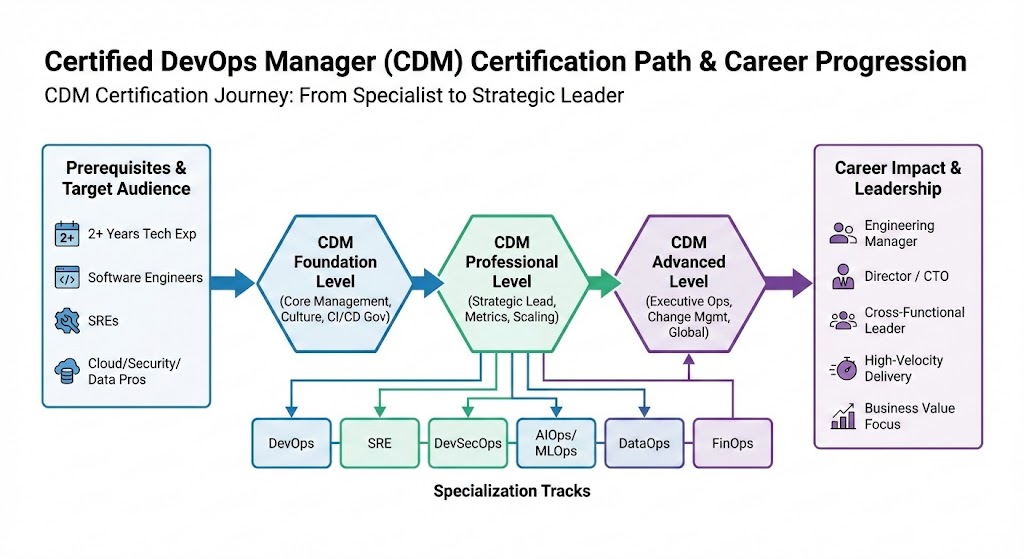
Senior software engineers, Site Reliability Engineers (SREs), and cloud architects who aspire to transition into leadership roles will find this certification exceptionally beneficial. Moreover, existing engineering managers and technical leads who need to formalize their understanding of DevOps governance should consider this program to strengthen their credentials. The certification also caters to security and data professionals who want to lead DevSecOps or DataOps initiatives within their respective departments. Both beginners with a strong conceptual foundation and experienced veterans looking for global recognition will find the content relevant. Specifically, in the Indian market and global tech hubs, the demand for certified managers who understand local team dynamics and international delivery standards continues to grow rapidly.
Why Certified DevOps Manager (CDM) is Valuable Today and Beyond
The longevity of the Certified DevOps Manager (CDM) stems from its focus on core principles and management frameworks rather than fleeting tool trends. As enterprises adopt cloud-native architectures at an unprecedented rate, they require leaders who can manage the resulting complexity and cost. Furthermore, this certification provides a significant return on time investment by equipping professionals with the skills to survive and thrive despite rapid shifts in technology. It allows managers to remain relevant by focusing on high-level strategy, cultural transformation, and the delivery of measurable business value. Consequently, professionals who hold this credential often command higher salaries and secure more influential positions within top-tier technology firms.
Certified DevOps Manager (CDM) Certification Overview
DevOpsSchool.com delivers the comprehensive Certified DevOps Manager (CDM) program, which is also hosted on the official DevOpsSchool.com platform. The program utilizes a rigorous assessment approach that combines theoretical knowledge with practical, scenario-based evaluations to ensure candidates can handle real-world challenges. It features multiple certification levels that cater to various stages of a professional’s career, from initial management roles to executive leadership. Each level follows a structured ownership model where the candidate must demonstrate proficiency in both technical orchestration and team management. By participating in this program, learners gain access to a curriculum that developers and industry experts have vetted for accuracy and relevance.
Certified DevOps Manager (CDM) Certification Tracks & Levels
The certification structure offers three distinct levels: Foundation, Professional, and Advanced, to support continuous professional development. At the Foundation level, the program introduces candidates to the core tenets of DevOps management and basic governance. Subsequently, the Professional level dives deeper into specific specialization tracks such as SRE management, FinOps oversight, and DevSecOps leadership. The Advanced level focuses on strategic organizational transformation and the ability to build resilient, self-healing engineering cultures. These levels align perfectly with career progression, allowing a professional to move from a team lead to a director or Chief Technology Officer (CTO) over time.
Complete Certified DevOps Manager (CDM) Certification Table
| Track | Level | Who it’s for | Prerequisites | Skills Covered | Recommended Order | Official Link |
| Core Management | Foundation | Aspiring Managers | 2+ years Tech Exp | DevOps Culture, CI/CD Governance | 1st | Link |
| Strategic Lead | Professional | Engineering Managers | CDM Foundation | Metrics, Budgeting, Scaling | 2nd | Link |
| Executive Ops | Advanced | Directors/CTOs | CDM Professional | Change Management, Global Ops | 3rd | Link |
| Specialized SRE | Professional | SRE Leads | CDM Foundation | SLIs/SLOs, Error Budgets | Optional | Link |
| Security Lead | Professional | DevSecOps Leads | CDM Foundation | Compliance, Risk Management | Optional | Link |
Detailed Guide for Each Certified DevOps Manager (CDM) Certification
Certified DevOps Manager (CDM) – Foundation
What it is This certification validates a professional’s fundamental understanding of DevOps management principles and their ability to supervise basic automated workflows. It ensures that the candidate can speak the language of both developers and operations teams effectively.
Who should take it Team leads, senior engineers, and junior managers should take this certification to establish a solid baseline for their leadership journey. It serves as the entry point for anyone moving from individual contributor roles into management.
Skills you’ll gain
- Mastery of DevOps terminology and cultural frameworks.
- Ability to design basic CI/CD governance models.
- Understanding of team collaboration tools and methodologies.
- Competency in tracking basic deployment metrics and velocity.
Real-world projects you should be able to do
- Implement a standardized deployment pipeline across two or more small teams.
- Conduct a cultural audit to identify bottlenecks in a development lifecycle.
- Set up basic monitoring and feedback loops for a web application.
Preparation plan
- 7 Days: Focus on the core DevOps Manifesto and understanding the three ways of DevOps.
- 30 Days: Complete the official coursework and participate in group discussions regarding case studies.
- 60 Days: Implement a mock project in a lab environment and take multiple practice exams to ensure readiness.
Common mistakes
- Focusing too much on specific tools like Jenkins or Docker rather than management principles.
- Underestimating the importance of cultural and “soft” skills in the assessment.
Best next certification after this
- Same-track option: Certified DevOps Manager – Professional.
- Cross-track option: Certified DevSecOps Professional.
- Leadership option: Certified Agile Leader.
Certified DevOps Manager (CDM) – Professional
What it is The Professional level validates advanced skills in managing large-scale, multi-cloud environments and optimizing complex delivery value streams. It confirms that a manager can handle budgets, resource allocation, and advanced performance metrics.
Who should take it Experienced engineering managers and senior leads who oversee multiple teams or complex infrastructure should pursue this level. It is ideal for those responsible for the overall efficiency of a department.
Skills you’ll gain
- Expertise in DORA metrics and Value Stream Mapping.
- Advanced capacity planning and cloud cost optimization techniques.
- Proficiency in managing high-availability systems and disaster recovery.
- Ability to lead cross-functional transformation initiatives across the enterprise.
Real-world projects you should be able to do
- Perform a full Value Stream Mapping exercise for a legacy application migration.
- Design a multi-region failover strategy for a mission-critical service.
- Optimize cloud expenditure by 20% through automated tagging and resource lifecycle management.
Preparation plan
- 7 Days: Review advanced metrics and financial management concepts in a cloud context.
- 30 Days: Engage in deep-dive workshops focusing on enterprise-scale architecture and governance.
- 60 Days: Analyze real-world case studies of failed DevOps transformations to learn how to avoid common pitfalls.
Common mistakes
- Neglecting the financial aspects of DevOps, such as cloud billing and resource waste.
- Failing to demonstrate how technical decisions impact business KPIs.
Best next certification after this
- Same-track option: Certified DevOps Manager – Advanced.
- Cross-track option: Certified SRE Professional.
- Leadership option: MBA in Technology Management.
Choose Your Learning Path
DevOps Path
The DevOps path focuses on the seamless integration of development and operations to accelerate delivery. Managers following this track learn to optimize the entire software development lifecycle by removing silos and automating repetitive tasks. Furthermore, they study how to balance the need for speed with the necessity of stability. Consequently, this path leads to roles such as DevOps Director or VP of Engineering. It remains the most popular choice for those coming from a traditional software engineering background.
DevSecOps Path
This path emphasizes the “Shift Left” philosophy by integrating security practices directly into the DevOps pipeline. Managers learn how to automate security audits, manage compliance as code, and foster a security-first culture among developers. In addition to technical tools, the track covers risk management and legal compliance frameworks. Therefore, professionals on this path are well-prepared to lead security engineering teams. This specialization is increasingly vital as cyber threats become more sophisticated and frequent.
SRE Path
The Site Reliability Engineering (SRE) path focuses on applying engineering principles to operations problems to create highly scalable and reliable systems. Managers learn to define and monitor Service Level Indicators (SLIs) and Service Level Objectives (SLOs) while managing error budgets. Additionally, they focus on incident response, post-mortem analysis, and the reduction of manual “toil.” This path is perfect for those who enjoy the intersection of coding and large-scale systems architecture. It bridges the gap between traditional operations and modern software development perfectly.
AIOps / MLOps Path
This specialized track addresses the unique challenges of managing artificial intelligence and machine learning lifecycles. Managers learn how to handle data versioning, model deployment, and continuous monitoring of ML models in production. Moreover, they explore how to use AI to enhance IT operations by automating root cause analysis and anomaly detection. Consequently, this path is essential for organizations that rely heavily on data-driven decision-making. It requires a blend of data science knowledge and operational excellence.
DataOps Path
The DataOps path applies DevOps principles to data management to improve the quality and cycle time of data analytics. Managers focus on automating the data pipeline, ensuring data privacy, and fostering collaboration between data engineers and business analysts. Furthermore, they learn how to manage large-scale data warehouses and real-time streaming architectures. Therefore, this path is ideal for professionals working in data-intensive industries like finance or healthcare. It ensures that data remains a reliable asset for the entire organization.
FinOps Path
The FinOps path centers on the financial management of cloud services to ensure organizations get the most value out of every dollar spent. Managers learn how to bring financial accountability to the variable spend model of the cloud. In addition to technical optimization, they focus on the cultural shift required to make engineers aware of their spending. Consequently, this track is becoming a board-level priority for many large enterprises. It combines finance, engineering, and business strategy into a single cohesive discipline.
Role → Recommended Certified DevOps Manager (CDM) Certifications
| Role | Recommended Certifications |
| DevOps Engineer | CDM Foundation, Certified Jenkins Engineer |
| SRE | CDM Professional (SRE Track), Chaos Engineering Cert |
| Platform Engineer | CDM Foundation, Kubernetes Administrator (CKA) |
| Cloud Engineer | CDM Foundation, AWS/Azure Solutions Architect |
| Security Engineer | CDM Professional (DevSecOps Track), CISSP |
| Data Engineer | CDM Foundation (DataOps focus), Google Professional Data Engineer |
| FinOps Practitioner | CDM Professional (FinOps Track), FinOps Certified Practitioner |
| Engineering Manager | CDM Advanced, Certified Agile Leadership |
Next Certifications to Take After Certified DevOps Manager (CDM)
Same Track Progression
After completing the Certified DevOps Manager (CDM) series, professionals should seek deep specialization in advanced organizational psychology or executive leadership. This allows a manager to move from tactical oversight to strategic vision, influencing the entire company’s direction. Furthermore, obtaining certifications in specific advanced methodologies like Value Stream Management can provide a competitive edge. Staying on this track ensures that the professional becomes a recognized authority in the field of DevOps leadership. Therefore, continuous learning remains a requirement for maintaining this high level of expertise.
Cross-Track Expansion
Expanding into other domains like SRE or DevSecOps allows a manager to become a more versatile leader. By understanding the intricacies of security or reliability, a CDM can better support diverse teams and handle more complex projects. Moreover, cross-training helps in breaking down departmental silos that often hinder organizational progress. For instance, a manager with both CDM and SRE credentials can bridge the gap between feature velocity and system stability. Consequently, this breadth of knowledge makes the professional an invaluable asset to any modern enterprise.
Leadership & Management Track
For those aiming for C-suite positions, transitioning into formal leadership and business management certifications is the logical next step. This involves studying corporate finance, strategic marketing, and organizational behavior at an executive level. In addition to technical skills, these programs refine the “soft skills” necessary for leading thousands of employees. Therefore, combining the Certified DevOps Manager (CDM) credential with an executive leadership program creates a powerful profile for top-tier management roles. It prepares the individual to handle the business challenges that accompany large-scale technical operations.
Training & Certification Support Providers for Certified DevOps Manager (CDM)
DevOpsSchool This provider offers the primary curriculum and official certification for the CDM program. They provide extensive hands-on labs, expert-led training sessions, and a wealth of study materials. Consequently, they are the go-to resource for anyone serious about completing this certification successfully.
Cotocus Cotocus specializes in providing immersive training experiences for enterprise teams looking to adopt DevOps at scale. They offer tailored coaching that aligns with the CDM objectives, focusing heavily on real-world implementation. Their mentors bring decades of industry experience to every session.
Scmgalaxy As a community-driven platform, Scmgalaxy provides a vast repository of tutorials, blogs, and forums dedicated to DevOps management. They support CDM candidates by offering practical insights and troubleshooting tips for common technical challenges. Therefore, it serves as an excellent supplementary resource for self-paced learners.
BestDevOps BestDevOps focuses on delivering high-quality, streamlined training modules for busy professionals. They offer condensed versions of the CDM prep courses that highlight the most critical exam topics. Furthermore, their practice tests are known for accurately reflecting the difficulty level of the actual assessment.
devsecopsschool.com This provider is the leading authority for candidates who choose to specialize in the DevSecOps track of the CDM program. They offer deep-dives into security automation, compliance-as-code, and vulnerability management. Consequently, they are essential for managers who prioritize security in their delivery pipelines.
sreschool.com For those pursuing the SRE track, sreschool.com provides specialized training in site reliability and systems engineering. Their curriculum covers everything from error budgets to incident management in great detail. They help managers build the technical foundation needed to lead high-availability engineering teams.
aiopsschool.com This platform supports the AIOps specialization by providing training on the intersection of artificial intelligence and operations. They help managers understand how to implement machine learning models for predictive maintenance and automated monitoring. Therefore, it is a vital resource for data-driven management.
dataopsschool.com Dataopsschool.com focuses on the unique challenges of data management within a DevOps framework. They provide CDM candidates with the tools and methodologies needed to optimize data pipelines and ensure data integrity. This makes them a key partner for managers in the analytics space.
finopsschool.com Finopsschool.com addresses the financial management side of the CDM program by offering specialized courses on cloud cost optimization. They teach managers how to balance technical performance with financial accountability. Consequently, they are a primary resource for those looking to master the business side of the cloud.
Frequently Asked Questions (General)
- How difficult is it to pass the Certified DevOps Manager (CDM) exam? The difficulty of the Certified DevOps Manager (CDM) exam is generally considered moderate to high, depending on your prior experience. It does not just test your ability to memorize facts but requires you to apply management principles to complex, real-world scenarios. Consequently, professionals who have spent time in the trenches of development or operations often find the practical questions more intuitive. However, the theoretical sections on governance and cultural transformation can be challenging if you have not studied the official curriculum. Therefore, dedicated preparation and hands-on practice are essential for achieving a passing score on your first attempt.
- How much time does it typically take to prepare for the certification? Preparing for the Certified DevOps Manager (CDM) certification usually requires between 30 and 60 days of consistent study. If you already hold a senior technical role, you might be able to accelerate this timeline by focusing only on the management and financial modules. Conversely, if you are new to the DevOps philosophy, you should dedicate more time to understanding the foundational cultural concepts. Most candidates find that spending 10 to 15 hours per week provides a balanced approach that allows for deep learning without causing burnout. Ultimately, your personal experience level will dictate the exact time required for mastery.
- Are there any mandatory prerequisites for taking the CDM exam? While there are no strict legal barriers to taking the CDM exam, having at least two to three years of experience in a technical environment is highly recommended. This background ensures that you understand the basic challenges of software delivery and infrastructure management that the CDM program addresses. Furthermore, familiarizing yourself with basic CI/CD tools and cloud platforms will give you a significant advantage during the practical labs. Some higher-level tracks may suggest holding a Foundation-level certificate before moving to Professional or Advanced levels. Consequently, following the recommended order usually leads to a much smoother and more successful learning experience.
- What is the return on investment (ROI) for this certification? The ROI for the Certified DevOps Manager (CDM) certification is often realized through immediate salary increases and access to higher-level job opportunities. Many professionals report a salary bump of 15% to 25% after adding this credential to their profile, as it signals a high level of expertise to recruiters. Moreover, the skills you gain in cost optimization and process efficiency can save your organization thousands of dollars, making you a more valuable asset. Therefore, the initial cost of the exam and training is typically recovered within the first few months of securing a new role or promotion. It is a long-term investment in your career.
- In what sequence should I take the different CDM levels? You should always begin with the Foundation level to establish a strong understanding of the core DevOps management vocabulary and principles. Once you have mastered these basics, you can then proceed to the Professional level to specialize in a specific track like SRE or DevSecOps. After gaining significant experience as a manager, the Advanced level will help you refine your strategic and executive leadership skills. Furthermore, this logical progression ensures that you build a solid pyramid of knowledge rather than having gaps in your understanding. Consequently, skipping levels is generally discouraged as it can lead to confusion during more complex assessments.
- Does the CDM certification help in getting jobs in India? Yes, the Certified DevOps Manager (CDM) certification is highly regarded in the Indian tech market, where many global firms have their primary engineering hubs. Companies in India are increasingly looking for leaders who can manage large, distributed teams while maintaining the high standards required by international clients. Holding a CDM credential sets you apart from the thousands of other applicants who may only have basic technical certifications. Moreover, it demonstrates that you are committed to professional growth and understand the global standards of DevOps excellence. Therefore, it is a significant advantage for anyone looking to advance their career in the Indian IT sector.
- How does CDM compare to other management certifications like PMP? While the PMP focuses on general project management across all industries, the CDM is specifically tailored for the fast-paced, iterative world of software engineering. The CDM emphasizes automation, continuous delivery, and technical culture, which are often missing from traditional project management frameworks. Furthermore, the CDM requires a deeper understanding of technical architecture and cloud-native practices than a PMP. Consequently, for a career in technology, the CDM is often more relevant and practical. However, holding both certifications can make you a very formidable candidate for high-level management positions in large enterprises. They complement each other by covering both general and technical leadership.
- Is the certification valid globally? The Certified DevOps Manager (CDM) is recognized globally, making it an excellent asset for professionals who wish to work in different countries. The principles taught in the program are universal and apply to technology teams regardless of their geographic location. Moreover, because the program is hosted on DevOpsSchool.com, which has a global reach, employers worldwide recognize the quality and rigor of the training. This international recognition allows you to move between different markets with confidence that your skills will be valued. Therefore, it is an ideal choice for anyone with global career aspirations in the tech industry.
- Can a non-technical manager take the Certified DevOps Manager (CDM)? A non-technical manager can certainly pursue the CDM, but they will likely find the technical labs and architectural questions more challenging. To be successful, they should spend extra time learning the basics of cloud computing, containers, and version control before attempting the exam. However, the management and cultural sections will likely feel more familiar to them. Furthermore, obtaining the CDM is a great way for a non-technical manager to gain credibility with their engineering teams. Consequently, while it requires more effort, it is a highly rewarding path for any manager working in a technology-centric organization.
- What kind of support is available if I fail the exam? Most training providers, including DevOpsSchool.com, offer support for candidates who do not pass the exam on their first attempt. This often includes access to additional study materials, retake discounts, and one-on-one coaching sessions to identify weak areas. Furthermore, the community forums at Scmgalaxy provide a platform where you can ask specific questions and get advice from those who have already passed. Consequently, a failure should be viewed as a learning opportunity rather than a final roadblock. Therefore, you should utilize all available resources to strengthen your knowledge before scheduling your next attempt.
- Does the certification expire? Like many professional certifications in the fast-moving tech world, the CDM may require periodic renewal or continuing education to remain valid. This ensures that you stay up to date with the latest industry trends, tools, and management methodologies. Furthermore, staying active in the DevOps community and participating in advanced workshops can often count towards your recertification requirements. Consequently, the renewal process encourages a habit of lifelong learning, which is essential for any successful manager. Therefore, you should check the official DevOpsSchool.com site for the specific details regarding the validity period of your certification.
- How do I verify the authenticity of a CDM certificate? The authenticity of a Certified DevOps Manager (CDM) certificate can be verified through the official portal at DevOpsSchool.com. Each certificate is issued with a unique identification number that can be entered into the verification tool to confirm the holder’s credentials. Furthermore, many professionals choose to link their digital badges to their LinkedIn profiles for easy verification by recruiters and peers. This transparency ensures that the value of the certification remains high and protects the integrity of the program. Consequently, you should always ensure that you receive your official digital credentials immediately after passing the exam.
FAQs on Certified DevOps Manager (CDM)
- What specific management frameworks are covered in the CDM curriculum? The CDM curriculum covers a wide range of frameworks, including the Three Ways of DevOps, DORA metrics, and the Westrum Organizational Culture model. It also integrates principles from Lean manufacturing and Agile software development to provide a holistic view of modern management. Furthermore, candidates learn how to apply these frameworks to real-world scenarios like scaling teams and managing technical debt. Consequently, graduates are well-versed in the theoretical and practical aspects of leading high-performance engineering organizations. Therefore, the program provides a comprehensive toolkit for any aspiring or current DevOps manager.
- How does the CDM program handle multi-cloud and hybrid-cloud management? The CDM program addresses multi-cloud management by focusing on vendor-neutral strategies and tools like Terraform and Kubernetes. It teaches managers how to maintain consistency across different environments while optimizing for cost and performance on each platform. Furthermore, the curriculum covers the challenges of hybrid-cloud governance, such as data sovereignty and secure connectivity between on-premises and cloud resources. Consequently, managers learn how to build resilient architectures that are not tied to a single provider. This flexibility is crucial for modern enterprises that often use a mix of different cloud services.
- Does the CDM certification cover the financial aspects of DevOps? Yes, the CDM certification includes a significant focus on the financial aspects of DevOps through its FinOps modules. Managers learn how to read cloud bills, allocate costs to specific teams, and implement automated scaling to reduce waste. Furthermore, the program covers the shift from Capital Expenditure (CapEx) to Operational Expenditure (OpEx) and how it affects corporate budgeting. Consequently, managers become better at justifying their technical investments to the finance department and the executive team. Therefore, this financial literacy is a key differentiator for CDM holders compared to purely technical professionals.
- What role does automation play in the CDM assessment? Automation is a central theme of the CDM assessment, but the focus is on the management of automation rather than just the implementation. Candidates are tested on their ability to design automated governance gates, security checks, and deployment pipelines. Furthermore, they must demonstrate an understanding of when to automate a process and when human intervention is still necessary for safety or compliance. Consequently, the exam ensures that managers can oversee the creation of “guardrails” that allow developers to move fast without breaking things. Therefore, automation is treated as a strategic asset rather than just a technical tool.
- How are the practical labs structured in the CDM training? The practical labs in the CDM training are structured around realistic enterprise scenarios, such as migrating a monolithic application to microservices or recovering from a major system outage. Candidates are given access to a sandbox environment where they must use various tools to achieve specific management objectives. Furthermore, these labs are often timed to simulate the pressure of a real production environment. Consequently, the experience gained in these labs is directly applicable to the daily challenges faced by DevOps managers. Therefore, the hands-on component is often cited by students as the most valuable part of the entire program.
- Can the CDM certification help with organizational culture change? One of the primary goals of the CDM certification is to equip managers with the skills to lead cultural transformation. The curriculum includes modules on psychological safety, blameless post-mortems, and breaking down departmental silos. Furthermore, managers learn how to communicate the benefits of DevOps to various stakeholders to gain their support for change. Consequently, the CDM is as much about people management as it is about technology management. Therefore, professionals who hold this certification are often the primary drivers of cultural improvement within their organizations.
- Is there a focus on compliance and security in the CDM? The CDM program places a heavy emphasis on compliance and security, particularly within the DevSecOps specialization track. Managers learn how to integrate automated security scanning and compliance auditing into the CI/CD pipeline. Furthermore, the curriculum covers risk management strategies and how to handle sensitive data in a cloud environment. Consequently, the program ensures that managers can build delivery systems that are both fast and secure. This focus is essential for managers working in regulated industries like finance, healthcare, or government.
- How does the CDM certification stay current with new DevOps trends? The CDM certification stays current through regular updates to the curriculum hosted on DevOpsSchool.com, guided by an advisory board of industry experts. These updates ensure that new technologies like AI-driven operations, serverless computing, and edge computing are included in the training. Furthermore, the certification’s focus on fundamental principles allows it to remain relevant even as specific tools come and go. Consequently, a CDM holder is prepared for the future of technology, not just the present state of the industry. Therefore, the certification remains a leading indicator of professional competence in the DevOps field.
Final Thoughts: Is Certified DevOps Manager (CDM) Worth It?
When considering whether the Certified DevOps Manager (CDM) is worth your time and resources, you must look beyond the certificate itself. As an experienced mentor, I have observed that the true value lies in the structured mindset and the strategic perspective you gain through the process. The transition from a “doer” to a “leader” is one of the most difficult shifts in a professional career, and this program provides the necessary scaffolding for that growth. Moreover, it offers a common language and a set of proven frameworks that allow you to navigate the complexities of modern enterprise environments with confidence.
While the technical landscape will continue to change, the need for skilled leaders who can bridge the gap between human teams and automated systems will only increase. Therefore, if you are looking to future-proof your career and move into a role that combines technical depth with business impact, the CDM is a solid investment. It is not a magic bullet that will solve all your organizational problems, but it is a powerful tool in the hands of a dedicated professional. Ultimately, the CDM provides the credibility and the competence required to lead at the highest levels of the technology industry.
